
GM @linuxfoundation. Exec Director Tokenomics Foundation. Author FinOps book. Ex-Co-Founder Cloudability. Father to twin boys. Husband to a force of nature.
San Diego, CA
Joined March 2007
- Tweets2.9K
- Following446
- Followers2.8K
- Likes37.1K




Anthropic S-1, the enterprise math:
$16.3B revenue in H1, up 1,300%
~80% of it metered by tokens
Fortune 500 $100K+ customers: <0.1% of their expenses
10x from here doesn't come from price. It comes from CFOs agreeing on what the value is. That's what the Tokenomics Foundation is standardizing.
tokeneconomics.com/projects/

Last Tuesday I brought about ~80 people into a working room at the Westin St. Francis for Tokenomics SF. Chatham House, no sales pitches.
AI Practitioners, engineering leaders, finance leaders, researchers, and the people building the AI factory, from NYU, Pinterest, Adobe, AMD, NVIDIA, Nebius, AWS, and BNY, among dozens of others.
What I took away:
Cost per token is the wrong place to stop. The chain runs from token to task to outcome to something a CFO can actually book. Almost nobody connects all four links yet.
The people making tokens and the people using them barely speak the same language. "More tokens, more revenue" is not a business case.
Value is the thing everyone forgets. Most teams feel confident about visibility into spend. Very few can show value a CFO would defend.
Task-level productivity gains don't automatically add up. If code still waits on review and deploy, the saved minutes disappear.
Hard token caps per person can backfire. People wait for tomorrow's allowance instead of finishing the work.
Inference software is moving so fast that skipping upgrades means leaving performance on the table.
And no single data source tells the story. Cost, telemetry, outcomes, and value have to land in one place.
Thank you to everyone who showed up and argued in good faith.
Next up: Tokenomics NYC Executive on Dec 8, on the 102nd floor of One World Trade Center. Same format, for CFOs, CIOs, CTOs, and SVP/EVP leaders in the Fortune 500.
Applications are open through Nov 30: tokeneconomics.com/tokenomic…

Scale doesn't buy clarity on AI value.
State of #Tokenomics data: 34% of companies under $100M revenue can confidently tie AI spend to an outcome their CFO accepts. At $100M-$1B, 14%. At $10B+, 23%.
More models, more fog.
tokeneconomics.com/state-of-…

Every token begins as electricity with a hope of driving value. Tokenomics is what happens between the grid and the ledger.
Weekly tokens on @OpenRouter went from 0.5T to 128.4T in 20 months. Roughly 250x.
At that growth, cost per token is not your budget problem. Volume is. Enterprises need unit economics before the bill finds them.
openrouter.ai/data/newslette…

youtube.com/watch?v=gPWtDsMp…
17 min highlights reel from the State of Tokenomics with interview of Deutsche Bank's CTO.
Key takeaways
- Three in four enterprises cannot show their CFO value on their AI spending. Only 7% named price as their biggest challenge.
- The mix is shifting: 83% expect to move more toward open weights models over the next 12 months, while still running frontier.
- Model routing is being run or evaluated by 86% of organizations, and the biggest enterprises are building and buying routers at once.
- Ownership matters. Organizations with a defined owner were 3.7x more likely to show value.
- Mission critical AI cannot simply be switched off, which pushes AI OpEx back toward capacity planning.
Enterprises aren't asking AI providers for discounts. In the State of #Tokenomics data, 23% asked for more transparency and granular usage data. Only 4% asked for cheaper prices. They want a bill they can explain to the CFO. tokeneconomics.com/state-of-…
From the State of Tokenomics…
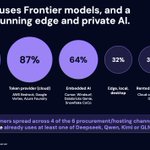
Half of AI consumers spread across 4 of the 6 procurement/hosting channels.
Nearly one in five already uses at least one of Deepseek, Qwen, Kimi or GLM.
tokeneconomics.com/state-of-…

State of Tokenomics data: three in four enterprises cannot confidently prove AI business outcomes to the CFO.
tokeneconomics.com/state-of-…
AI #tokenomics is at that moment where most of the market is staring incorrectly at token costs as the entire thing....
But the full bill includes energy, capital, silicon, data centers, routers and gateways and observability software and licensing, and critically, the labor to build and review and supervise all that AI.
Tokens carry somewhere between a tenth and a quarter of total run cost. The total line from tokens is not the bill.
Time to focus on the Total Cost of AI (TCA). tokeneconomics.com/insights/…
Episode 17 #Tokenomics Brief: Why Tokens Aren’t the AI Bill: Total Cost of AI (TCA)
I took a Labor Day break to record learnings in Tokenomics Foundation's working groups: the proposed "TCA (Total Cost of AI)" metric over "Value Realized" unit economic equation...
Here I recap a busy 10-day stretch for the Tokenomics Foundation’s four working groups and proposes a new organizing metric: Total Cost of AI (TCA), arguing that token/API costs are only 10–25% of total AI spend once energy, capital, infrastructure, software, labor, and process impacts are included.
00:00 Why AI Spend Is Misread
02:43 Introducing Total Cost of AI
04:18 Definitions Update and Personas
07:08 Production Meter Boundaries
10:31 Consumption Routing and Gateways
14:00 Value Architecture That Books
20:17 How the Groups Converge
21:39 Events Announcements
22:38 Three Practical Takeaways
23:47 Wrap Up and Call to Action
#Tokenomics #AIEconomics
I started to cringe when he said "Token cost - is token cost the right thing to talk about? Absolutely."
I disagree that token cost is the thing to focus on... wrong metric, not consistent between models, not tied to value, etc…. but he does recover it with "after Tokens you start to move more toward OUTCOMES."
Yes outcome is a vague thing but moving toward accomplishing a unit of work is the way to go, regardless of how many tokens it takes to get there.
A subtle but important nuance to moving away from counting tokens or even token budgets, which are only a part of the equation.
Token costs are the tip of the AI Tokenomics iceberg, there many more costs to consider and cost per outcome is a start to the way it needs to be measured.

Neil Movva (@neilmovva) started his career at Nvidia, working on GPUs and kernels, and has an unusually deep understanding of inference, from software to chips to power.
We spend a lot of time on each of those layers, how they connect, and where the important tradeoffs are.
What makes this conversation special is how detailed it is (like a 401-level class), yet Neil makes it remarkably clear and easy to follow.
Today he runs Sail Research, a company building infrastructure for agents to make tokens as cheap as possible.
We discuss:
- Latency versus throughput
- Why there are no bad chips, only bad pricing
- The end of kernel engineering
- Buying chips and power no one else wants
- New chip architectures
- Nvidia lore + his contrarian view of the company
- Open source and the frontier labs
I learned a ton. Enjoy!
TIMESTAMPS
0:00 Intro
0:38 Building a “Token Factory”
4:21 The Future of Background Agents
13:09 Nvidia and the GPU Stack
23:27 Chips, Memory, and Transformers
36:14 The Future of AI Training Data
44:32 Chip Scarcity and Compute Arbitrage
52:44 Reinventing the AI Data Center
59:01 Power and the “Scavenger Strategy”
1:10:10 Open vs. Closed AI
Don't count tokens... #tokenomics 101.
Episode #15. Tokenomics Goes Official. Defining AI Economics, Value, Routing Layers & the Per-Watt Economy.
00:00 Foundation Goes Official
00:34 Governance and Definition
02:11 Not Counting Tokens
03:48 Summit and Survey
04:47 Working Groups Kickoff
05:07 Measuring AI Value
07:13 Deflection and Baselines
09:31 Consumption Stack and Big T
11:27 Defining Tokenomics Scope
13:45 Energy and Per Watt Metrics
18:34 Industry Headlines
22:16 Academics Join In
25:03 Key Takeaways and Next Steps
Many who know of my son's death have been afraid to ask what happened. Others who don't have wondered why I've disappeared. Here is the story: linkedin.com/pulse/its-later…

FinOps Foundation Soars to 300 Members and Introduces New Partner Tiers for Cloud Service Providers and Vendors - Welcome Ancestry, Intuit, Letgo, Neustar and Pearson Education businesswire.com/news/home/2…
J.R. Storment retweeted

Read the latest update from @NetworkWorld and find out how #FinOps can help IT, finance and business leaders learn to speak the same language and make the cultural changes that are needed to successfully staff the hybrid #cloud. Read more here: bit.ly/2vHBfz2

J.R. Storment retweeted

How #FinOps software can help you manage #cloudcomputing spending. @ClintBoulton looks at how the approach works and offers 4 best practices. @bernardgolden @autodesk @here @stormental @Cloudability spr.ly/6018Ebd5p

J.R. Storment retweeted
Watch the complete video interview with @Stormental, Co-Founder of @Cloudability, where he explains how spending on #cloud can spiral out of control and introduces the idea of #FinOps bit.ly/2V3vEBn

Great to be quoted by @jpruth from @infoweekonline in his article on cloud spend: informationweek.com/cloud/ti… #aws #GCP #Azure