

From the gods who sit in grandeur grace comes somehow violent
Below the Palace of Minos
Joined October 2025
- Tweets1.3K
- Following533
- Followers621
- Likes8.5K


Pinned Tweet
One consequence of taking this line of thought seriously—which you should, because it is correct—is that it reformulates the pagan bardic traditions of compressive narrative nesting as a form of atemporal biblical exegesis orchestrated by the Logos throughout all of human history. All great tales converge at the Cross, and unfold from it into past and future.
Polytropos is used exactly one time in the New Testament, and it nods directly to the bardic tradition by establishing them as prophets of a sort who, like Odysseus, have suffered a very long and arduous voyage home:
“God, who at various times and in various ways (Polytropos) spoke in time past to the fathers by the prophets, 2 has in these last days spoken to us by His Son,” Hebrews 1:1-2 NKJV
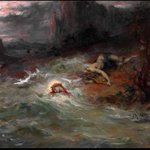
Here the entire poetic tradition is invoked and likened unto the storm-tossed sea, navigated by those able men of many ways—the yarn-spinners, tale-weavers, false liars in the service of a Truth grasped only in those fleeting moments by the Grace of a noetic intuition—who, though wrecked again and again, invariably and resolutely found their way to Ithaca, to their remembered home, to the revelation of the Incarnate Logos in history.


“So, sing on, dear shut-eyed one, dear far-voiced veteran, sing yourself to where the singing comes from…”


3
38


The archetype differs from the image in that the former is uncreated while the latter is created, and the image is perfected in so far as it participates in the perfection of the archetype. This is to say there is a communication of divinity by which the image itself is deified, attaining to a union with its archetype, which is itself an uncreated and eternal willing of God.

2
74
Strange Slate retweeted

Pan challenges Apollo @ Mt Tmolus; the mountain god judges for Apollo, while King Midas prefers Pan’s pipes.
in another contest, Apollo flays satyr Marsyas, whose mourners’ tears form a river and whose bronze figure appears on a votive altar to the supreme river god Oxus (Vaxš).


All of creation is reflected in the image of paradise, and all of paradise is reflected in the image of man.
“The human being is richer, more complete, and possesses more potentialities than the angelic spirits. Situated as he is at the meeting place of the intelligible and sensible realms, he unites the two within himself and participates at large in all the spheres of the created universe. For all things which have been created by God, in their diverse natures, are brought together in man as if in a melting-pot, and form in him one unique perfection—a harmony composed of many different notes.”
- Vladimir Lossky, The Mystical Theology of the Eastern Church

1
55
Strange Slate retweeted

J.R.R. Tolkien, longing for the wild lands

ALT He found himself wondering at times, especially in the autumn, about the wild lands, and strange visions of mountains that he had never seen came into his dreams.
A world, when properly realized, is never mere set-dressing. Magic is not a flashy party trick to wow bedazzled onlookers. All of these attributes of traditional mythology, imported into the genre known as “fantasy,” serve a genuine purpose: a disclosure of the real and hidden structures which make intelligible the phenomenal world. It is an intuitive exploration of archetypal relationships by means of that higher cognition known to the ancients as noesis.
To so casually disparage this mythic mode of understanding in favor of a shallow humanism (an exclusive focus on so-called “real people” and “real people problems”) is to miss the point entirely, which is quite a damning statement on the status of the humanities when coming from an ostensibly educated person.
“Myth is alive at once and in all its parts, and dies before it can be dissected.” - JRR Tolkien
jenniferjsnow.wordpress.com/…

Strange Slate retweeted

“You wouldn't abandon ship in a storm just because you couldn’t control the winds.”
— Saint Thomas More, Utopia

Strange Slate retweeted

"Lothlórien is beautiful because there the trees were loved."
- Tolkien, Letter 339

I’ve become convinced that a person’s hermeneutical ability is severely limited by a lack of procedural, embodied wisdom. The limitations of the mortal condition, and the requirements it once placed upon our ancestors, can be understood as a natural form of spiritual education administered by God through all creation. The associations of various mystery traditions with pastoral imagery is no accident, and neither is our reaching towards agricultural and architectural metaphor in the exploration of religious questions. These modes of human experience are an image of divine realities, and it is for this reason they exist. Christ is not like the shepherd. Rather, the shepherds have always been participating in Christ that they might know the ways of God.
There is a lot of focus these days, particularly in right wing spheres, on the importance of physical training and discipline in the development of bodily virtue. This is an important, but ultimately partial solution to the issue, for there is a larger territory to be explored.
I think I will need to eventually buy a small plot of land and build a homestead there with a garden and some livestock. The monasteries have always known this, of course.

Owning sheep for just a couple days has immediately improved my biblical exegesis by like a thousand-fold
2
7
166


