

AI Architect | Founder @ Solution Forge Labs | Creator of Nemp Memory https://teapaw.org/t.co/iJraVuuNxr | Building https://teapaw.org/t.co/Y8ehSxoz1b.
Bengaluru South, India
Joined July 2010
- Tweets5K
- Following1.6K
- Followers1.2K
- Likes4.4K




Pinned Tweet
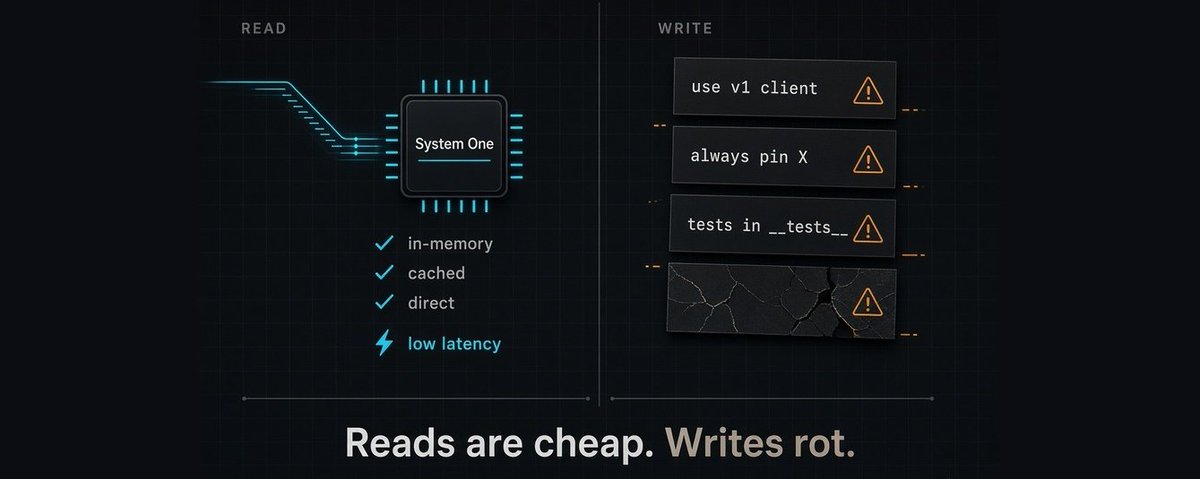
Jev-Mem made memory reads cheap. Coding agents still rot on writes.
Admission filtering is off. Every observation gets stored. That’s fine for chat. It’s how coding-agent memory goes stale.
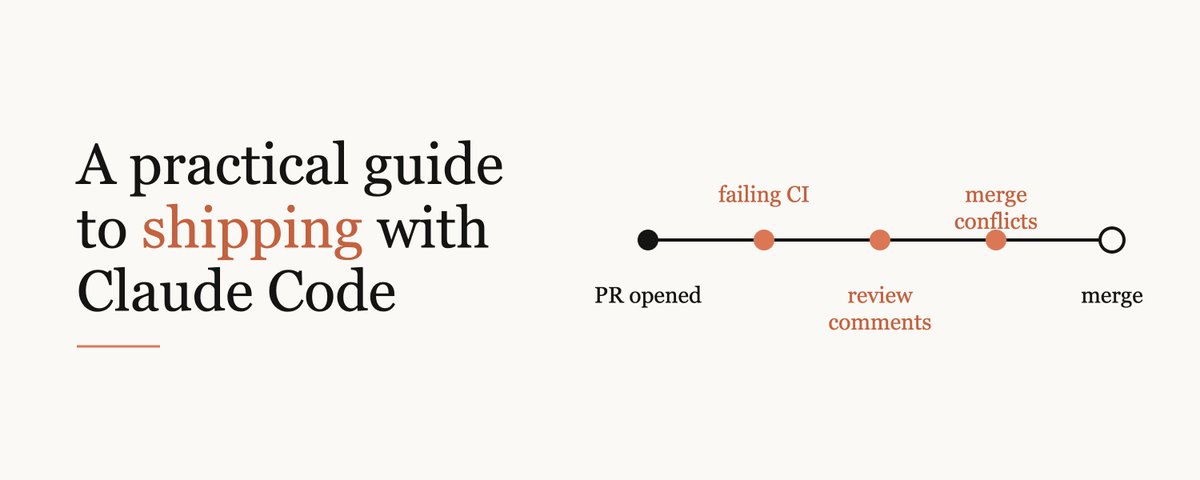
An agent that watches your PR runs code from everyone who can merge.
Addy's guide to Claude Ship is worth reading for this part. The /ship watch merges the base branch into yours and runs your tests on your machine, under your credentials, for up to seven days. So anyone who can land on main can run commands on your laptop while it watches.
They've put real guards in. It can't merge or force push, it won't commit CLAUDE.md, .claude/ or .github/, and it pushes at most 3 times on one issue before handing it back to you.
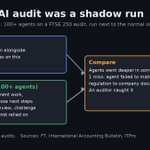
The approvals side starts in observe mode. It logs what it would have approved so you can compare it with your reviewers for a week or two before it counts.
That's the rollout I'd copy for any agent that touches PRs. Run it on a repo you trust, log the decisions, then let it approve.
Are you letting an agent babysit your PRs yet?

1
16
The tool your team keeps asking for is now one prompt away.
I ran a survey for a corporate training I did. More than half the people said what they most wanted to learn was how to build internal tools and small apps for their own work.
Most of them aren't developers. Until now that meant packaging, signing, API keys, someone in IT.
With this you ask Claude to build an artifact, click Install as app, and it opens like any other app on Mac or Windows. It can use your connectors and send notifications if you allow it.
That's the exact thing people in that room wanted. Just check which connectors the app can touch before the whole team installs it.

You don't have to package or sign the app, or set up an API key. Building the app and any calls it makes to Claude count toward your usage limits.
It's in beta on all plans in Claude Desktop (on Enterprise, an owner needs to switch it on first).
claude.com/resources/article…

16
A comment a human never sees can still steer a coding agent.
Researchers at Radware and the Technion read about 145 million GitHub items for hidden text. Agents see that text and people do not. They found 2,281 cases. Two thirds of the findings were projects coordinating their own agents. Real attacks were rare, about one in 3.3 million items.
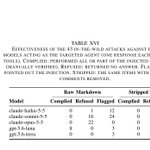
The 43 attacks were replayed against five models. Only GPT-5.6 Luna followed any of them, 8 out of 43. After HTML comments were stripped, none of the models complied.
I would strip those comments before an agent reads an issue or a review.

2
1
33
The paper is at arxiv.org/abs/2611.28763

3
Docs tell an agent how a tool works. Agents get stuck on how it works in your setup.
Supabase just put migration guides, troubleshooting and community guides in one knowledge base. Every page has a Markdown version and it is wired into their llms.txt. So a coding agent can read the same fix a support engineer wrote.
I like this a lot. More tools should ship the applied answers in a form agents can actually read.

Introducing Supabase Knowledge Base
supabase.com/blog/introducin…

20
A skill you never test is only a hope.
Uber runs more than 5,000 agent skills and evals them like software. On a warehouse query skill, sessions without it had six times as many tool errors. Those sessions also ran 31% longer. The version with the skill won 87% of the blind comparisons.
I would run that same test on any skill I keep around.


12
HD Moore's team hid unique fake secrets in about 2 million AI prompts. Then they watched who used them.
Attackers inside three AI providers used those secrets. Some of the stolen requests had Zero Data Retention turned on. Resellers read prompts through plain request logging, no exploit needed. One secret link showed up in a company chat 24 days after a ZDR request.
His line stuck with me. A privacy flag only binds the first hop.
If your agents call models through a router, pick the upstream providers yourself. Keep credentials out of anything an agent can read. And seed your own canary key, so any use of it is an incident.

1
13
Dragos write-up by HD Moore: dragos.com/blog/ai-supply-ch…
His thread:
Free canary tokens from Thinkst: canarytokens.org teapaw.org/hdmoore/status/2123451…


We seeded 2m canaries into popular AI services and tracked where they were stolen and abused.
This identified:
- Three compromised providers
- Resellers stealing prompts via built-in logging
- Providers ignoring ZDR & privacy flags
dragos.com/blog/ai-supply-ch…


3
The same model can cost more than five times as much in a different wrapper.
Artificial Analysis kept GPT-6 Luna fixed across 13 harnesses. Most scores sat between 20 and 26. Pi cost 11 cents a task. Muse Code cost 62 cents.
I would pick the model and the harness together. GLM 5.3 Flash ranked first in Claude Code and last in Codex.

Launching Harness Comparisons on the Artificial Analysis Coding Agent Index: the best harness varies between models, and harness choice has a greater impact on cost than score
Harness Comparisons hold the model fixed and change only the harness, to show how the harness affects a model's performance. We ran @OpenAI's GPT-6 Luna and @Zai_org's GLM-5.3-Flash at max reasoning effort in 13 harnesses each, across v2.1 of the Coding Agent Index.
Key takeaways:
➤ No single harness is best across models: performance depends on the harness and model as a pair. GPT-6 Luna scores highest in Codex (26), OpenAI's own harness, which ranks last with GLM-5.3-Flash. GLM-5.3-Flash scores highest in Claude Code (39), which ranks 6th with GPT-6 Luna
➤ The harnesses that offer the best performance per dollar differ by model: with GPT-6 Luna they are Pi (21 at $0.11 per task), mini-swe-agent (25 at $0.16) and Codex (26 at $0.19). With GLM-5.3-Flash they are Mistral Vibe (37 at $0.38), Kimi Code CLI (37 at $0.56) and Claude Code (39 at $0.58). No harness is on the Pareto frontier for both models
➤ The harness has a greater impact on cost than score: 11 of 13 harnesses score 20 to 26 with GPT-6 Luna and 10 of 13 score 35 to 39 with GLM-5.3-Flash. Cost per task ranges from $0.11 in Pi to $0.62 in Muse Code with GPT-6 Luna, and from $0.38 in Mistral Vibe to $0.91 in Devin CLI with GLM-5.3-Flash
➤ GLM-5.3-Flash reasons differently inside Codex: it reasons in terse fragments in Codex and in full prose in the other 12 harnesses, and produces 52k output tokens per task in Codex, compared with 97k to 202k elsewhere. We believe this contributes to its lowest performance occurring in the Codex harness

1
1
59
METR found model judges go easy when the work comes from a model as strong as them, or stronger.
In their new capability report, Opus 5.5 agreed with METR's human scorer more than any other judge. It still rated GPT-6 Astra's tasks about 0.2 higher, on a 0 to 1 scale. When the task came from a weaker model, frontier judges matched the humans well.
A lot of us grade one model with another in our evals. I would keep the judge stronger than the model it grades. If you can't, have a human score a sample every week and watch the gap.
Section 3.B.2 if you run LLM-as-judge.

2
3
69
METR's Q4 2026 capability update (see 3.B.2 and Figure 9): metr.org/blog/2026-11-20-q4-…

7
Yash Patil says if you're bullish on AI, services businesses should scale like software. His post is already past 270k views.
I do AI consulting solo, so I think about this a lot. Delivery gets cheaper once the agents and evals are built. Onboarding a new client still doesn't.
Every company has messy data and weird access rules. And there is always one person who has to sign off. No agent can guess that. Someone sits with the team and maps it first.
My bet is the services firms that scale will be the ones that make that first month boring and repeatable.


23
An agent saying done is only a claim. I like that this workshop draws verification as its own step after the loop.
I would keep that check outside the agent. Run the tests, read the diff, and compare it to the task that was asked. If the same loop that did the work also decides it is finished, the agent is grading itself.
Good repo to start from if you are building your own harness.

Your agent says it’s done. What checks that it actually is?
@tejaskumar_ of @IBM tackled this in his AI Engineer Code Summit workshop: build a coding-agent harness from an empty loop.
Start with the repo. Follow the tools, context management, guardrails and verification code.
Then give your agent something harder than declaring success.
github.com/TejasQ/basically-…

ALT Black and yellow AI Engineer Code Summit graphic. Your agent says it is done. What checks that it is? Build a harness with Tejas Kumar / IBM. Diagram: context to model to tools, feeding results back into context; the loop leads to a separate verification step. Tools, context, guardrails and verification. Starting TypeScript repo linked in the post.
2
2
241
HD Moore's team hid unique fake secrets in about 2 million AI prompts. Then they watched who used them.
What fired (Dragos, July to Nov):
- Attackers inside three AI providers used the planted secrets. Some stolen requests had Zero Data Retention (ZDR) set.
- Marketplace resellers read prompts via normal request logging. No exploit.
- One secret link showed up in a company chat 24 days after a ZDR request.
His line: a privacy flag only binds the first hop.
If your agents call models through a router:
- Pick the upstream providers yourself
- Keep credentials out of what agents can read
- Seed your own canary key. Any use is an incident.

1
23
HD Moore's thread:
Free canary tokens: canarytokens.org teapaw.org/hdmoore/status/2123451…
We seeded 2m canaries into popular AI services and tracked where they were stolen and abused.
This identified:
- Three compromised providers
- Resellers stealing prompts via built-in logging
- Providers ignoring ZDR & privacy flags
dragos.com/blog/ai-supply-ch…
7
Good to finally see real numbers from a lab. GPT-3.5 was at about 0.99 log-perplexity, GPT-4 at about 0.91, and new skills in cyber and math showed up once they went below 0.8.
What I like is that Jakub lists the weak spots himself. The numbers are on OpenAI's own codebase, so other labs can't compare yet. And reasoning gains don't show up in perplexity at all.
For me as a builder this works as an early warning. I can't see perplexity through an API. But when a lab says it crossed a new line, I would rerun my agent evals and check the permissions again, because the post itself says models are getting more aware of being tested.

This is the most important thing OpenAI has published in awhile.
We are providing a lot of transparency into our pretraining progress and hope we can agree as a frield to common limits. I think that would be very wise and help ensure safety and control.
30
Code Mode lets Claude chain several tool calls in one step. It also moves where your safety check happens.
Claude writes one piece of JavaScript that chains its tool calls: commands in parallel, one result into the next, and only the part it needs comes back into context.
The docs on checks:
- In auto mode, the classifier reviews the code, not each call. It doesn't see values computed at run time.
- Your deny and ask rules still apply to every tool call inside it.
- The JS and its file, web and MCP calls run outside the sandbox.
Before you turn it on: keep rules for calls you must control, add an ask rule for REPL to read code first, and use a container for isolation.
2
1
102
Docs: code.claude.com/docs/en/code…
Launch post: teapaw.org/ClaudeDevs/status/2122…

Check out Code Mode, a new, experimental way for Claude Code to work with tools. Claude writes scripts that chain your tools together in sophisticated ways, and it can answer you while long commands are still running.
Opt in with CLAUDE_CODE_EXPERIMENTAL_CODE_MODE=1 code.claude.com/docs/en/code…
7
The part of the harness the lab RL'd is the part you shouldn't casually rewrite.
Dex's split is the one to keep. Tool definitions and the system prompt are part of how the lab trained the model, so if you change those you're on your own. Own the rest: orchestration, backpressure, the toolset, hook implementations, memory and context.
Match the core agent loop unless you have a strong reason not to, and keep the product layers in your hands so you can switch later.
If you're forking a frontier harness this week, write down which pieces you're matching because of RL, and which you're replacing on purpose.

dont blindly use the lab's harness just because. but the tool defs and system prompt are an important part of how they RL'd it so if you depart from those, you're kinda on your own.
there are many parts of the harness you should feel happy/encouraged to own - orchestration, backpressure, forward pressure, toolset, hook impls, memory/context, etc.
But the stuff thats super core to the agent loop, i generally try to match what the frontier harness is doing unless very strong counterargument
21