






October: BTC fell 7.4%, and ETF inflows were about 95% lower than in September
Window: Sep 30 to Oct 31, 2026, using daily closes. Protocol fees, revenue and volume compare full months, September vs October.
Bitcoin
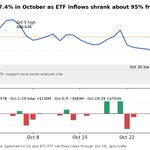
October ran up early and couldn't hold it, and sentiment cooled along the way. BTC reached about $86,600 on Oct 5, slid for most of the month after that, and closed Oct 31 near $77,450. Month-end to month-end that is a 7.4% drop, which gives back most of September's 8.3% gain. The composite Fear & Greed index went from 72.8 on Oct 6 to 38.35 on Oct 31, the lowest reading of the month and inside "fear."
Macro pointed in different directions. The US 10-year yield fell from 5.29% at the end of September to 4.98% on Oct 29, and the 2-year from 4.88% to 4.61%, so rates were coming down. Inflation was not: September CPI was 3.7% and PPI was up 6.3% year on year. The Fed left rates unchanged in October, and the market started pricing some chance of a December hike. Altcoins fell harder than BTC. SOL lost 19.2% over the same window.
ETF money was the first thing to change. US spot BTC ETFs took in about $2.57B net in September. October through the 29th came to about $130M, roughly 95% less. The first full trading week of October saw about $680M of net outflows, and flows only turned positive again in the last two weeks of the month, about $750M combined.
On-chain valuation came down with price but isn't at an extreme. MVRV, market cap divided by realized cap (the aggregate cost basis of all coins), fell from 1.57 at the end of September to 1.44 on Oct 31. The amount of BTC held at a profit dropped from about 14.33M to 12.39M coins, down 13.5%. Realized cap still rose 2.0% to about $1.09T, which means some people bought at higher prices this month. Miners look steady. Hashrate rose 8.1%, from about 930M TH/s to about 1.006B TH/s on Oct 28, and daily miner revenue was flat at around $44M. I don't see signs of miners being forced to sell.
The level that mattered was $83,000. BTC moved above it in September, and in late October it closed a week below it for the second time, so the market now largely treats that breakout as a false one. The lowest daily close in October was $77,052 on Oct 30, and intraday BTC touched about $76,600, close to the 21-week moving average. Some analysts see $73K–77K as a support zone in a bull market.
For November I'm watching whether $73K–77K and an MVRV around 1.4 hold. If they do, October looks more like a pullback within a bull market. If they don't, the debate moves to where we are in this cycle. The US midterm elections on Nov 3 and the December FOMC are the two dates on the calendar. If ETF flows keep up the late-October recovery, that would be the most direct sign of demand coming back.
Outside BTC I follow only three projects. Hyperliquid and Jupiter already earn real revenue and return part of it to token holders. What Sign is building would be a leap for the whole industry, and I watch it the way an angel investor would, over a long horizon.
HYPE (Hyperliquid)
HYPE fell 4.2% in October, about 3 points less than BTC. It dropped as low as $76.40 on Oct 24 and then recovered most of that.
Hyperliquid's October fees were $87.85M, up 6.4% from September, and revenue was $69.04M, up 4.6%. The Assistance Fund bought back $50.09M of HYPE, 20% more than in September, but $8.17M of that came on Oct 4 alone. Without that day, buybacks were about the same as September's.
The capital side weakened. DEX volume was 13% lower than in September, TVL fell 9.9% from $7.59B to $6.84B, and bridged stablecoins dropped about 22%, from $469M to $366M. In November the question is whether revenue can keep growing while volume and capital shrink.
JUP (Jupiter)
JUP fell 21.8% in October, about 14 points more than BTC. Early in the month it moved against the market, rising about 12% from Oct 5 to Oct 9 while BTC fell about 5%. That came from money rotating within Solana DeFi, Jupiter Lend's TVL briefly passing a comparable lending product, and short covering. Nothing changed in the token's economics.
After that, Jupiter's numbers weakened almost everywhere. Fees were 11% lower than in September ($15.91M vs $17.91M), and protocol revenue fell 36% ($3.92M vs $6.13M). TVL dropped 18%, from $2.59B to $2.13B. By business line, lending TVL fell 27.5%, perps 16% and jupSOL 23%.
There is also a slower-moving factor on the token side. The community wallet that pays quarterly rewards to holders has about 173M JUP left. At roughly 50M JUP a quarter, and with no new funding, that lasts until around mid-2027. Whether rewards continue after that depends on a community vote to draw on reserves.
SIGN (Sign)
SIGN fell 15.5% in October, from $0.0125 to $0.0106, a smaller drop than SOL's. Sign still has no revenue or usage data that can be checked publicly. Early infrastructure projects usually publish very little, so I keep treating it as an angel-stage bet and am waiting for its first numbers that outsiders can verify.
The $83K breakout failed, but neither on-chain holders nor miners are showing panic, and November mostly comes down to whether $73K–77K holds and whether ETF money returns. Rates are falling while inflation stays high, so macro doesn't give a single direction, and sentiment is in fear without being extreme. For the three projects, revenue tells you more than price. HYPE's revenue is still growing while capital leaves, JUP's revenue fell by more than a third, and SIGN has yet to publish its first public numbers.
ETF flow data here runs only through Oct 29.
Sources: CoinGecko (prices); bgeometrics (ETF flows, on-chain valuation); blockchain.com (miners); DefiLlama (TVL, fees, revenue); Hyperliquid (buybacks); FRED (Treasury yields); Crypto Fear & Greed composite (sentiment); public analyst commentary (third-party, reviewed).
A summary of public data and my own read. Not investment advice.


3
240
Rates are pushing Bitcoin back down. JUP is breaking out anyway, but its revenue isn't keeping up
One-line take: This week the bond market set crypto's direction. Majors are bleeding as long-end US yields climb. Inside Solana DeFi, money is rotating hard and JUP is the standout. But Jupiter's fees and buybacks fell over the last two weeks, so for now this rally runs on narrative and positioning, not revenue.
Window: prices Mon Oct 5 to Thu Oct 8 (Oct 8 = morning intraday unless noted). Protocol data compares full weeks Sep 24–30 vs Oct 1–7. Times UTC+8.
1) Macro: BTC has given back most of the Sep 21 breakout
Since Monday, BTC is down ~5.1%, from ~$86.6K to ~$82.3K intraday. ETH and SOL are each down ~7.3%. On Sep 21, BTC jumped from $81.2K to $86.6K on Binance daily closes, and most of that is now gone (latest close: $83.3K on Oct 7). The ~$81K area is where that breakout started and where most people expect buyers to show up.
The pressure is coming from rates:
- The US 10Y went from 4.96% (Sep 22) to 5.31% (Oct 5), and traded above 5.3% intraday again on Oct 7, the highest since 2002.
- 10s/2s widened from 0.25pp to 0.51pp. When the long end rises faster than the front end, the market is pricing "higher for longer."
- Brent is back above $100.
- The September FOMC minutes (out Oct 7) showed most officials leaning toward one more hike this year, on top of September's move to 3.75–4.00%. About $400M of longs were liquidated within an hour.
Sentiment followed. Composite Fear & Greed: 70 (Oct 6), 66 (Oct 7), 57.3 (Oct 8). That's ~13 points in two days, back near the Sep 16 pullback (54.5). Still "greed," but close to neutral. alternative.me alone: 73 to 64.
2) JUP: up against the tape, but revenue went down
At 18:30 on Oct 8, JUP was ~$0.377, up ~16% in 24h on ~$180M volume, about 2.7x the early-October daily average. Over the same window BTC fell 1.3%, SOL fell 2.8%, and 75 of the top 90 coins were red. JUP cleared its Sep 27 YTD daily high (~$0.37) and is up ~13% from Monday's ~$0.334 (~8% using the morning print).
No single clean catalyst. It looks like three things stacking:
- Solana rotation. Same day: Meteora (MET) +45–70% after an Oct 6 liquidity product launch, W +25%+, RAY ~+10%, JTO ~+8%.
- "#1 lender on Solana." On Oct 6, Jupiter Lend (~$1.41B TVL) edged past Kamino (~$1.40B), per public reports citing DefiLlama. Borrows grew from $970M (Oct 2) to $1.06B (Oct 8), +9.3%. Kamino still leads on 30-day fees, though: ~$4.82M vs ~$3.77M.
- Short covering. JUP futures volume +66%, open interest +16%. Liquidations were mostly shorts, but small.
Checked and not found: no new listing, no tokenomics change, no bigger buyback. A stablecoin partnership rumor has no official announcement.
The real gap is revenue. Oct 1–7 vs the week before:
- Fees: $3.35M vs $4.37M (−23%)
- Revenue: $1.04M vs $1.38M (−24%)
- Holder revenue (buybacks): $522K vs $689K (−24%)
30-day fees were $16.5M, down 9% from the prior 30 days. At the current pace, annualized buybacks are ~$37M, about 3% of market cap (~$1.25B).
My read: this is capital inside Solana hunting for the best story to own. The lending business is growing, but that hasn't reached platform revenue yet. We've seen this recently: on Sep 28–29 JUP dropped ~10% in one day ($0.364 to $0.329) after another rally that ran ahead of revenue.
3) HYPE: down with the market, fundamentals steady
HYPE went from ~$90.4 to ~$85.1 (−5.8%, Oct 8 intraday), roughly in line with BTC. Fundamentals held up:
- Weekly fees $17.1M vs $15.5M (+10%), revenue $13.5M vs $11.9M (+13%).
- 30-day fees $73.4M, flat vs the prior 30 days (+0.6%).
Read the buyback number carefully. The headline week was $16.6M, +63%. But Oct 4 alone was $8.2M (~90.7K HYPE). Without it the week was $8.4M, down 17.5%. 30-day buybacks: $46.6M vs $52.8M (−12%). Stablecoins on Hyperliquid slipped from ~$7.80B (Sep 23) to ~$7.48B (Oct 7), −4%.
Worth noting: in late September Robinhood began rolling out perps to US users, HYPE included, on its own licensed venue rather than on-chain. Regulated venues pulling away perp demand is a long-term issue for Hyperliquid. It doesn't show in the data yet.
4) SIGN, in one line
~$0.0123 (Oct 8 intraday), down ~12% from ~$0.0139 on Sep 28, ~$35M market cap, no new public business data. At this stage, data is a bonus, not the norm.
5) The slow variable: stablecoin yield is moving to distributors
On Sep 30, Stripe's Bridge launched OUSD on Ethereum, Base, Solana and Tempo, passing almost all reserve yield to the 200+ partners who distribute it. In late August, reports also said JPMorgan is considering its own stablecoin. Not a price driver this week, but the direction is clear: on-chain dollars are shifting from "issuer keeps the spread" to "distributors compete for it." Where those dollars end up, in which lending markets and trading venues, is the real long-term contest for Solana DeFi and Hyperliquid.
What I'm watching
- US September CPI (Oct 14) and the FOMC (Oct 27–28). Whether the 10Y gets back under 5.3% largely decides whether BTC holds ~$81K.
- Jupiter weekly fees back above $4M, and Lend borrows still growing. That's the line between story and revenue.
- HYPE buybacks with outlier days stripped out, and whether Hyperliquid's stablecoin balance stops falling.
Sources: CoinGecko, Binance (prices); DefiLlama (fees, revenue, Jupiter Lend, stablecoins); Hyperliquid Assistance Fund, tokenbuybacks.app (buybacks); alternative.me, coinybubble, CoinMarketCap (Fear & Greed, composite = average of available components); FRED (yields); Block Insider, crypto.news, CryptoTimes, TokenPost, Lookonchain, Crypto Briefing, CoinEdition, ICObench, Bankless (news).
A summary of public data and my own read. Not investment advice.


1
2
357

What's been happening in crypto over the past month
(Aug 27 – Sep 25, 2026 — vs August)
One-line take: risk assets still paid, but the driver flipped from “sentiment thaw” to “digesting highs + rate re-pricing.”
Charts (attached, in order):
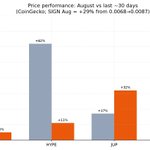
1) Price: Aug vs last ~30d (BTC / HYPE / JUP / SIGN)
2) HYPE fundamentals
3) HYPE HIP-3 mix
4) JUP fundamentals
——
1) Bitcoin & the tape
August: BTC roughly $63k → $79k (~+25%). Mood flipped fear → greed.
Last ~30 days: ~$80k → ~$85k (~+5%), trough ~$76k (Sep 16), peak ~$86k (Sep 22). Higher price, flatter slope.
Same window: short- and long-end Treasuries and effective fed funds rose by tens of bps from the start of the period. The dollar stopped falling and bounced. Money got more expensive.
Take: the uptrend isn’t invalidated — just don’t extrapolate August’s slope. Watch digestion around key moving averages, and whether rates keep grinding higher.
——
2) Why only three names besides BTC
BTC is the base layer for liquidity and risk appetite. Outside that, the list stays short on purpose — only names where you can explain how they make money and keep reconciling the books:
• Hyperliquid (HYPE) — on-chain trading venue: volume, fees, buybacks
• Jupiter (JUP) — Solana trading front door + multi-product stack: traffic & core revenue
• Sign (SIGN) — identity / protocol infra: earlier stage, thinner public data (satellite, not the main course)
Narratives are plentiful. Checkable business logic is not.
——
3) Hyperliquid (HYPE)
Price (CoinGecko): Aug ~+62% ($52→$84). Last ~30d ~+11% ($85→$94). Big move was August; this month looks like digestion at highs — still ahead of BTC’s ~+5%.
Fundamentals (last ~30d sums vs prior ~30d; TVL = point-in-time Aug 26 → Sep 25):
• TVL $6.84B → $7.64B (+12%)
• DEX volume $3.32B → $5.01B (+51%)
• Fees ~$63.3M → ~$72.4M (+14%)
• Revenue ~$47.4M → ~$56.4M (+19%)
• Assistance-fund buybacks ~$44.45M → ~$44.51M (~flat). Still running; no step-up.
Structure matters more than headlines: HIP-3–related 24h notional ~$0.31B → ~$2.43B; share of the venue ~4.4% → ~24.3%. Venue 24h notional ~$7.1B → ~$10B. Stablecoin “bridge” size roughly +55%.
Newsflow was noisy this month (access/compliance, prediction markets, position color). Weight that below the table. Meme-pad / energy-contract chatter = lead, not conclusion.
Call: price digesting, but 30d fees/volume/TVL still thicker than the prior window; buybacks stable; growth isn’t only old perps — a new line’s share stepped up. Revisit if we later see “price still firm while 30d fee & volume sums turn negative.”
——
4) Jupiter (JUP)
Price: Aug ~+17% ($0.193→$0.225). Last ~30d ~+32% ($0.242→$0.320) — stronger than BTC here, and stronger than JUP’s own August.
Fundamentals (same lens):
• TVL $2.30B → $2.62B (+14%)
• DEX volume $0.89B → $1.44B (+62%)
• Fees ~$15.3M → ~$17.0M (+11%)
• Revenue ~$4.9M → ~$6.4M (+32%)
Weekly cuts: lending / perps / jupSOL and other core lines lifted TVL; prediction markets stay tiny and soft — core hot, experiments cold. No new buyback that clearly drove the tape. Deep news almost empty.
Call: “Solana trading heat getting priced.” Usage and revenue expanded; revenue grew faster than fees — not a soft mix. Without fresh catalysts, don’t read this as a tokenomics shock. If JUP sells off hard ahead of BTC, check Solana traffic and perp activity first.
——
5) Sign (SIGN)
Price: Aug ~+29% (~$0.0068→$0.0087). Last ~30d ~+67% (~$0.0081→$0.0135). High beta both windows.
Fundamentals: basically price + market cap only. No TVL, fees, revenue, users, or a stable progress digest.
Call: shows risk appetite spilling into small-cap narratives — not a proven business inflection. Satellite observation until public, checkable metrics appear.
—
6) Bottom line
1. August = thaw + BTC/leaders leading. Last 30 days = high-level gear-shift + rates lifting. Slope and leadership both changed.
2. HYPE: digestion in price; 30d TVL/volume/fees/revenue still above prior; buybacks ~$44.5M flat; HIP-3 share jumped. JUP: price more aligned with volume & revenue expansion. SIGN: upside both months, no reconcile-able fundamentals.
3. Macro still answers to BTC and rates. The three satellites reconcile: fees–buybacks–new product; Solana traffic & core revenue; whether SIGN ever fills in public metrics.
Sources: CoinGecko prices; TVL/fees/volume from public DefiLlama + Hyperliquid-related series (rounded). Comparison = last-30d sums vs prior ~30d (or dated point-in-time). Public research summary — not investment advice.


1
1
233
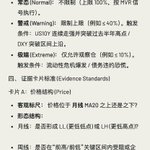
为了不再凭“感觉”炒币,我做了一个 BTC 趋势量化MVR系统(Minimum Viable Research)。目的很简单:不求精准预测顶/底部,只求在仓位调整时有个客观依据。用 2024 至今的数据回测,对趋势拐点的判断准确率达到 81%。 目前系统对 BTC 的最新趋势判断是:拒绝给出“买入”建议,但也尚未确认“全面熊市”。
1
36
我会持续完善这个系统,向优秀的量化前辈们学习,包括Arthur Hayes、Glassnode等。 目前的 81% 准确率基于 2024 年至今的震荡市数据,未来在极端行情下表现如何还需要时间验证。 如果你也想摆脱“凭感觉”交易,欢迎关注。我会每月更新 MVR 系统的信号读数,并与其他知名分析师的结论做对比。
1
27


I’ve taken the orange pill by locking in my $SIGN claim with a bonus—ready to HODL strong! Let’s ride this wave together. 🧡🧡 #SIGN #OrangeDynasty sign.global/shares/sign-aird…


Jeff Sun retweeted

My wife devoted herself wholeheartedly to this creation. Just like the kitten , we wish everyone joining us and becoming guests together. We will grow into owners of the haus and invite more and more friends.Don't wait,let’s GO together!
#STEPNGO #Haus
@Stepnofficial


