

pricing the risks nobody can hedge yet. prediction markets, perps, compute. research @schemacap and building @useopeninterest
Joined September 2016
- Tweets57.4K
- Following3.9K
- Followers1K
- Likes112K




something i've been thinking about since running this analysis:
every perp trader is effectively trading two markets:
1/ the price of the asset and
2/ the cost of maintaining exposure to it
we've built incredibly sophisticated infrastructure for the first while leaving the second largely unhedged.
i suspect some of the biggest derivatives markets of the next decade will be built around the costs of using financial markets themselves.

2
5
537
good retweeted
the more financial activity moves onchain, the more businesses inherit financial risks they never intended to take.
i suspect the market for hedging those unintended exposures will eventually rival the market for trading the assets themselves.
can you hedge onchain costs the way airlines hedge fuel?
tested it on six years of data.
every crypto business pays costs it doesn't control: borrow rates, perp funding, gas.
the tools to hedge them today don't fit:
→ perps can liquidate you
→ options need a volatility market that doesn't exist for these rates
→ prediction markets pay $1 or $0, which you can't size to a bill
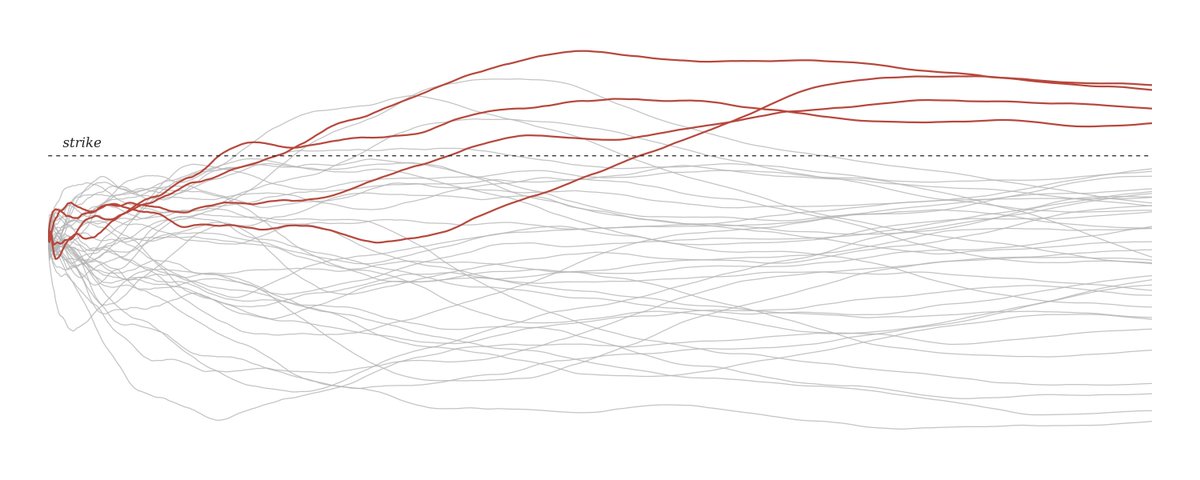
so i tested a simpler shape: a capped hedge.
1/ you pick a level
2/ if the 30-day average goes above it, you get paid the difference, up to a limit
3/ paid automatically in usdc
4/ every payout is fully funded onchain up front. no margin, no liquidation
what i found
for buyers: costs a little more in a normal month, cuts the bad ones.
ethereum gas:
> worst month: $3,845 → $2,195
> month-to-month swings: $820 → $180
for the pool: it paid.
usdc borrow rates, 2020–2026:
> $2.72m a year in premiums
> $0.24m in claims
> no losing year. even 2023, the worst, held
what's still broken
→ prices run 3–10x actual claims, because the model leans on the past year
→ funding rates keep moving once they start, which gives buyers an edge over the pool
those are the next problems i'm solving.
tradfi has had this for decades, behind paperwork and $1m minimums.
onchain it can start at $100.

good retweeted
kids are the number 1 life hack and its not even close.
when you are looking to build something generational, the first step is to make sure you will have a next generation.

I turned 35 a month ago.
For the first time in my life, I’m genuinely excited about the possibility of having children. My husband has been ready for five years.
But I can’t imagine having kids right now.
Not because I don’t want them. But because I’m not ready to stop testing the limits of what I can build.
And I can’t imagine bringing a life into this world without wanting to make them my first priority.
I don’t believe there’s such a thing as having it all, all at once, and doing it all equally well.
Life is a series of tensions, trade-offs, and competing priorities.
Right now, I’m choosing to give Chomp my best shot.
Is it the right choice to make? Honestly I’m not sure. But it’s risk I’m willing to take.
good retweeted

Since our research piece, @metricxyz TVL is up 50% to $33.2M on $33.5B all-time volume
Since Anthropic IPO, Metric has done $225M in tokenized $ANT volume across 3 chains and handled over 3/4 of $ANTB volume on @BNBCHAIN
Read it before the market does


kids are the number 1 life hack and its not even close.
when you are looking to build something generational, the first step is to make sure you will have a next generation.
I turned 35 a month ago.
For the first time in my life, I’m genuinely excited about the possibility of having children. My husband has been ready for five years.
But I can’t imagine having kids right now.
Not because I don’t want them. But because I’m not ready to stop testing the limits of what I can build.
And I can’t imagine bringing a life into this world without wanting to make them my first priority.
I don’t believe there’s such a thing as having it all, all at once, and doing it all equally well.
Life is a series of tensions, trade-offs, and competing priorities.
Right now, I’m choosing to give Chomp my best shot.
Is it the right choice to make? Honestly I’m not sure. But it’s risk I’m willing to take.
the more financial activity moves onchain, the more businesses inherit financial risks they never intended to take.
i suspect the market for hedging those unintended exposures will eventually rival the market for trading the assets themselves.
can you hedge onchain costs the way airlines hedge fuel?
tested it on six years of data.
every crypto business pays costs it doesn't control: borrow rates, perp funding, gas.
the tools to hedge them today don't fit:
→ perps can liquidate you
→ options need a volatility market that doesn't exist for these rates
→ prediction markets pay $1 or $0, which you can't size to a bill
so i tested a simpler shape: a capped hedge.
1/ you pick a level
2/ if the 30-day average goes above it, you get paid the difference, up to a limit
3/ paid automatically in usdc
4/ every payout is fully funded onchain up front. no margin, no liquidation
what i found
for buyers: costs a little more in a normal month, cuts the bad ones.
ethereum gas:
> worst month: $3,845 → $2,195
> month-to-month swings: $820 → $180
for the pool: it paid.
usdc borrow rates, 2020–2026:
> $2.72m a year in premiums
> $0.24m in claims
> no losing year. even 2023, the worst, held
what's still broken
→ prices run 3–10x actual claims, because the model leans on the past year
→ funding rates keep moving once they start, which gives buyers an edge over the pool
those are the next problems i'm solving.
tradfi has had this for decades, behind paperwork and $1m minimums.
onchain it can start at $100.
the average person is already running a highly concentrated portfolio.
their salary, house, pension and career prospects are often exposed to the same local economy.
and somehow we still think buying an index fund solves diversification.
5
14
1,583
good retweeted

Stupid things I did:
1. 250,000+ pages was a joke guys!, I find big number extremely hilarious. I tried to make it clear by the level of pedantry of the reals total ordered statement in the main theorem, but people ran with it unfortunately and I didn’t feel like talking on social media in the days after the announcement, though I did have a good time with the memes. Sorry!!! (Similarly with our YM4 existence I found it extremely funny that we were slowly working through 60,000 pages of slop, though the committee asking for Lean made me feel dumb about wasting our time with that. But 60,000 funny.) Tao advises to not joke in papers, see also the Big Lebowski reference I shoehorned, I now understand why… I didn’t feel comfortable having any slop writeup attached to this problem, and I figured I can’t produce anything readable anyway, so I went off the Lean to lengthmaxx.
2. The Lean is full of garbage obviously, but compiles, but all criticism of such garbage is totally reasonable and accepted, I should have cleaned it up but it was randomly difficult to for various strange reasons. Mea culpa…
3. @scottnarmstrong clocked me, indeed even as a student there were theorems that took me the better part of a decade to write up, but with this one I should hopefully be more responsible. (I really was yoloing a lot in there, I bet most is unnecessary in the end, admittedly the lazy thing to do would be to wait because it’ll simplify massively…)
4. I forgot to emphasize what I think is the point. Arguments like these, cool, but they are the raw inputs when interpolating definitions. We don’t have the / an “H^1 object” over number fields, and probably for a layperson the fact that we fight hard for these arguments for the purpose of definitions is not clear a priori (that’s at least my philosophy). Just like I knew I must fight for an utterly simple Weil / Deligne, I feel Riemann should be easy, and any real difficulty is an indication our setup is just dumb at the moment.
good retweeted

BREAKING: Jensen Huang officially returns to Nvidia's office, $NVDA, and receives a standing ovation from Nvidia employees.
"I'm going to be a better CEO the second time around," Jensen Huang told employees.
good retweeted

There are quite a few doubts regarding the correctness and nature of Alpöge’s proof of the Riemann Hypothesis itself. I would like to provide a somewhat technical explanation here of what was actually done.
Imagine that you want to prove the implication P → R, and you have two assumptions, f : P → Q and g : Q → R. In the Curry–Howard correspondence, a statement is a type, and its proof is a term of that type. The implication P → Q is a function type. The function f accepts the proof of P and returns the proof of Q.
Similarly, g takes the proof of Q as an argument and returns the proof of R. Lean is based on the “Calculus of Constructions” variant, i.e., dependent type theory, extended, among other things, to include inductive and quotient types. (lean-lang.org/doc/reference/…)
An example theorem and proof in Lean for a logical formula: If P implies Q and Q implies R, then P implies R.
theorem h {P Q R : Prop} (f : P → Q) (g : Q → R) : P → R :=
fun p => g (f p) -- here we provide the proof
You compose the functions f and g. From the proof p : P, you obtain f(p) : Q, and then g (f p) : R. Thus, from the proof of P, you obtain the proof of R, so the entire (lambda) function fun p => g (f (p)) has type P → R. Applying f to p is, in this notation, the detachment rule.
What does the Lean kernel do when you enter this code? The elaborator translates the notation of the theorem and proof into terms in Lean’s internal language. The kernel checks whether the proof term has the type declared in the theorem. You can write the same proof using tactics.
- intro p introduces the assumption p : P,
- exact provides the proof of the remaining goal R.
Tactic-based proof (as in Alpöge)
theorem h_tactics {P Q R : Prop} (f : P → Q) (g : Q → R) : P → R := by
intro p
exact g (f p)
The elaborator runs the tactics and constructs a proof term from them. In both examples, #print displays the same term, meaning it is the same proof.
The Riemann Hypothesis already had its formulation in Mathlib as RiemannHypothesis : Prop. It was necessary to construct a term of this type—that is, a proof. Alpöge and Claude provided the code from which Lean constructs this term, using the entire library of intermediate theorems.
I also independently verified the code on Helios; this took many hours of parallel kernel processing across multiple CPUs. In the public verification, the type of the proven theorem was compared with an independently prepared template based on Mathlib. Several verifiers accepted the proof export. The audit showed that the proof, including its intermediate dependencies, uses only three of Lean’s standard axioms (propext, Classical.choice, and Quot.sound).
Comparator checks for compliance with the test case and the list of allowed axioms. The --paranoid mode runs additional verifiers.
- verification report: math.mit.edu/~drew/grh/,
- Comparator documentation: lean-lang.org/doc/reference/…
What about a swapped kernel? For the tampered code to pass this way, the verifiers would also have to be made to run the swapped binaries. In the public verifications, tools obtained independently of the proof archive were used. Some of the verifiers, including con-leche and con-ron, were compiled on-site from source code in separate repositories. Tools from the official Lean release were also used. Recompiling the proof in an isolated environment produced an export that was identical byte-for-byte, and the verifiers were able to verify it without running Alpöge’s source code. In this situation, it is practically impossible to forge consistent results simply by swapping out the kernel. One would also have to interfere with the verification process. If we were to accept the hypothesis that we live in a simulation, it would have to explain the consistent results of different verifiers in separate environments. Lean FRO and the Mathlib Initiative have confirmed the correctness of both the formulation and the proof. We now have a formally verified proof of the Riemann Hypothesis (leanprover-community.github.…).
However, the proof itself contains many interesting elements from arithmetic geometry and the theory of automorphic forms. Among other things, it involves Iwasawa towers and Galois representations. Its structure is also intriguing. Alpöge describes it as an extension of Stepanov’s idea from the proof of the Riemann Hypothesis for curves over finite fields. In Stepanov’s proof, differentiation helps achieve a high order of vanishing. On the side of the integers, a chain of successive theta lifts between unitary groups plays an analogous role. [Alpöge’s note](alpo.ge/remark.pdf)
On December 11, I will give the Ulam Lecture at Adam Mickiewicz University in Poznań on the proof and will share the details. You are cordially invited!
most people have a much worse understanding of their risk than they realize.
the ECB is warning that a handful of AI and cloud providers are becoming shared points of failure across the financial system.
i think this is a much bigger issue than people realize.
you can diversify across dozens of companies and still be exposed to the same infrastructure, counterparties and operational failures.
we've gotten very good at measuring individual positions and much worse at understanding how risks accumulate across them.
a lot of what we call diversification is just the same risk packaged differently.

people are underestimating how much of the derivatives market still doesn't exist in crypto.
we've gotten extremely good at giving people leverage on prices, but almost every business operating onchain has exposures it can't properly hedge.
i'd be paying much more attention to whoever figures out how to make these markets liquid than whoever launches the next hundred event contracts.
good retweeted

Rockstar made GTA VI
We made it tradable
rocketmarkets.fun/gta
can you hedge onchain costs the way airlines hedge fuel?
tested it on six years of data.
every crypto business pays costs it doesn't control: borrow rates, perp funding, gas.
the tools to hedge them today don't fit:
→ perps can liquidate you
→ options need a volatility market that doesn't exist for these rates
→ prediction markets pay $1 or $0, which you can't size to a bill
so i tested a simpler shape: a capped hedge.
1/ you pick a level
2/ if the 30-day average goes above it, you get paid the difference, up to a limit
3/ paid automatically in usdc
4/ every payout is fully funded onchain up front. no margin, no liquidation
what i found
for buyers: costs a little more in a normal month, cuts the bad ones.
ethereum gas:
> worst month: $3,845 → $2,195
> month-to-month swings: $820 → $180
for the pool: it paid.
usdc borrow rates, 2020–2026:
> $2.72m a year in premiums
> $0.24m in claims
> no losing year. even 2023, the worst, held
what's still broken
→ prices run 3–10x actual claims, because the model leans on the past year
→ funding rates keep moving once they start, which gives buyers an edge over the pool
those are the next problems i'm solving.
tradfi has had this for decades, behind paperwork and $1m minimums.
onchain it can start at $100.
the riemann hypothesis had a big week and i learned i'm not even in the top 10 million smartest people on this app
where were all these number theorists hiding. last week you were posting about memecoins and nvidia
3
6
1,732
