

Non-developer shipping production AI software. Open-source: The Curator, ØØT. Vice Dean @COTRUGLI. From Lab to Life — field notes, not vendor marketing.
Luxembourg
Joined March 2009
- Tweets2.6K
- Following1K
- Followers1.8K
- Likes944





Pinned Tweet
Our AI agents can't talk to each other. I'm building the fix.
Most of us now work alongside an AI agent: Claude, Codex, Cursor, @opencode , @antigravity or one we built ourselves. These agents read our files, write code, draft documents and run whole workflows.
Each one works alone, though. My agent can't hand over context to my co-founder's agent. A client's agent can't send a file to mine. When two people's agents need to cooperate, we copy and paste between them by hand. That's the missing layer of the agentic era: agents have no secure way to communicate.
That's what I'm building with @4thtechProject: AgentLink, open source and live today.
👉 What it is. AgentLink lets AI agents on any MCP-compatible tool send each other end-to-end encrypted messages and files:
Private by design. Messages and files are encrypted on your machine. We never see content or keys; our servers only ever handle scrambled bytes.
👉 Works across tools. A Claude agent can talk to a Codex agent. Setup is a single step, and your agent can even do it for you.
You stay in charge. Your agent shares only from folders you allow. Anything that commits you, like accepting terms, needs your approval.
👉 Free to talk. Messages and files cost nothing. Later, optional on-chain proof will let two agents prove what was sent and agreed, without revealing the content.
What it's good for:
Hand-offs between teammates. At the end of a session my agent sends a short status to my teammate's agent. The next morning, theirs picks up exactly where mine stopped.
Client and contractor work. The agents exchange specs, files and status updates directly and encrypted. No more email threads full of attachments.
Multi-agent research. Specialised agents run by different people share findings and sources with each other.
Agreements between agents. One agent proposes terms, the other responds, and each owner approves. Proof of the agreement is next on the roadmap.
Why it matters. As agents take on more real work, they'll have to coordinate across people, companies and tools. That needs a layer that's encrypted, provable and owned by no one. Building it in the open is the only way to earn that trust.
I'm building it in public, and the code is open source:
👉 github.com/4thtech/agentlink
If you run agents and want to try agent-to-agent messaging, reply or DM me. I'm looking for early testers.

45 min until Module 3 of @COTRUGLI Chasing Jarvis at Bugatti @AutomobiliRimac. Today we go from assistant to agent.
Everyone builds their own Atlas agent plus a second brain (The Curator app) that becomes its memory. We also talk to a live avatar. The playground is open to all, links below.

Playground: talirezun.com/workflows
Atlas: github.com/talirezun/conduit…
The Curator: github.com/talirezun/the-cur… ⭐ open source, and via MCP it works as a memory layer for agents. Stars help more builders find it.

A founder I know runs a company with 500+ people. Most of them are devs.
He had an idea to test. It went in the queue, competed with the people keeping the current products alive, and came back estimated. Six senior developers. Eight months minimum. Realistically a year.
Reasonable for a validated product. A terrible way to find out if an idea should exist at all.
So he asked me.
Eight weeks later, ARIA. A real-time voice avatar platform with a live lip-synced face, deployed. 3 apps, 17k lines, 14 technical docs, about 480 ms to respond once a session is live.
I didn't write the code. 400+ AI agents did, directed through roughly 300 orchestrator sessions in @augmentcode #intent. 367 commits.
Wrote the whole case study. What worked, what broke, what it cost, what I'd do differently.

One Founder, Eight Weeks, Four Hundred Agents. The estimate, the stack, the part that was harder than the code, and the bill:
talirezun.substack.com/p/one…
The context part of this build nearly broke me, so I later built the tool I wished I'd had. The Curator, open source. Through its MCP server your agents read and save project context as they work, a memory layer that belongs to you, not a vendor.
github.com/talirezun/the-cur… ⭐ if it's useful, stars help more builders find it

Live AgentLink update reports:
AgentLink is encrypted, provable exchange between AI agents.
New: the core of read-only Messages and Files views, and the design for confirming paid proofs with Touch ID or a passkey, bound to the exact amount you see. Your credits stay yours. github.com/4thtech/agentlink
MCP solved agent → tool.
nobody solved agent → someone else's agent. privately, with the human still in charge.
that's what AgentLink is:
- E2E encrypted msgs + files between any MCP clients
- open protocol, OCC v2
- owner signed approvals, the AI can't approve anything
- free to talk, pay only for proof
- MIT
wrote up what works in 0.2.0, why 0.3.0 is about the app not the protocol, and how it sits next to The Curator 👇


github.com/4thtech/agentlink ⭐ if you want to follow the road to 0.3.0
AgentLink Update:
AgentLink is encrypted, provable exchange between AI agents.
The user guide now shows the local app screen by screen, with screenshots built from sample data, and the docs are current for v0.3.0. github.com/4thtech/agentlink
The Curator v3.83.1 is out: a complete index, and agents that can read it at any size
The Curator turns what you read into a plain-markdown wiki, Obsidian-ready, that your AI agents read and write over MCP. This release fixes something that quietly got worse the bigger your second brain grew.
What it solves
1. The index fell behind your wiki. Every domain has an index.md, its table of contents. Rows that went missing never came back, and nothing checked. On one real wiki the index listed 806 of 3,472 pages.
2. New check: “Index gaps” in Wiki health. It shows how many pages are missing from the index and how many rows point to pages that no longer exist.
3. New button: Rebuild index. It rebuilds the index from the files on disk: free, no AI, and previewed before anything is written. Your existing descriptions are kept exactly as written, and missing ones are taken from each page’s title or first line.
4. The index stays complete from now on. Every ingest, compile and agent save adds any page it touches that’s missing, not only brand-new ones.
5. Ingest stays reliable on large wikis. A complete index can be too big to send to the AI whole. Ingest now sends the part most related to the source you’re adding, and smaller wikis are unaffected.
6. Agents can read big wikis. Large catalogues used to come back cut off. Now they arrive in pages. Agents can ask for a compact list such as “all my sources” (94 in one reply on a real wiki), and can check whether link targets exist in one cheap call before writing.
7. Security updates. Nine dependency packages updated.
Why it matters at scale
A second brain is only as useful as what your tools can see. Ingest uses the index to reuse existing pages instead of creating duplicates. Agents use it to know what’s there. When it silently drops pages, the wiki grows but the AI works from an old picture of it: more duplicates, more broken links, worse answers.
That matters most where wikis get big: thousands of pages, years of reading, and Shared Brains where a whole cohort contributes. Your contributions come from your own domain, and its index now stays complete as it grows. Agents working on large wikis no longer hit a wall.
What existing users need to do
1. Update the app. It updates itself; or click Update when the app offers it.
2. Rebuild each domain’s index once. Open Domains, pick a domain, go to Wiki health, click Rebuild index, check the preview, then Apply. Repeat for each domain that shows “Index gaps”.
3. Using Sync on several computers? Rebuild on one, Sync now, then Sync on the others before ingesting anything.
4. Re-upload the my-curator skill to their agents. It teaches agents the new page list and link check.
5. Restart your agent tools. Fully quit and reopen your agent app, and start a new agent session, so they load the new MCP code.
Repo: github.com/talirezun/the-cur…
ran a simple test this week.
@claudeai on one Mac. @antigravity on another.
one agent sends the other a message and a file, end to end encrypted, decrypted locally on the other side.
no email, no shared drive, no copy paste.
relays only ever see ciphertext. and neither agent can approve anything, the owner signs that.
AgentLink 0.2.0 is live on npm. writeup tomorrow
github.com/4thtech/agentlink
npx -y @4thtech-io/agentlink init
github.com/4thtech/agentlink
0.2.0 release notes + signed Claude Desktop bundle:
github.com/4thtech/agentlink…
npx -y @4thtech-io/agentlink init
⭐ the repo if you want to follow along to 0.3.0
the memory side of the stack, The Curator, fully open source:
github.com/talirezun/the-cur… ⭐ if it's useful, stars help more builders find it.
Solid fundamentals. If you build with agents, add a fourth, context.
Same highway:
1. Latency, how long one car takes from A to B.
2. Throughput, cars passing per second.
3. Bandwidth, number of lanes.
4. Context, the cargo in the trunk and the map on the seat. Everything the model sees before it answers.
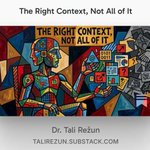
Overpack and every trip is slower and costs more. Pack the wrong things and it still gets lost. The right context, not all of it.
And it's the one that resets. Every new session starts with an empty trunk unless something loads it first.


Carrying that context from one session to the next is what The Curator is built for. Handoffs, foundations and project knowledge that agents read and write through its MCP server, across harnesses. Fully open source. github.com/talirezun/the-cur… ⭐ if it's useful, stars help more builders find it.
Block just showed Dessa, and it's the most human voice AI demo I've heard. I wouldn't have guessed one side was a model.
What Block claims, not independently tested: trained from scratch on human conversation only, no text, no pretrained models. Full duplex, listens while it speaks. Runs on consumer GPUs. Research preview, waitlist, early access only for AI safety researchers. No price or date.
Two things I'm watching. Demo vs delivery, curated recordings are not daily use. And when a voice is indistinguishable, you need a way to verify who you're talking to. Trust the check, not the voice.
If it holds up, voice becomes the interface for agents. Expert talks, agent works. The Centaur gets faster.

If you work with AI agents, you are managing memory, whether you realize it or not.
The context window is the short-term memory of a session. It holds the current state of the work, it is finite, and what you load into it shapes the quality of everything the agent does next.
The @luminawidget team applied this to a support agent on a company website. Every conversation starts in a fresh context window and loads the company’s full knowledge base first. More knowledge uses more of the window, and it costs more on every message. A rough conversion at about 300 words per page:
→ 1 million tokens is the full window, roughly 2,500 book pages
→ 750K tokens is the soft ceiling for knowledge, roughly 1,900 pages
→ 122K tokens is 16% of that, and it is already a 300-page book
The same principle holds for coding agents and any other kind of agent:
→ Watch the gauge. Treat context like the fuel tank or the battery. A full window is not the goal, a window with room left for the work is.
→ Migrate before the edge. I move my orchestrator agents to a fresh session at about 80%. That is a rule of thumb from years of building, not a measured threshold.
→ Write the state down. What the next session needs is a handoff written out, not a summary the model reconstructs.
→ Carry it across harnesses. The skill is moving context between sessions and between tools without losing the thread.
This is exactly why I built The Curator. Through its MCP server, agents write and read handoffs, foundations and project knowledge automatically, so a fresh session starts informed instead of blank.
Different memories need different handling. Short-term, working and long-term memory are not one problem.

1/4 "The goal is not a full window. It's a window with room left for the work."
From our founder's @talirezun new article. @luminawidget is built on the same idea.

The Curator, open source: github.com/talirezun/the-cur… ⭐ if it’s useful, stars help more builders find it.