
PhD student of UIUC
Champaign
Joined April 2025
- Tweets199
- Following263
- Followers320
- Likes801




Pinned Tweet
Excited to share our recent work at Google!
🤔 Can coding agents migrate an entire PyTorch repository to JAX without changing how it behaves?
🚀 Introducing T2J-Bench: 63 whole-repository migration tasks across 18 model families, covering both foundation model training and serving!
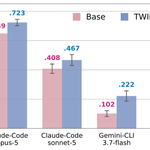
The strongest off-the-shelf configuration reaches only 0.676 reward against a 0.980 reference JAX oracle. Getting the code to run is only the beginning.
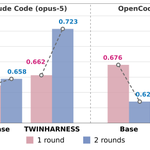
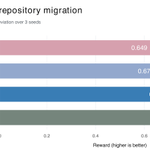
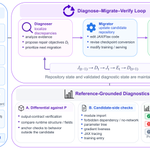
We also introduce TwinHarness: a reference-grounded migration loop that improves reward from 0.649 to 0.723 with the same underlying agent and model—an 11.4% relative gain!
GitHub: github.com/google-research/t…
Project page: ft2023.github.io/T2j-web/
Here’s the thread 🧵👇

Tao Feng retweeted

Multimodal agent memory is on arXiv!
📈 From static retrieval, to dynamic update, to self evolving!
🤖 Across Image, audio, video, GUI, and Embodied agent.
📱Important for personal agent and RSI…
Explore our observatory and submit papers by website to contribute!
📝 seeing-maintaining-learning.…
📄 arxiv.org/abs/2610.19366
#AgenticAI #RSI #PersonalAgent

Excited to be part of this survey! 🚀
Multimodal agent memory is more than retrieval. We organize the field along two axes—how memory is represented and how it is managed—and trace its evolution from static to dynamic to self-evolving.
Great work by the team! 👏
📄 arxiv.org/abs/2610.19366


Multimodal agent memory is on arXiv!
📈 From static retrieval, to dynamic update, to self evolving!
🤖 Across Image, audio, video, GUI, and Embodied agent.
📱Important for personal agent and RSI…
Explore our observatory and submit papers by website to contribute!
📝 seeing-maintaining-learning.…
📄 arxiv.org/abs/2610.19366
#AgenticAI #RSI #PersonalAgent
2
9
355
From saving costs to knowing your work: model routing for everyday AI assistants 🚀
Connect WorkBuddy and Codex with LLMRouter. Choose a strategy. Train your own router.
Why use the same model to polish an email, debug code, and tackle complex reasoning? Let LLMRouter help match each task to a suitable model while you keep working in your familiar assistant.
🧭 Start with simple rules, let an LLM choose, or train KNN, SVM, and MLP routers on your own tasks. Use preference data to personalize model selection—and refine your router as you collect feedback.
Our new guide walks through setup, router preparation, and practical video demos—from your first routed request to a complete tool-calling workflow.
📖 Blog & demos:
ulab-uiuc.github.io/LLMRoute…
🙏 Huge thanks to @lei_zijie, Zhongjie Dai, @Kunlun_Zhu, @nerv_599164778, @haozhen_ntu, @GeLiuSaber, and @youjiaxuan for making this work possible—and to the LLMRouter community for helping bring model routing into everyday workflows!
1
181
7/ What is the difference from simply adding another round?
The feedback matters!
With opus-5, ordinary OpenCode continuation drops from 0.676 to 0.628. TwinHarness improves from 0.632 to 0.706 between its first and second rounds.
At the task level, the second round causes regressions on 22 of 63 tasks with ordinary continuation, versus only 2 with TwinHarness.
Each method starts from its own first-round candidate. The pattern suggests structured verification helps preserve progress while guiding further repairs.

8/ Acknowledgments
Huge thanks to the T2J-Bench team: Tao Feng @taofeng_uiuc, Jiefeng Chen @jiefengchen1, Linxin Song @linxins2, Yufan Zhuang @yufan_zhuang, Yue Huang @HowieH36226, Bhavana Dalvi Mishra @bhavana_dalvi, Chi Wang @Chi_Wang_, Xiangru Tang @XiangruTang, Jieyu Zhao @jieyuzhao11, Ge Liu @GeLiuSaber, Tomas Pfister @tomaspfister, and Jinsung Yoon!
This work brings together collaborators from Google Cloud AI Research, UIUC, USC, the University of Notre Dame, and Google DeepMind.
We hope T2J-Bench helps the community build coding agents that preserve real execution behavior across ML frameworks.
Working on coding agents, JAX, or ML systems? We’d love to hear your feedback and see how your agents perform!
GitHub: github.com/google-research/t…
Project page: ft2023.github.io/T2j-web/

Tao Feng retweeted

How do you squeeze more supervision out of every expensive rollout?
Introducing CoPE: we add ONE loss to GRPO. On successful rollouts, the agent forecasts its own next K actions.
📈 Up to 2× sample efficiency vs GRPO
⚡ No extra model, no inference cost
Why actions, not observations? A web page or terminal log is mostly noise for the decision, while the action is short and to the point. Successful rollouts already record what came next: no simulator, critic, or annotation needed.
Each action is trained not only when it's taken, but also from the K earlier steps that forecast it: an implicit temporal ensemble, like action chunking in robotics.
The key: this ensemble is absorbed into the policy during training. At test time, the agent still predicts and acts one step at a time, with zero overhead.
Results (success %, GRPO → CoPE):
- ALFWorld 90.5 → 95.5
- WebShop 64.5 → 77.0
- ScienceWorld 64.5 → 72.5
- AppWorld 41.7 → 55.4
📄arxiv.org/abs/2610.20597
🌐 ulab-uiuc.github.io/CoPE/
💻github.com/ulab-uiuc/CoPE

Excited to share our work, JevAgentHarness! 🔥
Do we really need a large LLM for every decision in an agent harness?
We show that small decision models can take over most agent decisions—cutting costs by up to 89%, speeding up execution by 2.5×, and even outperforming their teacher models! 🚀
Benchmark, harness, and trained models are all open-sourced!
We'd really appreciate your support—upvotes, citations, and shares are all very welcome! ❤️

LLM agents call a big model at every step, even when the step is a multiple-choice decision like "which tool next?"
We study when a small decision model can make those choices instead, and release a benchmark, a harness and trained models.
📄 arxiv.org/abs/2610.21412
🧵👇

2
11
531
Tao Feng retweeted

Back in 2024, we organized the first-ever AGI Workshop at ICLR, attracting more than 800 attendees
At the time, only 3.6% of attendees believed AGI would arrive within 1–2 years. They were probably being laughed at back then
Now, @JensenHuang says NVIDIA has achieved AGI
Whether or not you agree with that claim, one thing is clear
The world is moving insanely fast: what sounds absurd today may feel obvious two years from now, and what you firmly believe today may no longer hold


🔥 Meet LLMRouter 2.0: Unified Infrastructure for Developing, Evaluating, and Deploying LLM Routers
As LLMs diversify in capability and cost, intelligent routing is becoming essential for matching each query to the right model—helping reduce API cost, combine strengths across models, and avoid relying on a single LLM.
But building and comparing routers is still surprisingly hard. Different papers use different model pools, tasks, objectives, and evaluation pipelines.
With LLMRouter 2.0, we make a major step toward a unified routing ecosystem across two fronts: rigorous benchmarking and real-world deployment.
🌐 Leaderboard: ulab-uiuc.github.io/LLMRoute…
📄 Paper: arxiv.org/abs/2608.06867
🤗 Dataset: huggingface.co/datasets/ulab…
📊 1️⃣ Unified Benchmarking with xRouteBench
xRouteBench provides a comprehensive, rigorous, and unified playing field for LLM routers.
One Benchmark, 5 Routing Scenarios. 4,767 queries × 18 LLMs, covering:
✅ Generic LLM Tasks: 13 tasks spanning knowledge, math, code, reasoning & more
✅ Conversational Memory: long-horizon QA over multi-session conversation history
✅ Vision: image & video reasoning
✅ Time Series: temporal reasoning
✅ Personalized: user-specific preferences
All routers share the same candidate pool, supervision pipeline, metrics, and performance–cost evaluation protocol.
🔍 What did we find?
• No single router algorithm wins everywhere.
• Query-aware routing achieves a 14.6% relative improvement over always using the same LLM.
• Router rankings shift substantially across different performance–cost trade-offs.
• Multi-turn routing does not consistently outperform single-turn routing.
🌍 2️⃣ From Benchmarking to Real-World Deployment
LLMRouter 2.0 also brings routing beyond offline benchmarks and into practical AI systems.
It now supports routing inside multi-agent systems, where different agents can dynamically select different LLMs across 5 representative MAS topologies, as well as real-world deployment via Slack/OpenClaw, where routers can leverage actual user interactions and pairwise preferences.
From benchmarking routers to routing agents and serving real users, LLMRouter 2.0 provides one unified infrastructure for the full routing lifecycle.
🚀 Let’s build the next generation of LLM routing—from rigorous benchmarking to real-world deployment.


Thread 4:
🕸️ Routing inside multi-agent systems. A MAS is usually instantiated with one shared base model. We instead make model choice a per-agent decision: each functional node planner, executor, verifier, summarizer gets its own routed LLM.

1
57
🙏 Finally, a huge thank you to everyone who made LLMRouter 2.0 possible!
This has been a truly collaborative effort, and I’m incredibly grateful to work with such an amazing team — especially my co-first authors @nerv_599164778 and @haozhen_ntu, and our wonderful collaborators and amazing advisors @GeLiuSaber and @youjiaxuan.
Huge thanks as well to Zhongjie Dai, Liangqi Yuan @liangqi_yuan , Zijie Lei @lei_zijie , Weizhi Zhang, Kunlun Zhu @Kunlun_Zhu , Haodong Yue, and Keyang Xuan @keyang_xuan for all the contributions that brought LLMRouter and xRouteBench together. ❤️
Excited to keep building LLMRouter with the community! 🚀
124