

❤️ EVM Research and EIPs • ⚗️ EOF + EVMMAX • Organizes @evmsummit • Part of @ethereumfndn
Ethereum
Joined August 2021
- Tweets264
- Following12
- Followers924
- Likes65




Ipsilon retweeted

Is anyone still using EVMC? I plan to stop maintaining it soon.
github.com/ipsilon/evmc

Ipsilon retweeted
On this spooky night, we say goodbye to our old friend…
github.com/ipsilon/evmone/re…

Ipsilon retweeted
evmone 0.16.0 released. Have fun with CLZ.
github.com/ipsilon/evmone/re…

Ipsilon retweeted
We've moved evmone's git repository to github.com/ipsilon/evmone

Ipsilon retweeted

Someone has to document the ins and outs of Ethereum protocol upgrades and it may as well be me.
Ipsilon retweeted
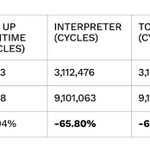
I'm trying to reproduce the famous 800x overhead and this is currently impossible because the source code of the benchmarks is not unavailable although the paper states it is.
This is my investigation so far: ethereum-magicians.org/t/lon…


By the way, the recent @VitalikButerin proposal around replacing the EVM with RISC-V was based on results we found in this paper about the 800x provability overhead of EVM in SP1.
Some numbers from the paper:

Ipsilon retweeted
Why don't you read the spec then? This is the Rationale section about new EXTCALL instructions' status codes. Please also check the matching specification part.
We are waiting for feedback for exactly 2 years.
eips.ethereum.org/EIPS/eip-7…

Ipsilon retweeted

There has been a lot of talk about the promise of RISC-V for Ethereum execution lately, but I don't think there has been sufficient thought about _how_ we get to that place. Here are my thoughts about how the transition could work and how EOF fits in.
notes.ethereum.org/@ipsilon/…

Ipsilon retweeted

The EVM Object Format (EOF) is a long-awaited upgrade for the EVM. We wrote about our stance in support of it.
Topics to expect in the post:
✧ Benefits of EOF
✧ Is EOF the only way?
✧ Can we solve "Stack Too Deep" without EOF?
✧ Why not EIP-615/EIP-2315?
✧ Do we really need immediate arguments?
...and more!
Give it a read.
→soliditylang.org/blog/2025/0…
Ipsilon retweeted
ICYMI, a major benefit that the experimental EOF support already provides is the elimination of "Stack Too Deep" errors using the SWAPN and DUPN opcodes.
This will make the Yul to EVM transformation in compilation via IR simpler and more efficient.
🔗soliditylang.org/blog/2025/0…

We are thrilled to release Solidity v0.8.29!
This version of the compiler brings support for EVM Object Format (experimental), custom storage layouts, ethdebug, and more.
📝 Blog: soliditylang.org/blog/2025/0…
💾 GitHub: github.com/ethereum/solidity…
Follow along for notable features 🧵↓

ALT Solidity version 0.8.29 GitHub Release
Ipsilon retweeted
We are thrilled to release Solidity v0.8.29!
This version of the compiler brings support for EVM Object Format (experimental), custom storage layouts, ethdebug, and more.
📝 Blog: soliditylang.org/blog/2025/0…
💾 GitHub: github.com/ethereum/solidity…
Follow along for notable features 🧵↓
ALT Solidity version 0.8.29 GitHub Release
Ipsilon retweeted
EOF Devnet-2+ will contain mostly "additive" features that are Quality of Life oriented and addressing gaps identified by the community.
These EIPs are listed in priority order. If we need to start getting in ship mode every EIP not yet in a devnet can be deferred.
Ipsilon retweeted
EOF Devnet-1 fixes some spec issues that were cut from prague as the were only "nice to have." Nothing major, just a few items we don't want to see in a hypothetical "EOF Quirks" talk.
Compilers and Developer tooling should start targeting the devnets here, because at this point the spec will mostly freeze, allowing only "additive" changes" and (barring serious bugs) no more breaking changes.
Ipsilon retweeted
Here's the EOF devnet plan that was discussed on Wednesday's EOF call - notes.ethereum.org/@ipsilon/…
Devnet-0 is what would have shipped with Prague, just awaiting full devnet setup.

Ipsilon retweeted

We do need better cause prioritization in ethereum core dev.
Like, if I had to choose between (i) the blob target increase from 3 to 6 and (ii) literally everything else in Pectra, I would choose (i).
What's the equivalent for Fusaka and G*?
(Obviously a big part of the answer is: blobs and blobs, though I think L1 EVM improvements are important too, my favorites are EOF -> full AA via 7701 and SIMD+EVMMAX plus moderate gas limit increases)
We're doing peerdas. Maybe explore more ambitious versions of peerdas eg. notes.ethereum.org/NgKvvYiAQ… ?
Ipsilon retweeted

EOF is separating the code from data, and bringing more structure to EVM contracts. The upcoming update affects the EVM tooling and makes things easier for many.
Let’s understand what this means for source code verification and how @sourcifyeth aims to leverage and improve EOF.

What's happening in technical terms when a contract is being verified?
Check out our new technical walkthrough post to learn about the process with examples
docs.sourcify.dev/blog/techn…

Ipsilon retweeted

why not check for yourself? It's not that hard to keep up with the activities of EF teams, as most of it happens in the open:
- Applied Research Group hosts ACDC and posts actively on ethresearch, and both @ralexstokes and @mikeneuder are active here and in various other community forums
- The Account Abstraction team contributes to many repos & EIPs (e.g. 4337, 7702), and their contribution will be obvious to anyone who works on wallets or has touched AA over the years - @yoavw is the right person to follow here
- Consensus R&D is also very active (contributing to community calls and on ethresearch), and people on this team like @dankrad and @drakefjustin are similarly pretty vocal and open about their work
- Cryptography Research publishes their work here: crypto.ethereum.org/research
- Devcon's work product probably speaks for itself. This week some of the team are busy with site visits for next year.
- @austingriffith's work on developer growth is similarly very public, follow @buidlguidl as well if you want to keep up.
- The Ecodev coordinators team is more of a support function for other teams, and their outputs are usually bundled with the work of other teams (e.g. helping raising money for important initiatives like the recent security attackathon, or helping improve EthMagicians, etc)
- @EF_ESP manages the entire grants apparatus of the EF, including regular inbound through the open program and they publish quarterly recaps on the blog + info on their website regularly (esp.ethereum.foundation/)
- @ethdotorg's work is similarly visible and easy to follow along with on github github.com/ethereum/ethereum…
- @go_ethereum's work is also all available on github github.com/ethereum/go-ether…, and obviously you will see geth team members on many ACDE calls and similar forums
- @teamipsilon's work is also very easy to follow on github github.com/ipsilon
- @EFJavaScript is the same github.com/ethereumjs
- @EFNextBillion publishes their work here nxbn.ethereum.foundation/
- @ethPandaOps is well known for their high rate of output and value to the ecosystem, you can learn more about them here: ethpandaops.io/
- Portal Network you can also follow along on github github.com/ethereum/portal-n…
- Privacy & Scaling Explorations (more of a group of teams than a single team) publish tons of info about their work here pse.dev/, and you can find the github repos of various PSE projects on that site
- Protocol Security's work and output is also very obvious to people involved in this domain - more about the team here github.com/ethereum/protocol…, and follow @fredriksvantes who leads the team if you want to see regular updates
- Protocol Support's work is also very visible (e.g. running ACDE, running the Ethereum Protocol Fellowship (github.com/eth-protocol-fell…), and lots more) and @TimBeiko is obviously the easy follow here.
- @EthereumRemix's work is also very public github.com/ethereum/remix-pr…
- Robust Incentives Group publishes info about their work on their website here rig.ethereum.org/, follow @barnabemonnot if you want to keep up
- Snake Charmers (i.e. Python) team also works in the open, blog posts here snakecharmers.ethereum.org/ and their work is spread across a few different repos like github.com/ethereum/web3.py, github.com/ethereum/eth-util…, and several others
- The Specs & Testing team manages much of the extensive testing and spec work to ensures that each hard fork upgrade to Ethereum goes off without any issues - their work is most visible to those close to protocol upgrades, but you can learn more here github.com/ethereum/tests and here blog.ethereum.org/2023/08/29…
That's every team at the EF, aside from ones that are already spinning out (see @argotorg) and operational functions like legal, finance, people ops, devops, and opsec which are together ~20 people. We have a pretty thin operational layer for an org of ~250 people.
Ipsilon retweeted
EIP-7830 allows for 64k EOF contracts, which costs somewhere north of 13m gas to deploy. That would be as large as should reasonably be deployed, unless we do something like raise the block gas limit above a 15m target.

Do you hate the 24k contract size limit on Ethereum?
How about 64k? That should be enough for everyone 😂
eips.ethereum.org/EIPS/eip-7…

Ipsilon retweeted

I had a hard time understanding how EOF bytecode is structured.
That's why I created a tool to visualize the containers 🙂 eof.wtf/
It's still not fully complete tho. Let me know what else you'd like to see in the tool.

Do you wonder how EOF contracts look like dissected?
This extremely handy tool from @kaanuzdogan does that very well: eof.wtf/