

https://teapaw.org/t.co/0wDzO6yeUf https://teapaw.org/t.co/fJwn0gZZyb
#techdhaba
Joined November 2020
- Tweets1.3K
- Following824
- Followers66
- Likes500




Pinned Tweet
Check out my latest article: 🧠 How to Debug a Linux Device Driver (Step-by-Step): The Kernel-Truth Playbook linkedin.com/pulse/how-debug… via @LinkedIn

Check out my latest article: 🔌 One Hardware, Two Worlds: Linux Driver vs FreeRTOS Driver linkedin.com/pulse/one-hardw… via @LinkedIn
Check out my latest article: 🗺️ ioremap(): The Memory Mapping Magic That Makes Hardware Access Possible linkedin.com/pulse/ioremap-m… via @LinkedIn

Check out latest article: 🚀 Device Tree (.dts): The Hidden Language Between Hardware and Linux linkedin.com/pulse/device-tr… via @LinkedIn

Check out my latest article: 🗂️ The Linux Virtual Filesystems Trinity: sysfs, procfs, debugfs (VFS Foundation) linkedin.com/pulse/linux-vir… via @LinkedIn

Check out my latest article: 🗄️ File System Drivers: The Unsung Heroes Between Your App and the Disk linkedin.com/pulse/file-syst… via @LinkedIn

Your pointer is a stranger to the kernel.
User space buffers are UNTRUSTED.
Kernel memory is SACRED.
So Linux uses two bodyguards:
• copy_from_user()
• copy_to_user()
No direct dereference.
No blind trust.
Only validated crossing.
#Linux #Kernel #OSInternals


Most embedded bugs don’t happen in main().
Flash = blueprint (truth)
RAM = live execution state
Every reset rebuilds RAM from Flash.
Get .data, .bss, stack, or heap wrong → bugs before main(). Master the map.
#EmbeddedSystems #BareMetal
linkedin.com/pulse/mcu-memor… via @LinkedIn

From Power-On to main() -Embedded System Boot Process (Step-by-Step | Ex... youtu.be/OnWR1RXjAFw?si=eCaF… via @YouTube
Most embedded bugs happen before main() ever runs.
Your code doesn’t start at main().
It starts at the Reset Vector → startup code initializes stack, .data, .bss, clocks → then jumps to main().
#EmbeddedSystems #BareMetal #Microcontrollers #StartupCode #ResetVector


Bare-metal works… until it doesn’t.
FreeRTOS gives you task isolation, deterministic scheduling, and control over timing—critical when systems grow beyond a while(1) loop.
#FreeRTOS #EmbeddedC #RTOS #FirmwareEngineering #techdhaba


Check out my latest article:
🚀 From Tier-3 College / Service Company ➝ Product Engineering — The Road Nobody Talks About
linkedin.com/pulse/from-tier…
#TransformYourCareer #EmbeddedSystems #FirmwareEngineering
#RTOS #LinuxKernel #DeviceDrivers
#Semiconductor #SoC #TECHDHABA

🚀 Your Code Isn’t the First Thing That Runs — The Truth About ARM Cortex...
youtu.be/Op7KVX5cZ6E?si=zJKz… via @YouTube
#RTOS #BareMetal #SystemProgramming
#Firmware #Bootloader #Microcontrollers
Boot isn’t “load Linux.”
It’s staged SoC bring-up:
ROM → TPL → SPL → TF-A → OP-TEE → U-Boot → Linux. Each stage stabilizes clocks, DRAM, ELs, power, and trust. Break one link - unstable or insecure platform.
Master the boot chain - platform engineer.
#Bootloader #TechDhaba


Booting a real ARM SoC is not just “ROM → U-Boot → Linux”.
It’s a secure, multi-stage chain:
ROM → TPL → SPL → TF-A → OP-TEE → U-Boot → LinuxBootloaders are silicon bring-up + trust anchors.
Get the boot chain wrong, Linux never runs.
hosturl.link/EOfhHg


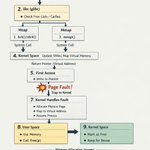
malloc() doesn’t give you memory. It gives you an illusion of memory.
Real RAM is allocated later, on a page fault.
User space → glibc → kernel → page tables → RAM
Once you see this, Linux memory makes sense. 🧠
#Linux #CProgramming #malloc
youtu.be/GgF_yaRgF_E?si=HCh3…
🧠 From C code → libc → kernel → page tables → RAM
This is how software really touches hardware.
#CProgramming #Linux #SystemsProgramming #MemoryManagement #malloc #LowLevel #Debugging
linkedin.com/posts/techdhaba…


techdhaba retweeted

#LearnEmbedded 🎓 "FPGA Design for Embedded Systems Specialization"
Decode the Secrets of the #FPGA in Embedded Systems. Enhance career opportunities and build better systems by acquiring skills in FPGA design
👉 coursera.org/specializations…
📌 #EmbeddedSystems #Semiconductor
