
Electronics projects with legs.
Joined September 2010
- Tweets258
- Following87
- Followers1.4K
- Likes26




This is a PCB version of my AVR16EB28-based digital signal generator. It generates a crystal-accurate square wave of from 2Hz to 33.5MHz in precise steps of 2Hz. You can enter an exact frequency, or adjust the frequency continuously using a rotary encoder: tinyurl.com/yc4ky7tv

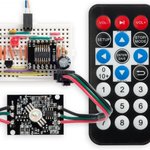
This is a NeoPixel driver based on a Microchip AVR16DD20 that fits on a small USB-C dongle. It lets you control NeoPixel LEDs using an infrared remote control: technoblogy.com/show?5O8R

This digital signal generator, based on an AVR16EB28, generates a crystal accurate square wave of from 2Hz to 33.5MHz in precise steps of 2Hz. You can enter an exact frequency, or adjust the frequency continuously using a rotary encoder: technoblogy.com/show?5Q7F

This circuit lets you control a set of one or more high-power NeoPixel RGB LEDs with an infrared remote control. It's based on an AVR64DD14 and a TSOP38238 IR receiver: technoblogy.com/show?5H4W

Here's a simple HSV to RGB function that can be expressed in a single line of C, as demonstrated by this plot of hue against saturation: technoblogy.com/show?3Z49

Here is an improved version of my TinyCard project, a simple text game maker to allow children to create short adventure games, interactive stories, surveys, or quizzes. It's based on a 160x128 colour TFT display and a Microchip ATtiny3224: technoblogy.com/show?54EI

My Universal TFT Display Backpack is a microcontroller board based on a Microchip ATtiny814 that can accommodate a range of different Adafruit and AliExpress colour TFT displays: technoblogy.com/show?5O3E

I built a Feather-format board based on the new ESP32-P4, a dual-core RISC-V processor running at up to 400MHz, with 768KB of on-chip SRAM, 32Mbytes of on-chip PSRAM, and up to 32Mbytes of external flash: technoblogy.com/show?5AII

Light Lab allows you to display different patterns on RGB LED NeoPixel (WS2812 or WS2812B) or DotStar (APA102 or SK9822) strips, and experiment with them: technoblogy.com/show?5DCO

This USB-C Power Delivery Dongle delivers one of six fixed voltages from a USB-C power adapter that supports Power Delivery: technoblogy.com/show?5729

The Bauble is a spherical festive decoration, based on an AVR32DD28, with 16 coloured LEDs that you can program to flash in different patterns: technoblogy.com/show?4O86

This simple continuity tester, based on an ATtiny202, a piezo buzzer, and an LED, is ideal for checking circuit wiring, or tracing out the tracks on a PCB: technoblogy.com/show?5DEV

This final article in the series shows how to fit my hardware driver for NeoPixel (WS2812) LED displays onto the 14-pin AVR64DD14 by taking advantage of the Event System on AVR processors: technoblogy.com/show?5CC0

This article shows how to eliminate most of the interconnections between pins on my hardware driver for NeoPixel (WS2812) LED displays by taking advantage of the Event System on AVR processors: technoblogy.com/show?5BQG

My latest project is a driver for NeoPixel (WS2812) LED displays using AVR hardware. It works by combining the SPI peripheral with a Timer/Counter using Configurable Custom Logic (CCL): technoblogy.com/show?5BGM

The Walkie-Textie is a simple handheld device, based on an ATtiny814, that allows you to send and receive text messages using a 12-key keypad and OLED display: technoblogy.com/show?2AON

My latest project is a Feather-format board based on the Microchip AVR128DA32. It runs at 24MHz, has 16KB of RAM and 128KB of flash, and runs uLisp: technoblogy.com/show?3V6B

This is a simple LED tester, based on an ATtiny85 or ATtiny202, that provides a convenient way of testing most types of through-hole or surface-mount LEDs: technoblogy.com/show?53Z6

For a more relaxed approach to life the Timescale Clock displays the time as a scrolling scale on two bi-colour dot matrix displays; see technoblogy.com/show?55KG

My latest project, TinyCard, is a simple text game maker to allow children to create short adventure games, interactive stories, surveys, or quizzes: technoblogy.com/show?51KR
