





Pinned Tweet
Renaiss @renaissxyz /39
Review of Visiting the Renaiss Booth at KOREA CARD CULTURE FAIR (KCCF)
The excitement surrounding TCGs is booming worldwide these days, and Korea is no exception 🔥🔥
Trading card shows are held in Korea on a weekly or monthly basis.
Among them, the KOREA CARD CULTURE FAIR (KCCF), which was recently held in Seoul, is organized by Daewon Media, a company that manages Korean licensing businesses for a wide range of global IPs
Compared to other trading card shows, KCCF is noticeably larger in scale and features a greater number of official events and activities!
As expected from such a popular card show, an enormous number of people attended. I arrived 20 minutes before the event opened, but I still had to wait two and a half hours before I was finally able to enter. It was honestly exhausting😔, but I was willing to wait because I wanted to visit the Renaiss booth and participate in various activities, including the Vinch World event
I visited the official Korean One Piece TCG booth as well as several booths operated by local card shops, but the most memorable booth was, without a doubt, Renaiss
A large number of visitors lined up to participate in the events hosted by Renaiss, and I eagerly joined the queue myself.
The Renaiss booth was divided into two main sections: a retail area selling cards and ETBs, and the Vinch World event area.
The retail section displayed products in multiple languages, including Korean, English, Japanese, and Chinese.
The variety of products on display was more than enough to attract the attention of visitors passing by.
The next section was the Vinch World event area, which was the clearest point of differentiation between the Renaiss booth and the other booths at the event.
Visitors could participate in Vinch World quiz events, such as guessing Pokémon names and finding the different character, and receive gacha tickets as rewards.
These tickets could then be exchanged for various prizes ranging from graded cards to booster packs.
I found the 'find the different character' activity particularly interesting
It felt like a very smart strategy for introducing the names Renaiss and Vinch World to Web2 TCG players who had never heard of them before and making those names stick in their minds
I received two gacha tickets through the event, and the result was... Two C-rank prizes 😭
It seems that I'm just unlucky in both Web3 Renaiss and Web2 Renaiss... Still, I was very happy to receive free card packs 🥰🥰
Another thing that stood out was that many of the people welcoming and assisting visitors at the booth were members of the Renaiss community.
Considering the sheer number of visitors they had to interact with throughout the day, they were probably exhausted. Nevertheless, they continued greeting everyone with bright smiles.
I imagine that many visitors came away with a positive first impression of Renaiss thanks to these community members
After returning home, I watched some YouTube videos and noticed that a well-known Korean YouTuber had also visited the Renaiss booth. In the video, they looked through the cards being sold, talked with fellow collectors, and participated in the booth's events.
It was fun to see Renaiss again on YouTube after having experienced it in person.


Renaiss @renaissxyz /38
Renaiss is coming to Korea’s card show!
- Dates: June 6–7
- Venue: KccF (Seoul aT Center)
A variety of exciting offline events will be available on-site! (More details below)

Rialo Quiz 28.0 #10
@RialoHQ @RialoKorea
The long-term vision described is to build systems that are:
1️⃣ Fully centralized
2️⃣ Disconnected from real-world data
3️⃣ Simple, seamless, and deeply integrated with real life
4️⃣ Limited to financial trading only
The answer is 3️⃣ Simple, seamless, and deeply integrated with real life.
The key point here is that a real-world blockchain is not simply a blockchain that can store real-world assets.
For blockchain systems to become part of everyday applications, the technology needs to connect with the systems and information that already exist outside the chain.
Real-world applications can involve:
• Real-time external data
• Identity
• Privacy
• Compliance
• Web2 services
• Financial assets
• Cross-chain activity
• Automated execution
• Complex application workflows
This creates a much broader set of requirements than simply executing a smart contract after a user submits a transaction.
Rialo's architecture is designed around this broader connection.
Stream provides native data feeds for applications such as DeFi and RWAs.
Edge enables bidirectional interaction between Web2 and blockchain environments without relying on additional middleware for that connection.
IPC makes identity, privacy, and compliance first-class capabilities.
Interop provides native interoperability across networks.
Then Execution Engine and Workflow connect these capabilities to conditional execution and more complex automated processes.
This also connects with Rialo's work on Reactive Transactions and Async Transactions.
Reactive Transactions allow blockchain logic to respond to conditions based on time, value, or data.
Async Transactions allow execution to pause for an offchain operation and automatically resume when the required condition is satisfied.
Together, these capabilities allow blockchain applications to be designed around events and real-world processes rather than only around manual transaction submission.
The same principle appears in Rialo's enterprise use cases.
Tokenized deposits can involve identity, entitlements, policy checks, settlement, redemption, and reconciliation.
Tokenized collateral can involve eligibility rules, real-time evaluation, automated substitution, and haircut calculations.
Onchain credit can encode credit agreements and programmatic covenant determination.
RWA applications can involve investor identity, accreditation, governance, transfer compliance, and asset lifecycle events.
These are not isolated blockchain transactions.
They are real-world workflows that involve multiple systems, rules, data sources, and participants.
That is why the long-term vision in this quiz is not about removing smart contracts, eliminating identity, or limiting blockchain to financial trading.
The direction is toward systems where blockchain infrastructure can become part of applications people actually use, while remaining connected to real-world data, services, identities, assets, and processes.
So the answer is:
3️⃣ Simple, seamless, and deeply integrated with real life.
And that connects directly to Rialo's broader vision of a real-world blockchain: not blockchain separated from everyday systems, but infrastructure designed to connect real-world data and processes with onchain execution, making blockchain a functional part of real-life applications and workflows.
🤝 Paid partnership · 🤖 Made with AI

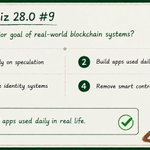
Rialo Quiz 28.0 #9
@RialoHQ @RialoKorea
What is a major goal of real-world blockchain systems?
1️⃣ Focus only on speculation
2️⃣ Build apps used daily in real life
3️⃣ Eliminate identity systems
4️⃣ Remove smart contracts
The answer is 2️⃣ Build apps used daily in real life.
Blockchain applications have often been built around crypto-native activities such as trading, transferring tokens, and interacting with DeFi protocols.
But a real-world blockchain system has a broader requirement.
It needs to support applications that can interact with the systems people already use in everyday life.
That means connecting onchain infrastructure with:
Real-world data → Real-world assets → Identity → Compliance → Web2 systems → Financial activity
This is particularly important when blockchain moves into areas such as regulated finance and RWAs.
A tokenized real-world asset still depends on information from outside the blockchain.
A financial application may need identity and eligibility checks.
A regulated transaction may need compliance rules to be evaluated before execution.
And users may still need to interact with familiar Web2 services and interfaces.
This is where Rialo's architecture connects with the idea of a real-world blockchain.
Rialo Stream provides native data feeds for DeFi and RWAs, allowing real-world information to become available onchain.
Rialo Edge provides bidirectional interaction between Web2 and blockchain environments.
Rialo IPC treats identity, privacy, and compliance as first-class capabilities.
Rialo Interop provides native interoperability across networks.
Then Execution Engine and Workflow connect information and conditions to actual onchain execution and automated workflows.
This creates a different application flow from a purely crypto-native system.
Instead of:
User → Wallet → Token → Transaction
a real-world application may look more like:
Real-world event/data → Onchain information → Verification → Decision → Execution → Settlement
That architecture matters because everyday applications don't operate in isolation.
They depend on external information, identities, organizations, financial systems, and events.
Rialo's enterprise use cases reflect this direction as well, including tokenized deposits, tokenized collateral, onchain credit, RWA tokenization, and real-time compliance.
The objective is therefore not simply to put existing crypto activities on another blockchain.
It is to provide infrastructure capable of supporting applications connected to real-world systems and use cases.
So the answer is:
2️⃣ Build apps used daily in real life.
And this connects directly to Rialo's core idea of a real-world blockchain: connecting blockchain infrastructure with real-world data, assets, identity, compliance, Web2 systems, and automated execution so that onchain applications can operate as part of real-world workflows.

1
65
Renaiss Questline Season 4 - 3
이번에는 @renaissxyz 의 renaiss fair에 대해 알아봅시다!
Renaiss에서 진행하는 가차 서비스의 공정함을 시스템을 통해 확인할 수 있는 건데여
제가 뿁은 카드는 아니지만, fair에서 트잭 해쉬값을 입력하면, 어떤 경로로 이 카드가 뽑혔는 지 투명하게 확인할 수 있다는 게 넘 좋네요!
🤝 Paid partnership · 🤖 Made with AI


Fairness isn't a slogan. It's the bar.
Every pull should answer two questions. Was the set packed fairly? Was the draw decided before you paid?
Renaiss Fair answers with math, not promises.
Build. An open-source algorithm builds every set by published rules. Same inputs, same set.
Seal. Every card is hashed into one Merkle root, on-chain before the first draw. Swap a single card and the root no longer matches.
Draw. The seed comes from a block that doesn't exist until you've paid. Not even Renaiss can know the result in advance. One seed, one exact card.
The code is public. The data is on-chain. Anyone can verify and replay every pull.
Fairness shouldn't be believed. It should be verified.
1
3
73
Renaiss Questline Season 4 - 2
지난 번에 Surf 써봤는데, 괜찮길래 이번에도 써봤습니다,,
이번에는 @renaissxyz Earn에 대해 알아봤습니다,,
Renaiss Earn은 단순 예치 상품이 아니라 유동성을 사고파는 옵션 상품이라고 하는데여,,
라운드가 열릴 때 마다 인기가 많는 것으로 알고 있어여!
그럼에도 불구하고 지금보다 더 인기가 많아지기 위해선,, 아무래도 APY가 더 오르면 사람들의 관심이 더 쏠릴 것 같네요!
🤝 Paid partnership · 🤖 Made with AI

Renaiss Questline Season 4 - 1
SurfAI에 @renaissxyz 관련해서 물어봤습니다!
그냥 물어본 것도 아닌 무려 딥 리서치로 물어봤는데여
Renaiss의 원대한 비전에 대해 아주 딥하게 알 수 있었습니다,,!
Surf 오랜만에 써봤는데 성능 좋네여

1
4
94
Renaiss Questline Season 4 - 1
SurfAI에 @renaissxyz 관련해서 물어봤습니다!
그냥 물어본 것도 아닌 무려 딥 리서치로 물어봤는데여
Renaiss의 원대한 비전에 대해 아주 딥하게 알 수 있었습니다,,!
Surf 오랜만에 써봤는데 성능 좋네여
🤖 Made with AI
Renaiss Questline Season 3 - 4
@renaissxyz 시즌 3의 마지막 미션은...
르네이스 커뮤니티에서 기억 남는 순간!
매번 르네이스 오프라인 밋업을 갈때마다 디스코드에서 보던 분들과 실제로 얘기하며 르네이스 커뮤니티에 소속감을 느끼고 있답니다!
그렇기에 이번주에 예정된 르네이스 행사들도 매우 기대되네요!!

Rialo Quiz 28.0 #9
@RialoHQ @RialoKorea
What is a major goal of real-world blockchain systems?
1️⃣ Focus only on speculation
2️⃣ Build apps used daily in real life
3️⃣ Eliminate identity systems
4️⃣ Remove smart contracts
The answer is 2️⃣ Build apps used daily in real life.
Blockchain applications have often been built around crypto-native activities such as trading, transferring tokens, and interacting with DeFi protocols.
But a real-world blockchain system has a broader requirement.
It needs to support applications that can interact with the systems people already use in everyday life.
That means connecting onchain infrastructure with:
Real-world data → Real-world assets → Identity → Compliance → Web2 systems → Financial activity
This is particularly important when blockchain moves into areas such as regulated finance and RWAs.
A tokenized real-world asset still depends on information from outside the blockchain.
A financial application may need identity and eligibility checks.
A regulated transaction may need compliance rules to be evaluated before execution.
And users may still need to interact with familiar Web2 services and interfaces.
This is where Rialo's architecture connects with the idea of a real-world blockchain.
Rialo Stream provides native data feeds for DeFi and RWAs, allowing real-world information to become available onchain.
Rialo Edge provides bidirectional interaction between Web2 and blockchain environments.
Rialo IPC treats identity, privacy, and compliance as first-class capabilities.
Rialo Interop provides native interoperability across networks.
Then Execution Engine and Workflow connect information and conditions to actual onchain execution and automated workflows.
This creates a different application flow from a purely crypto-native system.
Instead of:
User → Wallet → Token → Transaction
a real-world application may look more like:
Real-world event/data → Onchain information → Verification → Decision → Execution → Settlement
That architecture matters because everyday applications don't operate in isolation.
They depend on external information, identities, organizations, financial systems, and events.
Rialo's enterprise use cases reflect this direction as well, including tokenized deposits, tokenized collateral, onchain credit, RWA tokenization, and real-time compliance.
The objective is therefore not simply to put existing crypto activities on another blockchain.
It is to provide infrastructure capable of supporting applications connected to real-world systems and use cases.
So the answer is:
2️⃣ Build apps used daily in real life.
And this connects directly to Rialo's core idea of a real-world blockchain: connecting blockchain infrastructure with real-world data, assets, identity, compliance, Web2 systems, and automated execution so that onchain applications can operate as part of real-world workflows.
🤝 Paid partnership · 🤖 Made with AI
Rialo Quiz 28.0 #8
@RialoHQ @RialoKorea
What does real-world programmability enable?
1️⃣ Static smart contracts only
2️⃣ Event-driven and resumable contract logic
3️⃣ Manual contract execution
4️⃣ Off-chain only computation
The answer is 2️⃣ Event-driven and resumable contract logic.
Traditional smart contracts are generally designed around transactions.
A user or another system submits a transaction, the blockchain executes the contract logic, and the resulting state is updated.
But real-world applications often work differently.
Events happen independently of a user's immediate interaction.
A specific time arrives.
A price reaches a certain level.
External data changes.
An offchain operation finishes.
For these applications, the important question becomes:
Can the blockchain react when the required condition actually occurs?
This is where event-driven logic becomes important.
Instead of relying entirely on someone to monitor the condition and submit another transaction, the application can define conditions under which execution should take place.
This connects directly to Rialo's Reactive Transactions.
Rialo describes reactive transactions as conditional and time-based execution built directly into the blockchain.
The predicate can be based on time, value, or data, and validators evaluate the predicate deterministically at the end of each block.
That means the blockchain can evaluate whether the condition for an action has been satisfied as part of its execution process.
There is another side to real-world programmability:
What happens when the required information or operation isn't immediately available?
This connects to Async Transactions.
Rialo's async transaction model allows a transaction to pause while waiting for an offchain operation and then automatically resume once the required condition is met.
So the workflow is no longer limited to:
Submit → Execute → Finish
It can instead involve:
Execute → Wait → Receive required information → Resume → Complete
This is particularly relevant when blockchain applications need to interact with systems outside the chain.
It also connects with Rialo Workflow and the Execution Engine, which extend these ideas into more complex event-driven and conditional workflows.
Together with Stream, which provides native data feeds for DeFi and RWAs, the architecture can connect external information with onchain execution.
This is what makes “real-world programmability” different from simply putting more logic inside a smart contract.
The contract can become part of a workflow that responds to events, time, data, and external operations.
So the answer is:
2️⃣ Event-driven and resumable contract logic.
And this connects directly to Rialo's Reactive Transactions, Async Transactions, Execution Engine, Workflow, and Stream, which provide the infrastructure for onchain logic to react to real-world events and resume execution when external conditions or operations are ready.

Why would Rialo place more trust in markets with more information?
@RialoHQ @RialoKorea
More information doesn't automatically mean more accuracy.
What matters is whether the information is relevant, timely, and verifiable.
For a market, especially a Prediction Market or financial market, the outcome depends on having enough reliable information to understand what is actually happening in the real world.
A simple way to look at it is:
More relevant data → Better context → Better verification → More reliable decisions
Rialo's architecture is built around bringing real-world information into the onchain environment.
External data can be collected and pre-processed before being delivered through native data infrastructure such as Rialo Stream. Verification can then be used to check the integrity of relevant updates.
This matters because a market shouldn't rely on a single isolated piece of information when the underlying event or asset has a broader information environment.
For example, financial markets continuously change as new data arrives. Prices, market conditions, risk information, and other signals can all contribute to understanding the current state of an asset.
The same principle applies to Prediction Markets.
The market price comes from trading activity, but determining the final outcome requires information about the real-world event.
More relevant information can provide more context for that process, while verification helps distinguish reliable updates from information that shouldn't be trusted.
So the important relationship isn't simply:
More information = more trust
It's closer to:
More relevant information + verification → stronger information basis for market decisions
This connects to Rialo's broader goal of connecting real-world data with onchain markets.
The value isn't in having the most data possible.
It's in turning relevant, timely, and verifiable information into something that onchain applications can actually use..
🤝 Paid partnership · 🤖 Made with AI

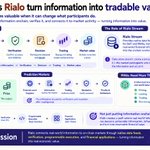
How does Rialo turn information into tradable value?
@RialoHQ @RialoKorea
Information by itself isn't necessarily an asset.
Its value emerges when it can be reliably connected to an application, a decision, and eventually a financial transaction.
Rialo's architecture creates a path for that to happen:
Real-world data → Data Feed → Verification → Onchain State → Financial Application → Market Activity
Real-world financial information can come from external sources, but simply bringing data onchain isn't enough.
It needs to be timely, usable, and verifiable before applications can rely on it.
This is where Rialo Stream fits in, providing native data feeds for DeFi and RWAs. The broader infrastructure then connects that information with programmable execution and financial applications.
Once the information becomes part of the onchain state, it can influence what applications and market participants do.
A change in market data can affect pricing.
Pricing can affect trading.
Trading creates market activity.
And market activity can turn information about the real world into an observable financial value.
This is especially relevant for RWAs.
A tokenized stock, commodity, credit instrument, or other real-world asset isn't useful simply because it has an onchain representation. Its value still depends on information about the underlying asset and the market around it.
So the process is less about “putting information onchain” and more about making information usable within financial systems.
Data → Information → Decisions → Transactions → Market Value
That is the information value chain Rialo's infrastructure is designed to connect.

2
57
How does Rialo turn information into tradable value?
@RialoHQ @RialoKorea
Information by itself isn't necessarily an asset.
Its value emerges when it can be reliably connected to an application, a decision, and eventually a financial transaction.
Rialo's architecture creates a path for that to happen:
Real-world data → Data Feed → Verification → Onchain State → Financial Application → Market Activity
Real-world financial information can come from external sources, but simply bringing data onchain isn't enough.
It needs to be timely, usable, and verifiable before applications can rely on it.
This is where Rialo Stream fits in, providing native data feeds for DeFi and RWAs. The broader infrastructure then connects that information with programmable execution and financial applications.
Once the information becomes part of the onchain state, it can influence what applications and market participants do.
A change in market data can affect pricing.
Pricing can affect trading.
Trading creates market activity.
And market activity can turn information about the real world into an observable financial value.
This is especially relevant for RWAs.
A tokenized stock, commodity, credit instrument, or other real-world asset isn't useful simply because it has an onchain representation. Its value still depends on information about the underlying asset and the market around it.
So the process is less about “putting information onchain” and more about making information usable within financial systems.
Data → Information → Decisions → Transactions → Market Value
That is the information value chain Rialo's infrastructure is designed to connect.
🤝 Paid partnership · 🤖 Made with AI
How does Rialo’s Information Value turn into market prices?
@RialoHQ @RialoKorea
Information only becomes useful to a market when it can affect decisions.
A real-world financial asset has a continuously changing state: price, market conditions, risk, liquidity, and other relevant data.
Rialo’s architecture is designed to bring this information into an onchain environment through real-time data feeds.
The basic flow can be thought of as:
Real-world data → Data Feed → Onchain State → Market Activity → Price
The key point is that the information itself does not set the market price.
Instead, verified and timely information becomes available to applications and market participants. Traders can then respond to that information through buying, selling, lending, or other financial activity.
For example, if new information changes how participants value an asset, their trading decisions can change. Those decisions affect supply and demand, and the resulting market activity produces a new price.
This is especially important for RWAs.
Tokenizing an asset is only the beginning. The onchain representation needs access to information about the underlying asset and its market if it is going to support pricing, trading, lending, or risk management.
Rialo Stream provides native data feeds for DeFi and RWAs, while the broader architecture connects that information with execution and financial applications.
So the relationship isn't:
Information = Price
It's:
Information → Decisions → Market Activity → Price
Rialo's role is to make the first part of that chain—bringing real-world information into an onchain environment—part of the infrastructure itself.
🤝 Paid partnership · 🤖 Made with AI
Why does Rialo care about Information Value?
@RialoHQ @RialoKorea
Not all information has the same value to a market.
In a real-time financial system, information becomes useful when it can change how participants understand an asset or an event.
A new price update, a change in buying and selling pressure, or a shift in market momentum can all provide information that traders may respond to.
This is where the idea of Information Value becomes important.
For a Prediction Market, the value of information comes from its ability to change expectations.
Before new information arrives, participants have one set of expectations.
After relevant information becomes available, those expectations may change.
That change can then appear through trading activity and ultimately in the market price.
New information → changing expectations → trading → price discovery
This connects directly with Rialo's real-time data infrastructure.
Rialo uses external data sources to provide live financial feeds, while pre-processing helps filter and improve the quality of incoming information.
The system then makes this information available through live-updating market data, including the 1,337 tickers representing real-world financial assets.
The important part isn't simply collecting more data.
It's making information available in a form that can actually be used by onchain markets.
This also connects with the Alpha and Bias signals we've looked at.
Alpha represents market momentum direction.
Bias represents the imbalance between buying and selling pressure.
These signals help describe what the market data is showing and how market conditions are changing.
Information Value also matters beyond trading.
Rialo's broader infrastructure connects real-world assets with pricing, lending, trading, risk management, Prediction Markets, Resolution, and Settlement.
Each of these processes depends on information being available at the right time and in a usable form.
For example, Prediction Markets eventually need external information to determine what happened.
Verification checks the relevant information.
Resolution determines the outcome.
Finality establishes the definitive state.
Settlement then acts on that result.
So information becomes valuable when it can move through the system and affect an actual financial process.
That's why Information Value fits into Rialo's larger architecture:
Real-world information → verified data → market activity → price discovery → onchain execution
The value isn't simply in having information.
It's in turning timely, relevant information into something an onchain market can actually use.

Rialo Quiz 28.0 #8
@RialoHQ @RialoKorea
What does real-world programmability enable?
1️⃣ Static smart contracts only
2️⃣ Event-driven and resumable contract logic
3️⃣ Manual contract execution
4️⃣ Off-chain only computation
The answer is 2️⃣ Event-driven and resumable contract logic.
Traditional smart contracts are generally designed around transactions.
A user or another system submits a transaction, the blockchain executes the contract logic, and the resulting state is updated.
But real-world applications often work differently.
Events happen independently of a user's immediate interaction.
A specific time arrives.
A price reaches a certain level.
External data changes.
An offchain operation finishes.
For these applications, the important question becomes:
Can the blockchain react when the required condition actually occurs?
This is where event-driven logic becomes important.
Instead of relying entirely on someone to monitor the condition and submit another transaction, the application can define conditions under which execution should take place.
This connects directly to Rialo's Reactive Transactions.
Rialo describes reactive transactions as conditional and time-based execution built directly into the blockchain.
The predicate can be based on time, value, or data, and validators evaluate the predicate deterministically at the end of each block.
That means the blockchain can evaluate whether the condition for an action has been satisfied as part of its execution process.
There is another side to real-world programmability:
What happens when the required information or operation isn't immediately available?
This connects to Async Transactions.
Rialo's async transaction model allows a transaction to pause while waiting for an offchain operation and then automatically resume once the required condition is met.
So the workflow is no longer limited to:
Submit → Execute → Finish
It can instead involve:
Execute → Wait → Receive required information → Resume → Complete
This is particularly relevant when blockchain applications need to interact with systems outside the chain.
It also connects with Rialo Workflow and the Execution Engine, which extend these ideas into more complex event-driven and conditional workflows.
Together with Stream, which provides native data feeds for DeFi and RWAs, the architecture can connect external information with onchain execution.
This is what makes “real-world programmability” different from simply putting more logic inside a smart contract.
The contract can become part of a workflow that responds to events, time, data, and external operations.
So the answer is:
2️⃣ Event-driven and resumable contract logic.
And this connects directly to Rialo's Reactive Transactions, Async Transactions, Execution Engine, Workflow, and Stream, which provide the infrastructure for onchain logic to react to real-world events and resume execution when external conditions or operations are ready.
🤝 Paid partnership · 🤖 Made with AI
Rialo Quiz 28.0 #7
@RialoHQ @RialoKorea
A key feature of modern blockchain UX improvement is:
1️⃣ Removing APIs
2️⃣ Adding slower confirmation layers
3️⃣ Sub-second end-to-end latency
4️⃣ Increasing gas cost volatility
The answer is 3️⃣ Sub-second end-to-end latency.
When talking about blockchain performance, TPS is often one of the first numbers people look at.
But for users and applications, throughput alone doesn't describe the actual experience.
What matters is how long it takes for an action to go from the initial request to the point where the application can actually respond.
That is end-to-end latency.
A blockchain application may involve several steps:
User action → data retrieval → transaction submission → execution → state update → application response
Even if the underlying blockchain processes transactions quickly, additional infrastructure between these steps can introduce delays.
This becomes especially important when blockchain applications interact with real-world data.
For example, a financial application may need to receive a live data feed, evaluate a condition, execute logic, update onchain state, and reflect the result to the user.
If every stage depends on separate external services, the total response time can become much longer than the blockchain's own execution time.
This connects directly to several parts of Rialo's architecture.
Rialo Stream provides native data feeds for DeFi and RWAs, bringing real-world financial information onchain.
Rialo Execution Engine supports event-driven and conditional execution.
Rialo Edge provides bidirectional Web2 interaction without middleware.
Rialo Interop provides native interoperability across networks.
And Rialo Workflow is designed for complex automated workflows.
These capabilities are connected by a common requirement:
The application needs to move information and actions through the system without unnecessary layers between them.
This is also related to the middleware problem we've looked at before.
When an application depends on separate services for data feeds, indexing, scheduling, bridging, execution, and Web2 connectivity, latency can accumulate across the entire workflow.
So improving blockchain UX is not simply about making the base chain faster.
It also means considering the complete path from the user's action or external event to the application's final response.
That is why sub-second end-to-end latency matters.
The answer is:
3️⃣ Sub-second end-to-end latency.
And this connects with Rialo's design around native data, execution, interoperability, Web2 connectivity, and automated workflows, where reducing unnecessary infrastructure layers can help make the entire application flow faster and more responsive.

Why does Rialo care about Information Value?
@RialoHQ @RialoKorea
Not all information has the same value to a market.
In a real-time financial system, information becomes useful when it can change how participants understand an asset or an event.
A new price update, a change in buying and selling pressure, or a shift in market momentum can all provide information that traders may respond to.
This is where the idea of Information Value becomes important.
For a Prediction Market, the value of information comes from its ability to change expectations.
Before new information arrives, participants have one set of expectations.
After relevant information becomes available, those expectations may change.
That change can then appear through trading activity and ultimately in the market price.
New information → changing expectations → trading → price discovery
This connects directly with Rialo's real-time data infrastructure.
Rialo uses external data sources to provide live financial feeds, while pre-processing helps filter and improve the quality of incoming information.
The system then makes this information available through live-updating market data, including the 1,337 tickers representing real-world financial assets.
The important part isn't simply collecting more data.
It's making information available in a form that can actually be used by onchain markets.
This also connects with the Alpha and Bias signals we've looked at.
Alpha represents market momentum direction.
Bias represents the imbalance between buying and selling pressure.
These signals help describe what the market data is showing and how market conditions are changing.
Information Value also matters beyond trading.
Rialo's broader infrastructure connects real-world assets with pricing, lending, trading, risk management, Prediction Markets, Resolution, and Settlement.
Each of these processes depends on information being available at the right time and in a usable form.
For example, Prediction Markets eventually need external information to determine what happened.
Verification checks the relevant information.
Resolution determines the outcome.
Finality establishes the definitive state.
Settlement then acts on that result.
So information becomes valuable when it can move through the system and affect an actual financial process.
That's why Information Value fits into Rialo's larger architecture:
Real-world information → verified data → market activity → price discovery → onchain execution
The value isn't simply in having information.
It's in turning timely, relevant information into something an onchain market can actually use.
🤝 Paid partnership · 🤖 Made with AI
Why does Rialo treat Liquidity as a core part of Prediction Markets?
@RialoHQ @RialoKorea
A Prediction Market is only as useful as the market activity behind its price.
The price is supposed to reflect what participants currently expect about an event. That requires enough buyers and sellers for new information to actually move through the market.
This is where liquidity becomes important.
When liquidity is low, a relatively small trade can cause a large price movement.
When liquidity is deeper, the market can absorb more buying and selling before the price moves significantly.
So liquidity affects how efficiently a market turns information into price.
New information → traders react → order flow changes → price adjusts
That relationship is particularly important for Rialo's Prediction Markets.
Rialo's broader infrastructure is built around real-time information, with live data sources, pre-processing, and onchain market data streaming.
But real-time information only becomes meaningful in a Prediction Market when participants can actually respond to it through trading.
Liquidity gives those participants room to express different expectations.
It also makes the market price less dependent on a small number of individual trades.
This connects with the market signals we've already looked at.
Alpha represents market momentum direction.
Bias represents the imbalance between buying and selling pressure.
Both are meaningful only when there is actual market activity behind the data.
Liquidity therefore isn't just about having more trading volume.
It's part of the market's ability to continuously absorb information, reflect changing expectations, and maintain a functioning price discovery process.
The same principle connects to Rialo's RWA vision.
If real-world financial assets are brought onchain for pricing, lending, and trading, tokenization provides the representation, real-time data provides the information, and liquidity provides the market activity.
Put together:
Assets → Data → Liquidity → Price discovery → Onchain financial activity
That's why liquidity is so closely tied to Prediction Market quality on Rialo.
It helps determine how effectively a market can transform changing information and participant expectations into a continuously updated price.

Rialo Quiz 28.0 #7
@RialoHQ @RialoKorea
A key feature of modern blockchain UX improvement is:
1️⃣ Removing APIs
2️⃣ Adding slower confirmation layers
3️⃣ Sub-second end-to-end latency
4️⃣ Increasing gas cost volatility
The answer is 3️⃣ Sub-second end-to-end latency.
When talking about blockchain performance, TPS is often one of the first numbers people look at.
But for users and applications, throughput alone doesn't describe the actual experience.
What matters is how long it takes for an action to go from the initial request to the point where the application can actually respond.
That is end-to-end latency.
A blockchain application may involve several steps:
User action → data retrieval → transaction submission → execution → state update → application response
Even if the underlying blockchain processes transactions quickly, additional infrastructure between these steps can introduce delays.
This becomes especially important when blockchain applications interact with real-world data.
For example, a financial application may need to receive a live data feed, evaluate a condition, execute logic, update onchain state, and reflect the result to the user.
If every stage depends on separate external services, the total response time can become much longer than the blockchain's own execution time.
This connects directly to several parts of Rialo's architecture.
Rialo Stream provides native data feeds for DeFi and RWAs, bringing real-world financial information onchain.
Rialo Execution Engine supports event-driven and conditional execution.
Rialo Edge provides bidirectional Web2 interaction without middleware.
Rialo Interop provides native interoperability across networks.
And Rialo Workflow is designed for complex automated workflows.
These capabilities are connected by a common requirement:
The application needs to move information and actions through the system without unnecessary layers between them.
This is also related to the middleware problem we've looked at before.
When an application depends on separate services for data feeds, indexing, scheduling, bridging, execution, and Web2 connectivity, latency can accumulate across the entire workflow.
So improving blockchain UX is not simply about making the base chain faster.
It also means considering the complete path from the user's action or external event to the application's final response.
That is why sub-second end-to-end latency matters.
The answer is:
3️⃣ Sub-second end-to-end latency.
And this connects with Rialo's design around native data, execution, interoperability, Web2 connectivity, and automated workflows, where reducing unnecessary infrastructure layers can help make the entire application flow faster and more responsive.
🤝 Paid partnership · 🤖 Made with AI
Rialo Quiz 28.0 #6
@RialoHQ @RialoKorea
Real-world identity in advanced blockchain systems may include:
1️⃣ Only wallet addresses
2️⃣ Email, SMS, and social login
3️⃣ Mining credentials
4️⃣ Hardware nodes only
The answer is 2️⃣ Email, SMS, and social login.
A wallet address can identify an onchain account, but real-world identity can involve much more than a public blockchain address.
People already use many forms of identity across Web2:
Email → SMS → Social accounts → Existing credentials
These identity systems are part of how users access applications and how services establish who is interacting with them.
As blockchain applications move beyond purely crypto-native use cases, this distinction becomes increasingly important.
Consider an RWA or financial application.
The system may need to know not only which wallet is interacting with a contract, but also whether that user or institution has the required identity, permissions, or eligibility.
This is especially relevant for regulated financial applications.
A wallet address alone does not inherently provide the same information as a real-world identity system.
This is where Rialo's IPC becomes relevant.
Rialo describes Identity, Privacy, and Compliance as first-class capabilities rather than concerns that applications have to solve entirely through external infrastructure.
This also connects with Rialo Edge, which provides bidirectional interaction between Web2 and blockchain environments without middleware.
That connection matters because real-world users don't suddenly stop using Web2 identity and communication systems when they interact with blockchain applications.
Instead, blockchain applications increasingly need to interact with the identity, systems, and services that already exist outside the chain.
This fits into the broader Rialo architecture we've been looking at:
Web2 identity and systems → Rialo → Onchain applications
For RWAs and regulated finance, the connection becomes even more important.
Identity can determine who is allowed to participate.
Compliance can determine whether an action is permitted.
Privacy can determine what information needs to remain protected.
And execution can then happen according to those conditions.
So real-world identity is not simply about attaching an email address to a wallet.
It is about giving blockchain applications a way to work with identity and access requirements that exist in the real world.
That is why the answer is:
2️⃣ Email, SMS, and social login.
And this connects directly to Rialo's IPC and Edge architecture, which bring real-world identity, privacy, compliance, and Web2 connectivity closer to the blockchain application layer.

Why does Rialo treat Liquidity as a core part of Prediction Markets?
@RialoHQ @RialoKorea
A Prediction Market is only as useful as the market activity behind its price.
The price is supposed to reflect what participants currently expect about an event. That requires enough buyers and sellers for new information to actually move through the market.
This is where liquidity becomes important.
When liquidity is low, a relatively small trade can cause a large price movement.
When liquidity is deeper, the market can absorb more buying and selling before the price moves significantly.
So liquidity affects how efficiently a market turns information into price.
New information → traders react → order flow changes → price adjusts
That relationship is particularly important for Rialo's Prediction Markets.
Rialo's broader infrastructure is built around real-time information, with live data sources, pre-processing, and onchain market data streaming.
But real-time information only becomes meaningful in a Prediction Market when participants can actually respond to it through trading.
Liquidity gives those participants room to express different expectations.
It also makes the market price less dependent on a small number of individual trades.
This connects with the market signals we've already looked at.
Alpha represents market momentum direction.
Bias represents the imbalance between buying and selling pressure.
Both are meaningful only when there is actual market activity behind the data.
Liquidity therefore isn't just about having more trading volume.
It's part of the market's ability to continuously absorb information, reflect changing expectations, and maintain a functioning price discovery process.
The same principle connects to Rialo's RWA vision.
If real-world financial assets are brought onchain for pricing, lending, and trading, tokenization provides the representation, real-time data provides the information, and liquidity provides the market activity.
Put together:
Assets → Data → Liquidity → Price discovery → Onchain financial activity
That's why liquidity is so closely tied to Prediction Market quality on Rialo.
It helps determine how effectively a market can transform changing information and participant expectations into a continuously updated price.
🤝 Paid partnership · 🤖 Made with AI
What improves when Rialo's Liquidity increases?
@RialoHQ @RialoKorea
More liquidity means there is more available capacity for buyers and sellers to trade against each other.
That changes how the market reacts to new information.
When liquidity is deeper, a single trade generally has less impact on the market price. More buying or selling activity can be absorbed before the price moves significantly.
For a Prediction Market, this matters because price is closely tied to market expectations.
New information arrives
→ traders react
→ buying and selling pressure changes
→ the market price adjusts
With more liquidity, that adjustment can happen more smoothly.
Instead of a relatively small trade causing a large price movement, the market can absorb more activity while continuously updating the price.
This also connects with the Alpha and Bias concepts we've looked at.
Alpha represents market momentum direction, while Bias represents the imbalance between buying and selling pressure.
As liquidity grows, there is more room for those market signals to develop through actual trading activity rather than being dominated by a small number of trades.
The same idea matters for Rialo's RWA infrastructure.
Rialo's tickers represent real-world financial assets, while live financial feeds keep the onchain environment connected to changing market conditions.
But tokenization is only one part of the process.
For real-world assets to become usable for pricing, lending, and trading onchain, there also needs to be a market where participants can actually interact with those assets.
More liquidity can make that interaction easier.
It can support deeper trading, smoother price formation, and better absorption of buying and selling activity.
So the relationship is fairly simple:
More liquidity → deeper markets → smoother trading → more efficient price formation
For Rialo, increasing liquidity strengthens the connection between real-world financial assets, real-time information, and active onchain markets.
That's what turns an onchain asset from something that can simply be represented into something that can actually participate in a functioning financial market.

Rialo Quiz 28.0 #6
@RialoHQ @RialoKorea
Real-world identity in advanced blockchain systems may include:
1️⃣ Only wallet addresses
2️⃣ Email, SMS, and social login
3️⃣ Mining credentials
4️⃣ Hardware nodes only
The answer is 2️⃣ Email, SMS, and social login.
A wallet address can identify an onchain account, but real-world identity can involve much more than a public blockchain address.
People already use many forms of identity across Web2:
Email → SMS → Social accounts → Existing credentials
These identity systems are part of how users access applications and how services establish who is interacting with them.
As blockchain applications move beyond purely crypto-native use cases, this distinction becomes increasingly important.
Consider an RWA or financial application.
The system may need to know not only which wallet is interacting with a contract, but also whether that user or institution has the required identity, permissions, or eligibility.
This is especially relevant for regulated financial applications.
A wallet address alone does not inherently provide the same information as a real-world identity system.
This is where Rialo's IPC becomes relevant.
Rialo describes Identity, Privacy, and Compliance as first-class capabilities rather than concerns that applications have to solve entirely through external infrastructure.
This also connects with Rialo Edge, which provides bidirectional interaction between Web2 and blockchain environments without middleware.
That connection matters because real-world users don't suddenly stop using Web2 identity and communication systems when they interact with blockchain applications.
Instead, blockchain applications increasingly need to interact with the identity, systems, and services that already exist outside the chain.
This fits into the broader Rialo architecture we've been looking at:
Web2 identity and systems → Rialo → Onchain applications
For RWAs and regulated finance, the connection becomes even more important.
Identity can determine who is allowed to participate.
Compliance can determine whether an action is permitted.
Privacy can determine what information needs to remain protected.
And execution can then happen according to those conditions.
So real-world identity is not simply about attaching an email address to a wallet.
It is about giving blockchain applications a way to work with identity and access requirements that exist in the real world.
That is why the answer is:
2️⃣ Email, SMS, and social login.
And this connects directly to Rialo's IPC and Edge architecture, which bring real-world identity, privacy, compliance, and Web2 connectivity closer to the blockchain application layer.
🤝 Paid partnership · 🤖 Made with AI
Rialo Quiz 28.0 #5
@RialoHQ @RialoKorea
A key goal of next-generation blockchain design is:
1️⃣ Reduce decentralization
2️⃣ Increase manual verification
3️⃣ Improve real-world connectivity
4️⃣ Remove smart contracts
The answer is 3️⃣ Improve real-world connectivity.
Blockchains are very good at maintaining and executing onchain state.
But real-world applications don't exist entirely onchain.
Financial markets depend on external market data.
RWAs depend on information about real-world assets.
Compliance depends on identity and external rules.
Applications often need to interact with Web2 services and offchain systems.
This creates a fundamental requirement:
How does a blockchain reliably connect its onchain logic with the world outside the chain?
Traditionally, this connection has often been handled through additional infrastructure such as oracles, indexers, bridges, APIs, and other middleware.
The more an application depends on these external components, the more integration points developers have to coordinate.
This is particularly important for RWAs.
If stocks, commodities, credit instruments, or other real-world assets are represented onchain, the blockchain needs access to relevant information about those assets.
Having a token onchain is not enough.
The system also needs a way to receive, process, verify, and use information from the real world.
This is where several Rialo capabilities connect together.
Rialo Stream provides native data feeds for DeFi and RWAs, allowing real-world financial data to become available onchain.
Rialo Edge enables bidirectional interaction between Web2 and blockchain environments without relying on separate middleware.
Rialo Interop provides native interoperability between networks.
Rialo IPC makes identity, privacy, and compliance first-class capabilities.
And the Execution Engine and Workflow extend this connection into execution, allowing applications to react to events and coordinate complex workflows.
Reactive Transactions take the idea even further.
Instead of requiring an external bot or keeper to constantly watch for a condition, the blockchain can evaluate predicates based on time, value, or data and execute when the required condition is satisfied.
This changes the role of the blockchain from a system that primarily waits for transactions to arrive into infrastructure that can interact more directly with external information and events.
The same theme appears across Rialo's architecture:
Real-world data → Onchain information → Verification → Decision → Execution
The goal is not to remove decentralization or smart contracts.
It is to make the blockchain more capable of interacting with the systems, data, assets, and events that exist outside the chain.
That is why the answer is:
3️⃣ Improve real-world connectivity.
And this connects directly to Rialo's core design: Stream, Edge, Interop, IPC, Reactive Transactions, Execution Engine, and Workflow are all part of the infrastructure for connecting onchain applications with real-world data, systems, and events.

What improves when Rialo's Liquidity increases?
@RialoHQ @RialoKorea
More liquidity means there is more available capacity for buyers and sellers to trade against each other.
That changes how the market reacts to new information.
When liquidity is deeper, a single trade generally has less impact on the market price. More buying or selling activity can be absorbed before the price moves significantly.
For a Prediction Market, this matters because price is closely tied to market expectations.
New information arrives
→ traders react
→ buying and selling pressure changes
→ the market price adjusts
With more liquidity, that adjustment can happen more smoothly.
Instead of a relatively small trade causing a large price movement, the market can absorb more activity while continuously updating the price.
This also connects with the Alpha and Bias concepts we've looked at.
Alpha represents market momentum direction, while Bias represents the imbalance between buying and selling pressure.
As liquidity grows, there is more room for those market signals to develop through actual trading activity rather than being dominated by a small number of trades.
The same idea matters for Rialo's RWA infrastructure.
Rialo's tickers represent real-world financial assets, while live financial feeds keep the onchain environment connected to changing market conditions.
But tokenization is only one part of the process.
For real-world assets to become usable for pricing, lending, and trading onchain, there also needs to be a market where participants can actually interact with those assets.
More liquidity can make that interaction easier.
It can support deeper trading, smoother price formation, and better absorption of buying and selling activity.
So the relationship is fairly simple:
More liquidity → deeper markets → smoother trading → more efficient price formation
For Rialo, increasing liquidity strengthens the connection between real-world financial assets, real-time information, and active onchain markets.
That's what turns an onchain asset from something that can simply be represented into something that can actually participate in a functioning financial market.
🤝 Paid partnership · 🤖 Made with AI
What happens when Rialo's Liquidity is too low?
@rialohq @rialokorea
Liquidity is what allows buyers and sellers to meet without every trade causing a large change in price
When liquidity is low, that becomes harder
A relatively small trade can move the price more than it would in a deeper market
That can make the market price more sensitive to individual trades, while the price may not reflect a broad level of participation
This matters a lot for Prediction Markets
The market price is meant to reflect the expectations of participants
When new information arrives, traders react and the price changes
But if there aren't enough participants or available liquidity, those changes can have a much larger effect on the market price
The connection looks like this
New information → trading → order flow → price movement
With sufficient liquidity, the market can absorb more trading activity
With limited liquidity, the same activity can create much larger price movements
This also connects with Rialo's real-time financial data infrastructure
Rialo brings live financial feeds into the onchain environment and displays 1,337 live-updating tickers representing real-world financial assets
But real-time data alone doesn't create a healthy market
The information still needs an active market where participants can respond to it
That's where liquidity becomes important
It also connects to the Alpha and Bias signals we've looked at
Alpha represents market momentum direction
Bias represents the imbalance between buying and selling pressure
When liquidity is thin, changes in buying or selling pressure can have a stronger effect on price
For Rialo's broader RWA vision, this matters because tokenized assets are intended to become usable for pricing, lending, and trading
An asset can have an onchain representation, but limited liquidity can make actual market activity more difficult and prices more sensitive to individual trades
So low liquidity doesn't simply mean fewer trades
It can affect how efficiently information becomes price
And for Rialo, that relationship sits at the heart of building active onchain markets around real-world financial assets

Rialo Quiz 28.0 #5
@RialoHQ @RialoKorea
A key goal of next-generation blockchain design is:
1️⃣ Reduce decentralization
2️⃣ Increase manual verification
3️⃣ Improve real-world connectivity
4️⃣ Remove smart contracts
The answer is 3️⃣ Improve real-world connectivity.
Blockchains are very good at maintaining and executing onchain state.
But real-world applications don't exist entirely onchain.
Financial markets depend on external market data.
RWAs depend on information about real-world assets.
Compliance depends on identity and external rules.
Applications often need to interact with Web2 services and offchain systems.
This creates a fundamental requirement:
How does a blockchain reliably connect its onchain logic with the world outside the chain?
Traditionally, this connection has often been handled through additional infrastructure such as oracles, indexers, bridges, APIs, and other middleware.
The more an application depends on these external components, the more integration points developers have to coordinate.
This is particularly important for RWAs.
If stocks, commodities, credit instruments, or other real-world assets are represented onchain, the blockchain needs access to relevant information about those assets.
Having a token onchain is not enough.
The system also needs a way to receive, process, verify, and use information from the real world.
This is where several Rialo capabilities connect together.
Rialo Stream provides native data feeds for DeFi and RWAs, allowing real-world financial data to become available onchain.
Rialo Edge enables bidirectional interaction between Web2 and blockchain environments without relying on separate middleware.
Rialo Interop provides native interoperability between networks.
Rialo IPC makes identity, privacy, and compliance first-class capabilities.
And the Execution Engine and Workflow extend this connection into execution, allowing applications to react to events and coordinate complex workflows.
Reactive Transactions take the idea even further.
Instead of requiring an external bot or keeper to constantly watch for a condition, the blockchain can evaluate predicates based on time, value, or data and execute when the required condition is satisfied.
This changes the role of the blockchain from a system that primarily waits for transactions to arrive into infrastructure that can interact more directly with external information and events.
The same theme appears across Rialo's architecture:
Real-world data → Onchain information → Verification → Decision → Execution
The goal is not to remove decentralization or smart contracts.
It is to make the blockchain more capable of interacting with the systems, data, assets, and events that exist outside the chain.
That is why the answer is:
3️⃣ Improve real-world connectivity.
And this connects directly to Rialo's core design: Stream, Edge, Interop, IPC, Reactive Transactions, Execution Engine, and Workflow are all part of the infrastructure for connecting onchain applications with real-world data, systems, and events.
🤝 Paid partnership · 🤖 Made with AI
Rialo Quiz 28.0 #4
@RialoHQ @RialoKorea
What weakens system security in current blockchain design?
1️⃣ Smart contracts
2️⃣ Layer 1 upgrades
3️⃣ Bridges between ecosystems
4️⃣ Native tokens
The answer is 3️⃣ Bridges between ecosystems.
One of the fundamental challenges in blockchain interoperability is what happens when assets and information need to move between separate ecosystems.
Different blockchains have their own execution environments, state, consensus mechanisms, and security assumptions.
When they need to communicate, an additional mechanism is required to connect them.
This is where bridges come in.
A bridge typically sits between ecosystems and helps transfer assets or messages from one environment to another.
That connection creates another security boundary.
Instead of relying only on the security model of one blockchain, the system now has to account for the bridge mechanism and the assumptions behind it.
This becomes especially important for applications involving financial assets.
A tokenized asset, for example, may need to move between different networks while maintaining the correct representation of ownership and state.
If the interoperability layer becomes compromised or introduces inconsistencies, the security of the overall application can be affected even when the underlying blockchains themselves remain secure.
This connects directly to Rialo's Interop architecture.
Rialo describes native interoperability as a core capability, rather than treating cross-ecosystem communication as something applications have to construct entirely through external middleware.
It also connects with Omni Account, which is designed so one account can transact across multiple networks.
The broader idea is that interoperability should not simply mean creating another external bridge and asking applications and users to depend on it.
It should be part of the infrastructure that applications can use.
This also ties back to the middleware problem discussed in Rialo's materials.
When applications rely on separate middleware for bridging, indexing, data feeds, scheduling, and other functions, each additional component introduces another dependency and another set of assumptions that developers need to manage.
So the security question is not simply about whether a particular blockchain is secure.
It is also about how many additional systems are introduced when different ecosystems need to work together.
That is why the answer is:
3️⃣ Bridges between ecosystems.
And this connects with Rialo's approach to native interoperability and Omni Account, where cross-network activity is treated as part of the underlying infrastructure rather than requiring every application to independently coordinate another external bridge layer.

Took a closer look at the $JUMP sale on Legion.
The sale runs from Sep 29 to Oct 2, 2026 at a $75M FDV. Public sale tokens unlock 50% at TGE, with the remaining 50% vesting monthly over the next 4 months.
The Republic has 5% of the sale allocation reserved for its community, so Republic participants have a chance to receive an allocation, but it isn’t guaranteed.
JUMP is designed for utility across the Jumper ecosystem, including staking or locking for fee discounts, reward multipliers and other perks.
Official source: help.legion.cc/en/articles/1…
🤝 Paid partnership

2
55
I went through Jumper’s 2026 updates to get a better picture of what the product has actually shipped and how usage has changed.
Jumper launched Earn and Portfolio on January 13, 2026, expanding beyond swaps and bridges into yield opportunities and portfolio tracking.
The March 2026 update also reported an average transaction size of $5,130, compared with $875 in March 2025, roughly 5.86x higher.
One distinction worth keeping clear is that Jumper is the consumer application, while LI.FI provides routing and orchestration infrastructure. The transaction figures above are activity metrics on Jumper, not company revenue, and user metrics should also be read as reported rather than treated as wallet counts.
Sources:
jumper.xyz/ko/learn/jumper-m…
jumper.xyz/ko/learn/jumper-m…
🤝 Paid partnership

2
54
I checked out Flow on Jumper Advanced and thought it was pretty interesting 👀
Instead of pushing a large trade through one liquidity source, Flow can split the order into smaller parts and route them across available liquidity sources. This can help reduce the price impact on larger trades.
Flow is already available on Jumper Advanced. Perps is still upcoming, so I’m not treating it as a live feature yet.
Source:jumper.xyz/ko/learn/introduc…
🤝 Paid partnership

2
58
Renaiss vlog day 35 @renaissxyz
오늘 깜짝 이벤트가 있었습니다!
서울의 카드샵에서 씨이오를 찾으면 특별한 sbt를 받을 수 있는 기회였는데여 ㄷㄷ
아쉽게도 전 못갔네여 ㅠ
🤝 Paid partnership
Renaiss vlog day 34 @renaissxyz
큰 거 온답니다 ㄷㄷㄷ
10월 2일에 새로운 인사가 영입된다네여 ㄷㄷ
영입으로 이렇게 사전고지를 한건 처음아닌가,, ㄷㄷ 기대됩니당
4
116