

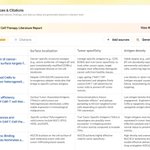





Overwhelmed by literature reviews? 🧪📚
Google Labs is launching an Early Access Program for Literature Insights, an AI research engine built with NotebookLM to help scientists, researchers, and PhDs search, extract, and synthesize academic literature.
Links below 👇

See how it works in the demo video or explore the platform:
🎥 Demo: youtube.com/watch?v=ayAgCX5E…
🔬 Google Labs: labs.google/science/
By joining, you’ll work directly with Google researchers to help shape the future of AI-powered scientific tools.
Ready to try it out?
👉 Apply for the Early Access Program here: forms.gle/J9371WBZhxVWXEJ87
Teo Stoleru retweeted

1️⃣ Literature Insights
Built with @NotebookLM, it searches scientific papers, organises everything into custom tables, and lets researchers chat with curated data to create slide decks, audio overviews, and more in minutes.
Teo Stoleru retweeted

Big thanks to all our Drive engineers 👏💕

“Ever since I discovered computer science in high school, I’ve dreamed of working at Google,” says Teo, a London-based software engineer on Google Drive. “I always wanted to build products that impact people globally every single day, and Google felt like the perfect place to do that. I was drawn to the commitment to innovation, creativity, and a healthy disregard for the impossible.”
Now, Teo works in Drive’s Generative AI space, developing features like in-context summaries and content-based nudges. “It's a very fast-moving environment, but working with cutting-edge technology to launch features that will completely shift how users interact with Drive is very exciting.”
Teo’s advice for students seeking a similar path? “I encourage students to view their university years as a period for experimentation and discovery. Instead of focusing solely on academics, I recommend using this time to build a diverse toolkit. Exploring a variety of roles, technologies, and locations through different internships will help you gain a deeper understanding of what truly motivates you.”
Thank you for your contributions to #LifeatGoogle, Teo! ➡️ goo.gle/4dG74eB

ALT Teo in front of Google office

ALT Teo posing in Google office

ALT Teo posing on Google office rooftop, with view of London in the distance
Teo Stoleru retweeted

“Ever since I discovered computer science in high school, I’ve dreamed of working at Google,” says Teo, a London-based software engineer on Google Drive. “I always wanted to build products that impact people globally every single day, and Google felt like the perfect place to do that. I was drawn to the commitment to innovation, creativity, and a healthy disregard for the impossible.”
Now, Teo works in Drive’s Generative AI space, developing features like in-context summaries and content-based nudges. “It's a very fast-moving environment, but working with cutting-edge technology to launch features that will completely shift how users interact with Drive is very exciting.”
Teo’s advice for students seeking a similar path? “I encourage students to view their university years as a period for experimentation and discovery. Instead of focusing solely on academics, I recommend using this time to build a diverse toolkit. Exploring a variety of roles, technologies, and locations through different internships will help you gain a deeper understanding of what truly motivates you.”
Thank you for your contributions to #LifeatGoogle, Teo! ➡️ goo.gle/4dG74eB
ALT Teo in front of Google office
ALT Teo posing in Google office
ALT Teo posing on Google office rooftop, with view of London in the distance
Big day for the team! We just launched Ask Gemini in Drive 🚀 Unlocking the knowledge hidden in your Drive has never been easier ✨

Teo Stoleru retweeted

Happy that our MPSN paper has been accepted to #ICML2021. Final version with improvements & code coming soon. Work w/ @ffabffrasca*, @wangyg85*, @kneppkatt, G. Montúfar*, @pl219_Cambridge, @mmbronstein
arXiv: arxiv.org/abs/2103.03212

Teo Stoleru retweeted

How do Neural ODEs learn 2nd order dynamics? In our new paper “On Second Order Behaviour in Augmented Neural ODEs” we perform an extensive study to answer this question. w/ @CristianBodnar, @itsmebenday, @simidjievskin, @pl219_Cambridge
Paper: arxiv.org/abs/2006.07220 1/12



Teo Stoleru retweeted
It takes a village.
@Simona_Halep climbs up to thank her team.
#RG18
Teo Stoleru retweeted
The moment @Simona_Halep became Roland-Garros champion!
#RG18


I’m really grateful to have been awarded by @Google a @WomenTechmakers scholarship for academic performance, leadership & impact on the community of women in tech. More details at goo.gl/HJLzZG and goo.gl/bwe6F1
Teo Stoleru retweeted
My thesis on text to image synthesis has been published on arxiv (arxiv.org/abs/1805.00676), which means it is considered by the moderators to bring significant improvements in the field. It was also the most read research work from @csmcr on ResearchGate


