
Talking about college admissions, career & personal growth that empowers young people | 15 yrs coaching students, 10 yrs on school board & 10 yrs HR experience
- Tweets37
- Following6
- Followers5
- Likes4


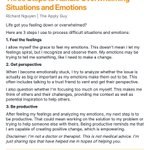




ALT Screenshot essay titled 'How High School Students Made Me a Better Communicator and 3 Steps to Communicate Your Ideas More Effectively (Including to Teenagers)'. The text discusses the challenges of teaching courtroom evidence to high school students and how this experience has improved the author's communication skills. It outlines three steps for better communication: 1) Explain the goal or purpose clearly to give direction, 2) Break concepts down into simple steps to accommodate the audience's understanding, and 3) Use relatable examples to maintain engagement and interest. The author emphasizes that effective communication may require repetition and adaptation.

ALT Screenshot of an essay titled 'Three Insights from Doing 30 Day Online Writing Challenge'. The essay discusses the author's experience and learnings from participating in the Ship 30 for 30 online writing program. Key insights include: 1) Inspiration exists even in moments of feeling uninspired, as the author learned to reflect and draw from past writings. 2) The importance of prioritizing action over perfection in writing, shifting focus from achieving perfect posts to maintaining personal standards. 3) The value of sharing thoughts publicly, acknowledging that more readers engage with content than might happen if kept private. The closing remarks emphasize that the program was beneficial for taking action and enhancing writing efficiency.

ALT Screenshot essay titled 'Why We Should Stop Using the Feedback Sandwich & What to Do Instead' discusses the ineffectiveness of the feedback sandwich in delivering criticism. The author, reflecting on experiences as a coach and HR professional, identifies three main issues with this approach: praise may be perceived as insincere, constructive feedback may be ignored by narcissistic individuals, and the introductory and concluding compliments overshadow the main criticism in the middle. The essay concludes by recommending two separate conversations—one for praise and another for critique—to improve clarity and effectiveness in communication.


ALT A screenshot essay titled "3 Smart Study Strategies to Ace Your Next Exam" discusses effective study methods. It reflects on the author's experience preparing for the California Bar Exam and highlights three strategies: 1. Push Through - to recognize when to persist in studying despite feeling lazy. 2. Compromise - adjust study plans when tired but still able to study. 3. Stop - knowing when to stop if too tired, emphasizing the importance of restful study for productivity rather than performative effort.

ALT A screenshot essay titled 'Don't Wait! Three Actions You Should Do If You're on a College Waitlist'. The body discusses the bittersweet nature of being waitlisted by a dream college, emphasizing that while being waitlisted means the applicant is compelling, it also means they have not yet been accepted. The essay outlines three recommended actions: 1) Informing the college of the intention to remain on the waitlist, 2) Writing a letter or email to the admissions office to share new achievements or information, and 3) Checking email daily for final responses, as colleges may give a limited time frame for acceptance. It concludes by advising applicants to put down a deposit at another university as a backup plan.

ALT A screenshot essay titled "How 'I Should' Sets You Back & How to Move Forward" discusses the negative impact of the phrase 'I should' on motivation and personal goals. The text highlights various examples such as 'I should eat healthier', 'I should read more', and emphasizes that these statements can lead to guilt if not acted upon. The author suggests replacing 'I should' with decisive action to reflect true priorities, stating that acknowledging a task should be followed by either doing it or moving on, thus limiting further guilt. Key takeaways stress that saying 'I should' is meaningless without the intent to act.

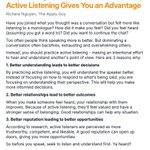
ALT Screenshot essay titled 'Stop Talking, Listen More: 3 Reasons Why Active Listening Gives You an Advantage.' The text discusses the pitfalls of dominating conversations and the benefits of active listening. It poses a rhetorical question about the listener's experiences in conversations. The essay outlines three main reasons for practicing active listening: 1) It leads to better understanding and informed decision-making. 2) It fosters better relationships and a sense of belonging. 3) It enhances reputation and creates more opportunities, as active listeners are viewed as trustworthy and likable. The conclusion encourages prioritizing listening over speaking.