

🎖️25+ years options professional | https://teapaw.org/t.co/8SkKjj3kvi | Weekly letter on everything options | Realistic, probability-based strategies & education.
Green Mountains, Vermont
Joined April 2024
- Tweets7.9K
- Following74
- Followers3K
- Likes2.6K






Pinned Tweet
Building The Option Premium has been one of the most rewarding things I have ever done professionally.
Not because of any metric or milestone, but because of the conversations, the questions, and the feedback I receive from people like you. Traders and investors who are serious about their craft, who want to understand what they are doing and why, and who are tired of the noise that dominates so much of this space.
As many of you already know, I have grown this community entirely organically. No paid advertising. No affiliate deals. No clickbait headlines promising 500% returns on a lucky trade. That has always been a deliberate choice. I believe that the right way to build something in this industry is to earn it, one subscriber at a time, through consistency, transparency, and genuine usefulness. That means the single most powerful thing that can happen for this community is a simple word-of-mouth recommendation from someone who is already here.
If you have found value in what we do together, whether that is through the trade alerts, the educational content, the IV analysis, or simply a different way of thinking about risk and probability, I would be deeply grateful if you shared it with someone who might benefit. A fellow trader. A colleague. A friend who has been trying to figure out options and keeps running into the same dead ends.
Or broader still, a trading group, an investing community, a forum where serious people are asking serious questions and deserve a serious answer. You don't need to sell anything. Just tell them what you told yourself when you decided to be here.
I am not trying to be the loudest voice in the room. I am trying to be the most useful one. And with your help, I believe we can keep building something that stands for something in a space that badly needs it.
Thank you, sincerely, for being part of this.
Andy
"I'm hedged" is half a sentence. The other half is: against what? A put struck 5 percent below the market is a drawdown hedge. It costs about 2.00 here and starts paying in an ordinary, garden-variety correction. A put struck 20 percent below is a tail hedge. It costs about 0.30 and sits there doing nothing until the market is already down 20 percent. One is expensive and useful fairly often. The other is cheap and useful almost never, until the day it is the only thing that matters. Neither is wrong. The mistake is owning the second and expecting it to behave like the first. #OptionsTrading

2
290
Ask ten investors how they sized their hedge and nine will describe a feeling. The arithmetic takes three lines and no feelings at all. First, multiply your portfolio by its beta. An 80,000 portfolio with a beta of 1.2 behaves like 96,000 of the index. Second, find what one put covers. With the index fund at 500, one contract covers 100 shares, or 50,000. Third, divide. 96,000 over 50,000 is 1.92, so two puts do the job. Beta is a blunt instrument, and it drifts. It still beats the method most people use, which is to buy one put and hope it is enough. #OptionsTrading

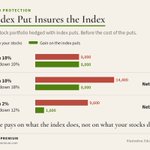
🎯 Hedging a stock portfolio with index puts is a little like insuring your neighbor's house. If the whole street floods, you both collect. If only your kitchen catches fire, you get a sympathetic look. Take an 80,000 portfolio. If the index and your stocks both fall 10 percent, the puts roughly cover you. If your stocks fall 18 percent instead, you are still out 6,400. And if the index slips 2 percent while your stocks fall 12, the hedge pays 1,600 against a 9,600 loss. The lesson is not to skip the hedge. It is to be honest about how much your portfolio really resembles the index. #OptionsTrading

1
336
Sequence Risk: Why Your Wins and Losses Never Arrive in the Order You Expect
The same 100 trades in a different order end in the same place, yet most traders don't survive the ride. What sequence risk is and how I size to outlast it.
Read the entire article below.
Access the entire article here: theoptionpremium.com/p/menta…

74
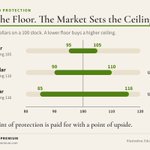
📐 Wall Street's favorite word is free, and it almost never means what you hope. A zero-cost collar costs no cash. It costs upside. You pick the floor, which is the put you buy. The call you sell has to pay for that put, and that decides your ceiling. On a 100 stock, a floor at 95 might buy a ceiling at 105. Loosen the floor to 90 and the ceiling moves to 110. Loosen it to 85 and you get 116. These numbers are illustrative and will shift with volatility. The trade itself never shifts. The more of the downside you refuse to feel, the more of the upside you agree to miss. #OptionsTrading

1
272
41 Analysts Said NVDA Was Headed to $272. The Options Market Said 1 in 3. Here's the Scorecard.
In March, 41 analysts put $NVDA at $272. The options market gave it a 35% chance. Here's what happened, and the three numbers every forecast should include.
Access the entire article below.
1
1
284
Read the entire article here: theoptionpremium.com/p/proba…

92
🧩 Every hedge has fine print. The put spread collar is unusual because you write it yourself. With shares at 100, buy the 95 put for 3.00. Sell the 85 put for 1.00 and the 110 call for 2.00. The net cost is zero. Selling that lower put is what lets you push the ceiling out further than a plain collar would. The price is written right on the chart. Protection starts at 95 and stops at 85. In a real crash you are losing again, just 10 points better off than your unhedged neighbor. It is an umbrella, not a bunker. Know which one you bought before the weather changes. #OptionsTrading

2
306
A stop order feels like a seat belt. It is closer to a note on the dashboard that says please brake. Say you own shares at 100 with a stop at 95. Bad news arrives after the close and the stock opens at 85. Your stop becomes an order to sell at whatever price exists, which is about 85. A 95 put would have sold at 95. Now flip it. The stock dips to 94 for an afternoon, then climbs to 105. The stop sold you out near the low. The put holder is still on board. The stop is free until the day it is not. The put charges 2.00 every single time. Choose the cost you can live with. #OptionsTrading

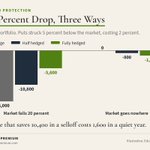
The best time to buy a hedge is before you want one. That is also exactly when it feels like a waste of money. So here is the full bill, both sides. Take an 80,000 portfolio and puts struck 5 percent below the market, costing 2 percent. In a 20 percent selloff, no hedge loses 16,000. Half hedged loses 10,800. Fully hedged loses 5,600. Now the part the brochures skip. In a flat year the full hedge costs 1,600 and you have nothing to show for it. Hedging is not about being right. It is about deciding, while calm, how much of a quiet year you will trade for a tolerable bad one. #OptionsTrading

3
336
$VIX closed above 30 at least once in 17 of the last 27 years. Usually for a handful of days. In 2009, for 111. So far in 2026: 3. More to come. Follow to stay tuned.

1
337
📈 $VIX closed at 37.41. Since 2000 it has finished that high or higher on 242 of 6,763 sessions, or 3.6% of days.

285
You have never met anyone who was proud of their homeowner's insurance. You have also never met anyone who cancelled it because the house failed to burn down. A protective put works the same way. Own 100 shares at 100 and buy the 95 put for 2.00. The 2.00 is your premium. The first 5.00 of loss is your deductible, since coverage starts at 95. Below that, the put pays dollar for dollar until it expires. Your worst case is 93 a share. Most of the time the policy expires unused. That is not a failed trade. That is what a good year for insurance looks like.

255
On Thursday morning the $VIX opened at 22.06, lower than Wednesday’s close. By the closing bell it was 28.89. That is a seven point swing and a 31 percent rise within a single session. Anyone who sold index premium at the open because volatility looked like it was settling learned a familiar lesson. A falling VIX at 9:30 tells you very little about 4:00.

2
320
🗓️ Three of $SPY’s five worst sessions of 2026 have come in the last 11 trading days: November 5, 16 and 19. That clustering is what lifts option premium.

262
I worked hard on this one.
For those interested in poor man's covered calls (PMCC), this is the most comprehensive guide out there.
theoptionpremium.com/p/poor-…
Please like, comment and repost. I would like as many people as possible to have access to the report. Thank you!

1
3
394
📚 What Is a Protective Put? How Stock Insurance Works and What It Really Costs
A protective put caps the loss on a stock you own. See how it works, the true maximum loss, what it costs per year, and how it compares to a stop loss.
Read the entire article below.
1
217
Read the entire article here: theoptionpremium.com/p/optio…

83