

Masters in Nutrition Science & Bachelor of Science (Physio). Author and podcast host. Science over hyperbole. Tweets are educational only, not medical advice.
Australia
Joined October 2019
- Tweets19.6K
- Following1.5K
- Followers37.5K
- Likes9.2K



Simon Hill MSc, BSc retweeted

I am a fan of Dr. Nicola Guess, and this conversation with @theproof does not disappoint, especially her explanation on adherence because all too many people do not seem to understand that advice can only be effective when it is followed.
youtube.com/watch?v=kZzRMnpq…
Simon Hill MSc, BSc retweeted

Them: ApoB didn't correlate with plaque progression.
Us: Wait...that wasn't your preregistered primary outcome.
Them: Plaque begets plaque
Us: Wait...your study shows LMHRs have historically high plaque progression.
Them: The data is wrong because our vendor sucks.
Us: Why did you go on a historic marketing campaign and produce a documentary?
Them: We retracted our paper. All good.
Us : That's not how this works.

Most of the diet arguments you see online are fought over questions the science will never settle, because the study that would settle them cannot be run.
Christopher Gardner has spent more than 30 years running human diet trials at Stanford, and in this episode he explains what that limitation actually means for the choices you make at the supermarket. We get into the four things every popular diet agrees on, why a null result can be the most useful finding in a paper, and how he reads new data that contradicts his own position.
For the full show notes head to: theproof.com/30-years-of-die…
Simon Hill MSc, BSc retweeted

The Keto CTA study is back on my feed today, and the authors are reiterating that it was retracted at their request.
That’s fine. I’m actually open to the idea that the Cleerly data was flawed.
My much, much larger problem is with the way the science was communicated. As they say, “Trust takes years to build, seconds to break, and forever to repair.”
At launch, the message was “no association of ApoB with plaque” and “most participants showed NO OR MINIMAL progression.” (Pictures below.)
But when the authors requested the retraction, the exact same data was suddenly the problem. Plaque progression was so high and so one directional, that it was said to be statistically implausible.
So what is it? No or minimal progression or progression so consistent and so bad that the data must be flawed?
Second, it’s worth remembering how science is supposed to be communicated. Plaque progression was the PRIMARY OUTCOME cited for the Keto CTA study.
But plaque progression was not reported.
The authors later apologized (which, to their credit, is good!) for not including the number in the graph they provided.
But while putting the number in the figure would have been nice, that is not how you DISCUSS your primary outcome in the DISCUSSION of a paper.
Let’s compare this to how @BradStanfieldMD discussed the primary outcome of his Rapamycin study, a study he put a tremendous amount of reputation behind and, quite literally put a second mortgage on his house to get over the finish line:
“4.1 Principal Findings
This randomised, double-blind, exploratory trial evaluated whether once-weekly sirolimus (rapamycin) 6 mg, timed to avoid peak training windows, could enhance functional adaptations to a 13-week resistance and endurance programme in sedentary older adults.
Contrary to the ‘cycling hypothesis’ derived from preclinical models, we found no evidence of benefit. Instead, sensitivity analyses (complete-case and per-protocol) revealed a statistically significant blunting of functional gains in the sirolimus arm. Specifically, participants taking the drug performed fewer chair-stand repetitions and showed non-significant trends toward reduced walking distance and grip strength compared with placebo. Safety monitoring identified a higher burden of minor AEs and one serious infection (pneumonia) in the treatment arm.”
He was clear. The study did not meet his primary endpoint, and instead, the intervention appeared to have worsened it. That is how science is communicated.
I asked Grok to write the Discussion the Keto CTA should have had for its primary endpoint, had it been written the way Dr Stanfield did. Here is what Grok wrote:
"Discussion
Principal Findings
This prospective, single-arm observational study evaluated whether long-term exposure to elevated LDL-C and ApoB (in the lean-mass hyper-responder phenotype on a ketogenic diet) was associated with progression of noncalcified coronary plaque over one year, as quantified by coronary CT angiography. The pre-specified primary endpoint was change in noncalcified plaque volume (NCPV).
Contrary to the hypothesis that these elevations would not drive measurable plaque progression in this metabolically healthy cohort, we observed a median increase in NCPV of 18.9 mm³ (IQR 9.3–47.0 mm³), corresponding to a 42.8% relative change. The mean change was 31.5 mm³ (SD 31.5 mm³), reflecting substantial inter-individual heterogeneity. Most participants showed an increase in NCPV."
That is how you discuss your primary endpoint. It’s not supposed to be a number on a chart (which was omitted anyway).


We, the authors, retracted the paper, @Drlipid
This was due to the anomalous @Cleerlyhealth dataset they provided us alongside their repeated refusal to quality control check their work.
Study participants have since resubmitted their scans and have gotten results far more in line with the other independent analyses from Heartflow and QAngio.
So yes, understandably, we moved to withdraw the paper leading to its retraction.
(This has been known for over half year now.)
xitter.cf/realDaveFeldman/status…

Bingo - with barely any responsibility taken.

The messaging is crazy:
-Original Keto CTA Messaging: Huge victory for Keto!!
Then everyone found the plaque numbers.
-New Keto CTA Messaging: The numbers as so terrible that it's completely implausible, so we retracted the study. (And they say they knew that at the time of original publication as well)
Do you have any questions about sun-spots and screening for melanoma?
As well as treatments for skin cancer.
Having a convo on this topic tomorrow.
New Substack article on liver fat and diet
nutritionscientist.substack.…

Lots of engagement and interest in this study on the ketogenic diet and liver fat. Hats off to @mpetersenmdphd and Sam Klein for putting together such an interesting study design.
My discussion with Dr Guess on the interpretation of the results below.
Planning an episode with @mpetersenmdphd to continue the exploration and learnings.
It Wasn’t the Ketones: What Really Cut Liver Fat in the New Keto Study | Nicola Guess
youtu.be/kZzRMnpq5Is
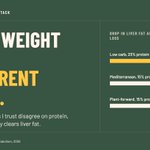
A new trial in Cell Metabolism found a keto diet cut liver fat by 67%, versus 45% on a Mediterranean or plant-forward diet – with weight loss matched and all food provided.
So keto wins? Not so fast.
The keto diet in this trial was also much higher in protein: 23% of energy versus 15% on the other two. Ketones only rose modestly. When I sat down with Dr Nicola Guess, her read was that more protein and fewer carbs were doing the heavy lifting, not ketosis.
And despite 23% of energy from saturated fat, LDL and apoB changed about the same as on the other diets. But everyone was losing weight, which can mask the effect, so this study can't tell us saturated fat is fine.
The practical take is a higher-protein, lower-carb Mediterranean-style plate, with olive oil, nuts, and seeds.
Full conversation is EP #441– link below.
Save this for later, or share it with someone navigating fatty liver or prediabetes.
Study: Petersen MC et al. Cell Metabolism, 2026.


It Wasn’t the Ketones: What Really Cut Liver Fat in the New Keto Study | Nicola Guess
youtu.be/kZzRMnpq5Is
Jacked @ 60
Happy birthday @richroll


The Viral Keto Liver Study: What It Actually Showed About Liver Fat, Protein & Carbs | Nicola Guess, PhD
youtu.be/kZzRMnpq5Is
Simon Hill MSc, BSc retweeted

An orthopedic surgeon and a performance coach developed a resistance training routine that protects and strengthens knees by improving the body’s ability to move.
Here’s how to do these exercises: wapo.st/4hX2Liz
Have a great ENT on The Proof tomorrow.
Any questions about ear, throat nose physiology/conditions/treatments??
Can A Partially Torn Tendon Heal Without Surgery? | Howard Luks
youtube.com/shorts/IXfJQiGpj… @hjluks

What Causes Fatty Liver? MASLD, Metabolic Dysfunction & Alcohol Explained | Aleksander Krag
youtu.be/pAzh7rXZ6Pc
Ai or a massive change in sentiment? @grok
