











ronald retweeted
Dear @saylor, time to add some NAT dots soon.
Bitcoin’s long-term value depends on a growing security budget - yet right now it’s trending down as each halving exponentially decays the block reward.
NAT is the only market-driven hedge that doesn’t require any protocol changes.
How much will BTC be worth if its security budget collapses?
ronald retweeted

翻出2023年11月介绍 $NAT 的旧帖,标题叫《XX是个什么鬼系列二——$NAT》。
三年过去,这个“什么鬼”我还在写,也还在拿着🤣
从它刚出现时深入了解、分享,到后来持续跟进变化,已过去刚刚好三周年。
当年吸引我的,是“区块伴生”这个性感的概念。
NAT的产出数量,依照比特币区块里的bits字段确定,不是项目方拍脑袋决定。比特币自己产生的数据,除了记录交易,还能衍生出新的资产和应用,这件事让我觉得非常创新和有意思。
那篇旧帖里,写过一句:
“项目们和玩家们理解如何使用它也需要时间。”
当时大概也没想到,这一写,就是三年。
三年里,它也没有停在原地。
最初要解释的是社区关于什么是 DMT(数字物质理论)@TheBlockRunner 、非任意通证;后来,分享“区块伴生矿”,写矿工为什么接收NAT,怎么分配,能不能多一份收入。
这次社区的项目回顾,也没有把过去包装成从第一天就算好的宏图:NAT起初是展示DMT的实验,新区块被机器人抢铸,后来才把新增NAT转给矿工。
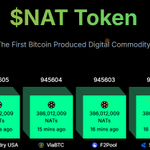
蚂蚁、ViaBTC、鱼池等矿池已陆续领取、出售$NAT。从一个新概念,走到矿工可以变现的一份额外区块奖励,这是扎扎实实落在地上的变化。
额外收入能有多少、价值有几多、能持续多久,从此就与比特币安全预算的解决方案牢牢的捆绑在一起。
当然,也不能只是拿着等。
去年两周年,把写过的长推、白皮书和社区资料共11篇喂给 NotebookLM ,做成科普材料,后来又应社区要求补了英文、西班牙语讲解。
看到海外社区愿意引用、转发和使用,确实开心。自己几年读过、写过的东西,能帮别人少绕一点路,就没白折腾。
今年,中文社区又自己筹钱,准备去迪拜面对面给矿池讲NAT。有人开发,有人研究,有人翻译,有人跑出去介绍。。。社区一直在壮大,自发的线上分享会竟已超100场。
8月写过:“时间就是 $NAT 唯一的朋友。”
但时间不会自动带来成功,得有人把它前赴后继的去建设。
矿工的额外收入,是走出的关键一步;比特币生态的应用、乃至AI智能体之间的结算与激励,能不能继续长出NAT的位置,更是我仍然期待的未来。
三年了,还在持有,还在分享,也依然看好。
$NAT,三周年快乐🫡


ronald retweeted

We said on the pod someone should make a ethereum:0x249130f5e2dd4cf278180c0df8273f3592ad1247 documentary.
The community went and made one.
Nobody asked them, and nobody paid them. That's what conviction looks like.
EP341: We watch the @natgmi doc live, and it's a 10 out of 10 👇
Can NAT Save Bitcoin Mining?! Scarce or Secure Documentary Reaction! | TBR #341
The NAT documentary is out, and on NAT's third birthday we sat down and reacted to the whole thing live with TJ. We once said on this podcast that someone should make a NAT documentary, and someone in the community actually did it. Shout out to @choirzooh for putting it together.
The film opens with a story most Bitcoiners skip: in August 2025, a project called Qubic took control of Monero without hacking anything. It simply paid Monero's miners up to three times more than the network did, and Kraken paused deposits. Our take is that everything gets attacked eventually, and assuming Bitcoin never will is foolish. NAT pays miners too, but to stay honest.
From there it lays out Bitcoin's security budget in plain terms. Miners get paid to guard the record, that pay is cut in half every four years, and Satoshi bet in 2010 that fees would take over within a few decades. Fees have spiked a few times, then faded every time, and today they are less than 1% of what miners earn. All 11 Bitcoin funds, all 19 public miners and 50 companies filing with the SEC name miner pay as a risk, while miners like Mara move their power into AI.
We spend a lot of time on why a higher Bitcoin price doesn't fix this. If Bitcoin grows 100x but miners earn the same, you are guarding a much bigger honey pot with the same number of bees. We compare Bitcoin to a decentralized boardroom that refuses to fund new revenue streams, like Apple blocking its own iPhone team. The film then walks through every other fix on the table, from bigger blocks to tail emission to changing proof of work, and shows how each one breaks a promise.
Then it gets to NAT. Since February 2025 every new NAT goes to whoever mined the Bitcoin block, by a fixed formula tied to Bitcoin's own difficulty, with no changes to Bitcoin and no pre-mine for us. Pools finding about 57% of Bitcoin's blocks now take it, more than BIP 110 ever had, and almost nobody has written about it.
What stuck with us most is the size of the job. The gap in Bitcoin's security budget is about $3 billion a year today and grows every halving. Closing it would take NAT at around $50 billion, roughly 3% of Bitcoin, which is smaller than Dogecoin was at its peak. That isn't a forecast, and nothing here is financial advice, but it puts the problem in a range a market can actually reach.
We gave the film a 10 out of 10. For almost 20 years nobody has offered a fix that keeps Bitcoin both scarce and safe without changing Bitcoin, and this one only needs people to choose to hold it. If you think you can argue against it, come on the podcast. Watch the documentary on @natgmi and read the NATpaper at natgmi.com/natpaper.
ronald retweeted
Most crypto tokens die in three days.
ethereum:0x249130f5e2dd4cf278180c0df8273f3592ad1247 is turning 3 years old today.
It started as a free and fair experiment in Ordinals, and now pools totaling 60% of Bitcoin's hash power use NAT to help power their operations.
For those that missed how it all started and want to catch up, here's the whole story 👇
Happy 3 Year NAT Anniversary! Why ethereum:0x249130f5e2dd4cf278180c0df8273f3592ad1247 Is The Biggest GEM In ALL Of Crypto!
Three years ago, right before Thanksgiving, we launched @natgmi, got violently sick for a week, and came back to find that 20,000 people had minted every single block on Bitcoin's blockchain. In crypto, most tokens don't last three days, so for NAT's third birthday we went back through the whole story.
It started with Bitmap. People wanted a way to derive commodities from Bitcoin blocks, so we wrote Digital Matter Theory: a way to register patterns in Bitcoin's own data, which we call elements, and launch tokens against them using @tap_protocol. We knew nobody would pay attention without a token, so we launched NAT on the bits field, the number that tracks Bitcoin's mining difficulty. When hash power goes up, that number goes down, and we liked that property.
The mint was free and open. People paid somewhere between $2.5 and $5 million in transaction fees to claim blocks, and every dollar went to Bitcoin miners. We made zero from it, no matter what the naysayers say. When trading opened, NAT came out of the gate like an IPO, hit around $70 million, and then the hype settled.
Then we made the call that changed everything. A bot was minting every new block, so we redirected new NAT to Bitcoin miners instead. On February 26, 2025, close to the very bottom of the chart, the redirect went live. Five months later Antpool started selling it, and @ViaBTC, @f2pool, @SpiderPool_com and @luxor followed, roughly 60% of Bitcoin's hash power.
We also share a stat a community member found. At its all time high, NAT delivered about $150 per block to miners, and it got there in half the time it took Bitcoin's own subsidy to hit $150 per block. Satoshi stepped away when Bitcoin was worth around $30 to $40 million, roughly where NAT sits today, and the community carried it from there.
That is what gets us most three years in. Nobody is directing the NAT community, and the NAT Eastern community pooled their own money for a booth at Blockchain Life Dubai, December 1st and 2nd, to pitch Bitcoin's security budget to mining pools in person. This is what a decentralized force looks like, and it is the reason we are still in crypto: you can contribute to a trillion-dollar network from anywhere, without asking permission.
The bigger point is the problem NAT is pointed at. Bitcoin's security budget gets cut in half every four years, so price has to double forever just to keep up, and nobody holding a big bag wants to talk about it. Miners need a second subsidy, and we think this is the conversation everyone will have to have eventually. If you are new to NAT, read the NATpaper, natgmi.com/natpaper, and catch our live reaction to the community documentary dropping November 21.


ronald retweeted
BITCOIN CAN INDEED FAIL
Bitcoin miners are selling their reserves simply because BTC mining isn’t profitable anymore.
Makes you wonder: What industry survives when its revenue gets cut in half every 4 years?
None. And rising electricity costs aren’t even factored into that equation yet.
The next halving is just around the corner, and if the price does not at least double from previous highs, we’re going to see many more miners pivot away to other businesses.
The result is a declining security budget and by extension, a lower cost to attack a trillion-dollar network.
The first warning signs are already here in the form of a structural shift in hashrate:
Even though hashrate isn’t the right metric to measure network health (security), it’s still a clear warning sign that needs to be taken seriously.
It has been in a declining phase for over a year now - the longest stretch since inception and the toughest market environment miners have ever faced.
Bitcoin's fundamentals are shifting...
We need to get past the point where people finally realize the core issue is declining miner revenue - driven by preprogrammed halving events that cause an exponential decay in block rewards.
Which ultimately means the solution has to be INCREASING miner revenue in the most efficient way possible.
There are really only three options: tail emissions, taxing holders, or a market-driven second subsidy.
Two of them cost people money. Only one gives people a chance to make money.
If we don’t act now, we risk Bitcoin becoming so centralized that only 1 or 2 miners are left securing the chain and the cost to attack drops to a level where attacking the network makes economic sense.
Bitcoin's immune system is at work as we speak and it's the only reason why Bitcoin will NAT fail.


ronald retweeted

🚨BITCOIN WILL FAIL🚨
The reduction in mining rewards will jeopardize the security! 💯
Rewards decay = Miners leaving
$NAT FIXES THIS PROBLEM! 👀
If you see this, you are so early…. 👇🏼
ronald retweeted
People will call for the death of Bitcoin and hawk their competing solution.
Make no mistake, Bitcoin can die.
But NAT if we can help it.
ethereum:0x249130f5e2dd4cf278180c0df8273f3592ad1247 is for those that understand Bitcoin's problem. Miners are the single most important aspect of Bitcoin, without security there is no value.
Study @natgmi

I cannot stress this enough: the next BTC halving is not bullish.
Right now a block pays 3.125 BTC. Fees are less than 1% of that.
Mining is only profitable with the latest ASICs and power under ~$0.08/kWh. Hashprice already sits near record lows.
In 2028 the subsidy drops to 1.5625 BTC. Same costs, half the revenue.
If price doesn't double, miners shut off, hashrate drops and the network gets cheaper to attack.
Bitcoin's security model, just like Saylor's: only works when number goes up.
ronald retweeted
The NAT Eastern community (NAT东方社区) is taking ethereum:0x249130f5e2dd4cf278180c0df8273f3592ad1247 to Blockchain Life Dubai, Dec 1-2.
They pooled their own money for a booth and to send members from China to pitch Bitcoin's security budget to mining pools in person.

ronald retweeted
Digital Matter Theory suggests Bitcoin isn’t just data…
It’s physics in digital form.
@JasonPLowery defined what truly makes Bitcoin valuable.
Power projection.
Bitcoin is simply just a tool to project power in cyberspace. The higher the cost to attack Bitcoin, the more valuable it becomes.
DMT-NAT amplifies this: By tokenizing Bitcoin’s bits field (difficulty target), new NAT is issued with every block - giving the winning miner extra value on top of BTC.
Bitcoin decides who gets what, not a central authority.
Therefore: Higher cost of attack = more valuable Bitcoin
With transaction fees making up nearly 0% of total block rewards, NAT is the only token in crypto that doesn’t compete with Bitcoin - it only strengthens it.
Thank you Satoshi for DMT-NAT.

ronald retweeted
ethereum:0x249130f5e2dd4cf278180c0df8273f3592ad1247 拥有一个非常庞大的东方社群。
这是加密货币领域最重要的代币。
随着时间的推移,这个“大家庭”越壮大,比特币就会变得越安全。
ronald retweeted
The bleak state of the market reminds us too much of FTX days 4 years ago.
It feels as if nothing can lift this industry out of the muck.
It was at that time when we discovered Ordinals and found new hope and excitement for the future.
What will be the Ordinals moment of this bear market cycle?
EP340: we discuss 👇
NVIDIA Crisis | NAT Documentary | State Of The Trenches SUCKS! | TBR #340
@nvidia lost around $500 billion after Jensen Huang stepped down, and the timeline can't agree on what the real story is. Everyone is focused on the affair. We think the bigger question is the reports that advanced chips were reaching China despite sanctions, because if any of that holds up, it's treasonous territory. We also get into what a company loses without its visionary, from Steve Jobs and Tim Cook to Google's founders coming back, and whether this sell-off is a generational buying opportunity.
Then we turn to crypto, where this bear market somehow feels worse than 2023. We expected hyper-bitcoinization under a friendly administration and got the same casino with dimmer lights. We line the chart up against the FTX collapse four years ago to ask whether we're at the cycle bottom, what a drop to $40-50K would mean, and why Adam Back's $1 million by 2028 call could be a bad sign if it only happens through money printing.
From there we play the trailer for the @natgmi community documentary and break down the question at its center: who pays to secure Bitcoin? Nobody knows the exact number, but every real-world security spend scales with what it protects, and miner revenue gets cut in half every four years. We also share how Dan Held and Adam Back ended up blocking us, why drivechains and L2s don't solve it, and why public miners keep leaving.
The pattern we keep coming back to is simple. The loudest voices in Bitcoin are selling a price target, while the public companies doing the actual mining list miners losing money as a major risk in their own disclosures. Both can't be true for long, and the gap between what gets said on stage and what gets filed is where the real story is.
It's also why we're not chasing the next cat. Every new chain launches the same casino, and fundamentals are the only thing that let you see past it. Ordinals came out of nowhere four years ago in a market that felt exactly like this one, and we're working on our own version of that moment for Robinhood Chain. The documentary drops November 21st, the day after the NAT anniversary and @mboilyETH physical NAT coin @DMT_CENT auction. None of this is financial advice.