

American Photographer — publishing one million photographs.
San Francisco, CA
Joined December 2006
- Tweets46.3K
- Following1K
- Followers67.9K
- Likes223K




Pinned Tweet
This man never agreed to be photographed.
His name was Erno Nussenzweig, an Orthodox Jewish man walking through Times Square when Philip-Lorca diCorcia made this portrait, one of a series called Heads. No hello. No permission. No release form. Just a stranger's face caught in a burst of light, every hair of that beard lit like wire.
DiCorcia printed it big, hung it in a gallery, and sold copies for $20,000 to $30,000 apiece.
Nussenzweig found out four years later. He was a Klausenburger Hasid, and his faith forbids graven images. He sued in New York, arguing the photograph violated the state's privacy law and his religion along with it.
The case climbed all the way to the Court of Appeals in Albany, the highest court in New York. And the courts held the line. A photograph made as art is protected expression. Out in public, you do not own your own face. No consent needed to make the picture, hang it, or sell it as art. Consent only enters when somebody uses your face to sell soap. The first judge on the case wrote that she believed his distress was sincere. She ruled against him anyway.
Garry Winogrand, probably the most famous street photographer who ever lived, built his entire body of work on never asking permission. Not once. He just shot, thousands of frames of strangers who never knew his name. And Henri Cartier-Bresson summed up the whole approach in one line: "Aim well, shoot fast, and scram!"
I have made thousands of portraits out on the street myself. Sometimes I ask. Some people you can talk to, get a yes, and the portrait is better for it. But other times there is a moment, a look, a second of somebody being completely themselves, and asking would kill it dead. The face arranges itself, the truth leaves, and you are left holding a picture of nothing. So you take the photograph. The unguarded second is the whole reason to be out there.
None of that means Nussenzweig was wrong to be angry. Both things are true at once. He got to be furious, and the photograph got to exist.
Should a photographer need permission to photograph a stranger in public? I know where I stand. Where do you?


Mayor Daniel Lurie, all talk no action. All hat no cattle. No one is accountable.

I thought @DanielLurie said if people decline services they would be placed into mandatory treatment? What happened to that? Every SF 311 encampment case opened ends with “declined services” and the drug addicts stay camped out setting fires:
No neighborhood in San Francisco has been hit harder by the ILLEGAL Honduran fentanyl dealers than Bilal’s.
They kill and murder with impunity. But Bilal wants to protect them and offer them “sanctuary” rather than work with @ICEgov to deport them out of our country.
The Tenderloin suffers due to Bilal’s virtue signaling. Sons and daughters die every single day in his district because of Bilal’s drug dealers.
We should be celebrating ICE in the Tenderloin not protesting against them. ICE makes us more safe. ILLEGAL Honduran drug dealers make us less safe.

The recent videos and reports about ICE activity in SOMA are scary and unacceptable. This unlawful behavior by federal agents underscores the importance of looking out for one another and staying informed.
Here are resources at your disposal if you see any ICE activity in your area:
RAPID RESPONSE NETWORK SF Rapid Response Network
24-hour hotline: (415) 200-1548
immigrants.sf.gov/help/rapid…
RESOURCES FOR IMMIGRATION LEGAL SUPPORT
San Francisco Immigrant Legal Defense Collaborative (SFILDC)
A collaboration of 16 local organizations providing legal representation to individuals and families facing removal proceedings.
sfildc.org
Attorney of the Day Program
Free phone consultations for unrepresented immigrants provided by the Justice & Diversity Center of the Bar
Association of San Francisco.
Phone: (408) 461-8795
Hours: Monday to Friday, 9 AM-2 PM; 3 PM-5 PM
San Francisco Immigrant Legal & Education Network (SFILEN) A network of 12 organizations offering free legal assistance and education to low-income immigrants.
Website: sfilen.org


Found slide. Date stamped August 1970. The Golden Gate Bridge, dissolving.
Whoever shot this was driving north toward Marin with a camera up to the windshield, and the bridge was doing the thing it does in August. The towers just quit halfway up. The far tower is barely a rumor. There is no city in this picture at all, just the road and the orange and the white and the hills waiting on the other side.
Look at what is not there. No steel net under the rails. No median wall down the middle either. In 1970, six lanes of traffic were separated by a row of little yellow plastic tubes, one of them standing there next to the white Plymouth like it wandered off on its own. That was how it worked back then. Everybody just trusted everybody.
The cars are doing their own quiet work in this frame. A Chevy Apache pickup on the right, APACHE still spelled out in chrome across the tailgate. Black California plates. Ordinary people crossing on an ordinary day, gas around thirty six cents a gallon, the Beatles freshly broken up that spring, and not one driver in this photo knowing the bridge would outlive every single car in it.
I photograph this bridge constantly. From the water, from the headlands, from right where this was taken. But I cannot photograph this. Nobody can anymore. This version of it only exists on a piece of film in a stranger's slide tray, in the fog, in August of 1970.
Car people, what is the sedan on the left?

Straight down over the Port of Oakland.
From up here the ship could be a toy. It is not a toy. It is longer than a couple of football fields and it is carrying thousands of steel boxes, and the two white cranes straddling it are picking those boxes up one at a time and setting them down like eggs.
I can read the STOP signs painted on the asphalt. I can see the little white pickup trucks, the ones that look like ants next to the cranes. Somewhere down there a man in a cab six stories up is moving forty tons with a joystick, smooth as you please, and nobody on the ground is even looking up.
On the ground the port is all noise. Diesel and backup alarms and chain link and hurry. From a few hundred feet up it goes quiet and tidy. Just colors in rows. Red, blue, rust, white. Every box from somewhere else. Every box full of something somebody wants.
Pretty much everything you own rode in on a scene like this. Your phone did. Your shoes did. The coffee you drank this morning did. It got boxed in a factory on the other side of the Pacific, floated for two weeks, and a crane in West Oakland lifted it off the boat while you were asleep. We live on top of this machine our whole lives and almost never actually see it.
I spend most of my time walking streets with a camera at eye level. Some days I put the drone up instead and the same world turns into geometry. Both are true. This one just happens to be the one you can only see from the sky.
What do you think is in the boxes?

This photograph is a lie and I mean that as a compliment.
None of it is real. The desert is a tabletop. The rusting blue Chevy wagon is a few inches long. The oil drums are orange juice cans. The blood red sunset is a light glowing behind a backdrop in a dark room in Oakland.
It is Aristotle's Cage, an installation by the artist Michael C. McMillen, on permanent view at the Oakland Museum of California. He built it between 1983 and 1992, a miniature junkyard of the American West. Dead cars, oil drums, old television sets, train tracks half buried in the sand, all of it under a sky that never changes. You walk in through a screen door with a sign over it that says Elsewhere, and then you just stand there in the dark with it.
McMillen worked in movies, on the sets of Blade Runner and Close Encounters of the Third Kind, and it shows. The whole piece feels like the last shot of a film about the West, after everybody has gone home.
I have spent years driving this country photographing real junkyards and real dead cars rusting in real sun. But sometimes the most honest picture of a place is the fake one, built by hand, small enough to fit in a room. The West we carry around in our heads, the one from the movies and the songs, was always a set. McMillen just admits it.
Have you stood in front of this one? And be honest, how long did it take you to realize it was miniature?

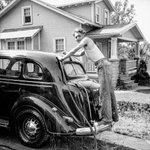
From a negative. Maryland, late 1930s.
A kid washing a car. He is standing on the back bumper in his work boots to reach the roof, garden hose in his hand, undershirt on, jeans rolled at the cuff. Nobody told him to get down off the car. Nobody was worried about scratching the paint. The car was a tool and the kid had a job to do.
Look at the shine on that fender. Look at the house behind him, the porch, the steps, a whole American life sitting there in the sun.
A commenter on Flickr says the car is a 1937 Chrysler Imperial, which was a serious car in its day, the top of the Chrysler line. Car people, confirm it or fight about it. That is half the fun of posting these.
This is one frame out of a whole archive of negatives shot around Maryland. I do not know the photographer's name and I do not know this kid's name either. Somebody's father. Somebody's grandfather. If this is 1937 or 1938, then within a few years gas was rationed, the factories stopped building cars altogether, and a kid his age was very likely in a uniform somewhere. But on this afternoon none of that has happened yet. On this afternoon he is just washing the car.
The rest of the archive is here: flickr.com/photos/thomashawk…
Who was he? And is that really a '37.


Sheng Thao won the Oakland mayor's race by 677 votes.
The mailer that darkened Loren Taylor's face and gave him red eyes went to 168,000 homes. It was paid for with $75,000 from the Duongs' California Waste Solutions, per the deal points in Andy Duong's own WhatsApp note, shown to the jury this week.
Thao's own campaign consultant testified he thought the piece was offensive and wanted the campaign to denounce it.
They refused. Because it was working.

Day 4 of the Sheng Thao trial.
The FBI investigation that led to the raids and the indictment started with a tip in February 2023, less than two months after she took office.
Special Agent Katherine Barclay told the jury Monday that the Oakland Public Ethics Commission flagged the attack mailers that went out against her opponents in the final days of the 2022 race. The printer who produced them said Mario Juarez never paid. That complaint led agents to Juarez’s iCloud. On it they found a WhatsApp note shared with Andy Duong titled “Deal Points for Sheng Thao :: Election :: Post Election::.” It listed the favors on both sides, including $75,000 for those mailers from California Waste Solutions.
The mailer itself darkened Loren Taylor’s face and gave him red eyes. It went to roughly 168,000 homes. Thao won by 677 votes. Her former campaign consultant, Noah Finneburgh, testified that he thought the piece was offensive and wanted the campaign to denounce it. He said Thao and Andre Jones decided not to, because the mailer was helping them.
Outside the courthouse, local advocates held a press conference calling for an end to the culture of corruption at City Hall. Former recall leader Seneca Scott said, “The city of Oakland is still run by the same corrupt machine that gave us Sheng Thao. Nobody has even apologized for supporting her.”
Former Councilmember Loren Taylor, who lost to Thao by those 677 votes, said coordination between the Thao campaign and the attack ad “seems pretty apparent to me.”
Testimony resumes Thursday.
Powder River, Wyoming. Population barely a hundred. And standing over a dead log cabin steakhouse on the highway, this guy.
Twenty one feet of rusting cowboy, giving you the thumbs up. Tumble Inn across his belly. LOUNGE CAFE on a big blue arrow. Sizzlin Steaks down at his boots. Every tube in him broken, the paint peeling, the neon long gone dark. I love him anyway.
He was built in 1959 for a restaurant in Las Vegas that never installed him. Too big, the owner decided. A Wyoming oilman named Bill Grey found him, bought him, had the waving arm added and the Sizzlin Steaks base built, and hauled him out to Powder River around 1960. An old timer said that when they first lit him up he was the biggest, brightest thing in all of Wyoming.
The steakhouse closed in 2005. He stood there alone for 18 more years, rusting in the wind off the high plains, outliving the business he was built to sell.
I have photographed more than 30,000 neon signs in America, and most of that has meant driving. Backroads, old highways, the main streets of towns the interstate forgot. It is a race, honestly. The weather takes them, the bulldozers take them, the plastic sign companies take them, and there are thousands I will never get to in time. These signs are art. Hand bent glass and painted steel, built by local sign shops for local dreamers, and when one goes dark a whole town gets a little less itself.
He got rescued. In 2023 they hauled him 35 miles to Casper, power washed decades of bird nests out of his belly, repainted him and rebent his neon. The crew named him Earl. He is being lit again this year at the Yellowstone Garage in Casper, close to home, still on the highway, still working.
Anybody ever eat a sizzlin steak at the Tumble Inn? And has anybody seen Earl lit up in Casper yet?
Enlarge this one big. Look at the rust. He earned every bit of it.
Shooting neon signs is one hell of a rabbit hole to go down. It's more like a black hole really as you will never get them all no matter how hard you try.
Here are just a few thousand of the neon signs that I've photographed in an album on Flickr: flickr.com/photos/thomashawk…

Found Ektachrome slide. Fisherman's Wharf at night, November 1969.
Peter Alioto's Italian Specialty House. Hof Brau. Sea Foods. The Sea Captain's Chest. And up top, in blue neon, the two words that sold a restaurant back then:
AIR CONDITIONED.
I've seen this scene during the day before, but historic slides of this block at night are more rare. Every tube lit. This is what the Wharf looked like when it was loud and red and unembarrassed about wanting your money. Neon on neon, and the hills behind it doing their own light show.
Look at the cars. A Yellow Cab, 789, a white Falcon in the foreground. A block of Detroit iron at the curb, and not one of them new. In November 1969 the cars on the Wharf were already somebody's old cars.
There were a couple of different Alioto's on the Wharf back then. This one was Peter's. The famous one, Alioto's at stall number 8, started in 1925 when Nunzio Alioto, a Sicilian immigrant, opened a fish stand. His widow Rose built it into the first building ever put up on the Wharf, and the family says she invented cioppino. San Franciscans have been arguing about that claim for 80 years.
Alioto's closed in 2020 and never reopened. This past January the city took the famous sign down and tore the building down for a public plaza. A hundred years of family history, replaced by picnic tables.
Peter's is gone too. And the Sea Captain's Chest, the nautical gift shop on the corner, did not survive the 70s. Everything lit here is dark now.
I have photographed more than 30,000 neon signs in America myself, and I am still out there shooting them. But I do not own a time machine. I cannot go back and photograph the thousands we have already lost. So I find these slides.
Somebody stood on Jefferson Street in November 1969 with a camera loaded with Ektachrome and figured an ordinary night was worth one frame. Finding their work is the next best thing.
Did you eat at Peter Alioto's? Or drink at the Hof Brau? And when did Peter's close? I cannot find it written down anywhere.

This is why I walk.
I drive plenty. Half my photography life is road trips, pulling over for neon and grain elevators and whatever the highway hands me. But in a city I walk. I put a camera over my shoulder and walk for hours, no destination, because the city hands you things it will not hand anybody in a car.
This morning, my last morning in New Orleans, I turned down a side street in the French Quarter. Not a main street. Just a random turn, the kind you make for no reason at all. And there it was, parked against a wall, lit by a single ray of sunlight.
House of Wings. N'awlinz Style Seafood. An old step van with a big red rooster on the side, a little chick beside him, both of them strutting. No vinyl wrap. No QR code. That rooster did not come off a printer. Somebody painted him, brush in hand. Old school.
Step vans were built to replace the horse a hundred years ago, for milk and bread and laundry routes. Drivers stood up at the wheel and hopped out either side, a hundred stops a day. The best were skinned in aluminum by Grumman, the airplane company, which is why they do not rust and are still out here working long after they should be dead. Every food truck you have ever eaten from is one of these or its grandchild. This one spent its life delivering door to door and now it sells wings. Same job, same truck.
And then look at the wall. Cream on top, red on the bottom, the same two colors in nearly the same place as the paint line on the truck. The truck is camouflaged against its own building. Serendipity. I did not arrange it. I just showed up on foot, with a camera, and it was there.
That is the whole secret to photography, if there is one. Serendipity is not rare. It is everywhere, parked on side streets in every city in America. It is just invisible at speed. You have to be out there, walking slow, looking at everything, believing the next corner is the one.
I never ate the wings. I left town today and the House of Wings is my unfinished business in New Orleans, along with two girls in a truck in the Quarter in 2006 I would still love to photograph again.
Walk your city, camera in hand. And enlarge this one big and look at that rooster.

This is the Perrine Bridge in Twin Falls, Idaho, and it is the only bridge in America you can legally jump off.
486 feet above the Snake River. No permit, no permission, no season. BASE jumping is allowed here 365 days a year, the only man made structure in the country where that is true, and jumpers fly in from all over the world for it.
Stand on the sidewalk long enough and you will watch somebody climb over the railing, step out into three or four seconds of freefall, pop a canopy and float down to the canyon floor like it is the most normal thing in the world.
This canyon has form for this kind of thing. In 1974 Evel Knievel tried to jump it in a steam powered rocket, from a dirt ramp a few miles east of this bridge. His parachute deployed too early and he drifted down to the riverbank and walked away with minor injuries. The ramp is still there.
I did not come to Idaho for a bridge. I come to Idaho the way I go everywhere now, on the road with a camera, working on photographing not only the 100 largest cities in America but all 50 states. Shoshone Falls is right down the road, which Idahoans will tell you is taller than Niagara, and then there is this bridge, with people falling off it on purpose.
My Idaho album is here: flickr.com/photos/thomashawk…
Would you jump?

.@DanielLurie all talk no action, all hat no cattle.
All he does is just say “welp folks, we still have a lot of work to do” over and over and over and over again while doing absolutely nothing about the fentanyl crisis in our city.
Weak, ineffective mayor.
There is no accountability, there is no plan.
San Francisco needs a @spencerpratt

16th and Mission is beyond insane. Zero @SFPD presence. @JackieFielder_ doesn’t care. The mayor has given up. It’s some of the most unbridled public disorder, public health hazards, and human suffering in the nation, right here on the streets of San Francisco. Crazy crazy crazy.
Why are people so opposed to single family homes?

You're not going to love this take, but the city would literally be better off with a fire that burned most structures down, provided we actually used the opportunity to rebuild properly and didn't pull an LA of only rebuilding single-family homes.
Caveat is you need a respectful warning like a foreshock so that people don't die.
This is Oscar Jonesy.
For more than 20 years he was the silverback at the San Francisco Zoo, and he lived there for 44 years, since 1981. Generations of San Francisco kids grew up watching him.
I took this portrait of him at the zoo, and of all the animals I have ever photographed, he is the one who looks most like he was sitting for it. Like he had something to say.
In February 2025 the zoo put him under anesthesia for what they called a routine medical procedure. He never woke up. He was 43.
Six months later it came out that Oscar had been diagnosed with advanced heart disease. The Great Ape Heart Project, the authority on gorilla heart care, says a gorilla with heart disease should never be put under anesthesia unless it is the only way to save his life. The zoo did it anyway, and then said nothing about the heart disease for six months.
His daughter Kabibe was crushed to death by a hydraulic door at the same zoo in 2014. She was 16 months old.
There is a new silverback at the zoo now, a gorilla named Cecil, who came from Louisville last year. I wish him a long and healthy life. I also hope somebody at that zoo is made to answer for Oscar.
San Francisco grew up with this gorilla. I shot him many times over the years. Did you ever visit him and if so what do you remember about him?

Watching C.J. Chenier tear it up at the New Orleans Funk Fest right now.
His father Clifton Chenier invented zydeco. Literally invented it. The King of Zydeco, and the first Creole musician to ever win a Grammy.
C.J. joined his dad's band on his 21st birthday. When Clifton died in 1987, C.J. inherited his father's accordion and the Red Hot Louisiana Band, and he has been leading that same band ever since. Almost 40 years now.
He is 69 years old and he plays that accordion like it’s part of his body.
If you ever get the chance to see CJ Chenier perform down in New Orleans, don't pass it up.
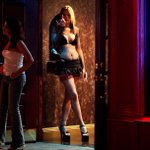
I took this photograph 20 years ago, in the French Quarter in April 2006, eight months after Katrina.
Two girls in a slow moving pickup kept yelling, take our picture, take our picture. One of them got shy and turned away, so her friend pushed her face back towards my camera. Snap. The truck was gone in an instant.
As far as I know, neither of them has ever seen this photograph.
I wrote that the girl on the left embodies the joie de vivre New Orleanians have, that even the people hardest hit by life here carry a spirit about them. Twenty years of photographing cities later, I still believe that.
Tennessee Williams said America has only three cities: New York, San Francisco, and New Orleans. Everywhere else is Cleveland.
San Francisco is home. I have spent half my life photographing New York and New Orleans. There is a lot of truth in that quote, and some days, standing on a corner in the Quarter, I believe every word of it.
But I am also in the middle of photographing the 100 largest cities in America, with albums published for 60 of them, and the project has ruined the quote for me a little. Detroit has a grit and a dignity all its own. So does Pittsburgh. So does Memphis, and El Paso, and a dozen other places Williams would have waved off as Cleveland. And of course Chicago has that pizza. And don't you dare try to say Lou Malnati's deep dish is not pizza. Every great city has its own charm. You just have to walk it with a camera until it shows you.
So no, I will not take the Williams quote as religion. But back here in New Orleans this weekend, with the food and the music and the art and the people. I understand exactly why he said it.
My 100 Largest American Cities collection: flickr.com/photos/thomashawk…
Now the part I actually care about. Somewhere out there are two women who were girls in a truck in the Quarter in 2006. Were they sisters? Friends? I would love to take their portrait again, 20 years later. How awesome would it be if this found them?
And Cleveland, defend yourself. Tell me why your city belongs on the list. You are one of the hundred American cities I still need to photograph.

Tom Catz. Somewhere in New Orleans there is a story behind this sign.
I photographed this last night inside Chickie Wah Wah, a little music club on Canal Street in Mid-City. Red neon, TOM CATZ, over the grinning face of a cat in round glasses, hanging over the bar like he knows some secrets. And maybe he does. I just cannot find where he came from.
Here is what I do know. Chickie Wah Wah's walls are a museum of dead New Orleans. The club is covered in signs rescued from local businesses that are gone, packed in tight around the stage like a collage. So Tom Catz was something once. A bar? A club? A restaurant with a cat for a mascot? Somebody's uncle's place?
The club itself is a survivor. Dale Triguero opened it just before Katrina, in a derelict building that had been the Canal Bus Stop. The storm wrecked the building, and he rebuilt it and reopened it anyway. He named it after a 1950s Bobby Marchan record, Chickie Wah Wah. Huey Piano Smith had cut his own version, Little Chickie Wah Wah, and the club calls the two of them its patron saints, with both 45s on the wall.
Triguero died in 2021, and rather than let Mid-City's music room become a parking garage or a law office, the musicians who loved the place kept it alive. It is a listening room. They will politely ask you to take your conversation outside, where they pipe the music so you do not miss anything.
This is why New Orleans is New Orleans. The band is ten feet away, the room holds almost nobody, and the walls remember everything the city has lost.
So help me out. What was Tom Catz? Where was it, and how did its sign end up glowing across the bar inside of Chickie Wah Wah?
Grok tells me it’s from the Tom Cat dinner from Wildwood, New Jersey. I don’t think that’s right though. What would a sign from a diner in New Jersey be doing all the way down in the Big Easy.
Surely somebody out there knows or knows somebody who knows.
