

researcher @ baseten
Canada
Joined December 2022
- Tweets659
- Following274
- Followers201
- Likes1.4K




Pinned Tweet
vLLM repo: github.com/b10-tv/speculativ…
HF checkpoint: huggingface.co/RampPublic/sp…
BaseLabs blog: labs.baseten.co/articles/spe…

1
477
thovil retweeted

effectively translating between model hidden states pushes what is practically possible in routers and multi agent swarms. @thomasvillix crushed with our friend @b_geist at @RampLabs!


11
378
thovil retweeted

Baseten and Ramp collaborated on speculative encoding: useful for when you want a session to use multiple models but don’t want to pay the re-prefill penalty.
thovil retweeted

We should be able to change models without paying for the same work twice.
Today, one agent can spend time reading a long document, hand the task to another model, and that model has to read the whole thing again. You’re paying in time and compute to repeat work that was already done.
That makes it much, much harder to use the best model for each part of a task. The model that reads the document shouldn’t have to be the model you use for everything that follows.
Our team at @RampLabs is working on a different approach: translate what one model has already processed into a form another model can use, without rereading the original text. One translator for seven models across four model families, and all 42 directions between them.
The team also showed that an agent can ask a specific question of another agent’s context and get just the relevant information back, in a form its own model can use.
The goal is models that work better together, and higher ROI for companies using AI deeply.
We’re releasing the code and checkpoints. Excited to see what people build!
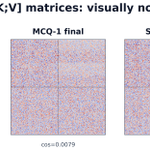
[DS] Scrambled, still right: Shuffle a document and a model's borrowed memory looks like a different document, yet it still answers correctly.
1
28
thovil retweeted

We’re extremely excited to see what the community can build on top of speculative encoding, big and small. We're releasing checkpoints along with our inference code so you can hack with multi-model translation at home.
vLLM repo: github.com/b10-tv/speculativ…
HF checkpoints: huggingface.co/RampPublic/sp…
Unleash the swarms!
thovil retweeted

It's always good to shop around, and this is true for LLMs in particular. The demands of a long-running agentic task often change throughout its lifetime, so different models with varying capabilities and ranging costs are appropriate at different points. That's the ideal but...

If your agents use more than one model (multi-agent systems or swarms) for a task, you have to process the same context every time a new model picks up the task. Our research team at @baselabs collaborated with @RampLabs to translate between models instead, introducing a new method called speculative encoding.
This method translates information across models up to 4x faster while still keeping 96% accuracy. We’ve open-sourced the weights and code below.
thovil retweeted
Multi-agent swarms shouldn't have to read context more than once. Introducing speculative encoding, one 2.35B MoE that directly translates between any model's hidden states. Across 7 models, it keeps 96.9% of base accuracy and cuts prefill latency by up to 7.5× on long documents.
thovil retweeted

If your agents use more than one model (multi-agent systems or swarms) for a task, you have to process the same context every time a new model picks up the task. Our research team at @baselabs collaborated with @RampLabs to translate between models instead, introducing a new method called speculative encoding.
This method translates information across models up to 4x faster while still keeping 96% accuracy. We’ve open-sourced the weights and code below.
thovil retweeted

Today, in collaboration with @RampLabs we release a new method called speculative encoding.
Agent to agent communication requires re-prefilling on every new model change.
To get around this, we train a single network to translate states across 7 different models and 4 families, retaining over 96% of the accuracy and up to 4x the speed!
Humans need to read text, but agents don’t. Stop re-prefilling across models (yes even across families), translate instead, with speculative encoding. Really excited to see what the community builds with this! We’ve releasing our best checkpoint and inference code, too.
2
12
585
thovil retweeted

Excited this post is finally out 🎉
Benchmarks can be gamed. Production can't: real users have to actually like the model.
This one beats Opus 5.5 at deep research and is now the default in Genspark's agent. Built by Baseten's training team in collab w @genspark_ai.
Genspark and Baseten Applied Research post-trained an open-weight model that beats Opus 5.5 at deep research.
Starting from Qwen3.5-397B, our post-trained model scores 0.759 on @genspark_ai's internal evals, ahead of Opus 5.5 (0.738) and well above the base model (0.612). It’s now the default model in production behind Genspark’s Deep Research agent.

thovil retweeted

It's a good model, sir

Introducing the Artificial Analysis Decision Index v2: a new proprietary evaluation, updated benchmarks, and a headline metric that rewards model calibration
We’ve released the second version of the Artificial Analysis Decision Index to better reflect real-world utility and guard against benchmark gaming. 45% of the Index is now built on private datasets, up from 25% in v1. Drex Max v1.1 from @NaceAI narrowly leads among decision models at 73, within 1 point of GLiDE v1.2 (@fastinoAI) and Mammoth 27B (@baselabs)
Updates in Decision Index v2:
➤ Decision Score: We adopt a new headline metric that rewards a model for both correctness and calibrated confidence. Each question scores from 0 to 100: right answers score above 50, wrong answers below 50, and confidence in its top answer moves the score within each half
➤ AA-Paperclip (30%): We added a new private benchmark of 1,500 documents including resumes, receipts, invoices, and AI and machine learning research papers. Models make decisions and extract facts from each document and are scored jointly as a single decision, correct only if all 15 answers are right
➤ AA-Symmetry (15%): This evaluates whether models change their answers for equivalent questions worded differently. We test 120 questions with variations such as reordered options, swapped labels, and negated yes/no questions, then measure how consistent the model’s probabilities are across those variations
➤ AA-Omniscience-Decision v1.1 and HLE-MultiChoice v1.1 (15% each, down from 25%): AA-Omniscience-Decision now varies the wording of its “I don’t know” option across ten alternatives. HLE-MultiChoice adds an option to decline using the same ten phrasings
We’ve also added EvalSafe-ONET-AA (15%), our implementation of @typesafeai’s ONET benchmark. We have retained When2Call from @NVIDIAAI in the Index at a decreased weighting of 10% (down from 25%), and removed WildGuardTest given its high saturation
Key results:
➤ Three decision models sit within 1 point at the top of the Index: Drex Max v1.1 from Nace AI and GLiDE v1.2 from Fastino Labs both score 73, with Mammoth 27B from Base Labs scoring 72
➤ Cost per 1M Tasks varies by more than 60x across decision models: Celeris-1.1 Decision ($14), Decider v1.2 ($68) and Drex Max v1.1 ($102) sit on the Decision Index vs. Cost Pareto frontier, while Clef costs $859. Token price is not the only cost driver: most decision models, including Drex Max v1.1 and Decider v1.2, bill a document’s input once for all its questions, while GLiDE v1.2 and Decider Flash v1.2 bill it for every question. This means GLiDE v1.2 costs $780, nearly 8x higher than Drex Max v1.1 despite only 33% higher list prices
➤ Language models can score higher, alongside higher Cost and Time per Task: Claude Haiku 5.5 (Max) scores 77 and GPT-6 Luna (Max) scores 76 on Decision Index v2, putting them ~3 points ahead of Drex Max v1.1. GPT-6 Luna (Max) costs $1,530 per 1M Tasks vs. $102 for Drex Max v1.1 (15x the cost) and takes 11.34 seconds per task vs. 275 milliseconds (~40x slower)


thovil retweeted
OPSD and related variants have been popular areas of post-training research in 2026.
Whilst the original papers were commendable work with respect to on-policy learning and the dense feedback they provided, we should treat the bias that a hinted teacher injects as incongruent with long-horizon continual learning.
This week we unpack some of the literature, alongside our own attempted fixes and observations to understand why this is the case.
