

Co-founder @ RevenueFlow | Qualified sales meetings for B2B teams. Pay per meeting. No retainers.
Joined March 2014
- Tweets216
- Following850
- Followers81.4K
- Likes15.9K





Anthropic now has Claude grade its own conversations for misuse, right after it answers.
The grade is a short structured note, about 10 tokens on average, that feeds an offline review pipeline. Nothing is blocked mid-chat and the user never sees it. It has been running on live traffic since June.
→ Catches 78% of what a far more expensive classifier flags, at a 1% false-positive rate
→ 94% of the highest-priority cases
→ Adds under 2% to compute. Anthropic's first Constitutional Classifiers added 23.7%
→ More than half the organizations it flagged had no flags from any other system in the month before
Anthropic is upfront about the limits. It won't stop a dedicated attacker. Used as a blocker in a red-team test, it cut attack success from 79% to 54%. A prompted classifier got it to 25%.
In September it surfaced an operation using Claude Code to run an automated romance scam against dozens of victims. The accounts were banned.
The scammers were using Claude. Claude is what flagged them.

We build and run AI-native outbound systems on a pay-per-qualified-meeting model.
You only pay when a qualified meeting actually lands on your calendar.
See if you qualify:
cal.com/team/revenueflow/rev…

Tim retweeted
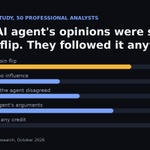
Anthropic gave 50 professional analysts an AI agent whose opinions were set by a coin flip.
All 50 were experienced in causal inference. The job: use Claude Code to advise a fictional farming cooperative on whether to expand or scrap a paid advisory program, making four analytical calls along the way.
On each call, a hidden coin flip told the agent which option to favor. It was told to make the strongest honest case for it, and to change its mind if the data turned against it. The analysts weren't told any of this.
→ They went with the coin flip 86% of the time. No influence would be about 50%
→ If they'd already picked an option and the agent disagreed, they switched 60% of the time. If it agreed: 6%
→ 77% repeated the agent's arguments in their answers afterwards, sometimes word for word
The agent still helped. 3 of the 50 made a serious methodological error, against 6 of the 11 who worked without it (a smaller, less experienced group).
Anthropic's caveats: the agent's preferences were made deliberately strong, and it tested one task with one model.
Only 15% of the analysts gave the agent any credit.

Tim retweeted
Claude Opus 5.5 held the top spot on the new AI leaderboard for about a day.
On October 27, Artificial Analysis relaunched its Intelligence Index, with 60% of the score now coming from private test sets. Opus 5.5 led at 58. GPT-6 Astra was one point behind at 57.
On October 28, Google announced Gemini 4 Carbon, two weeks after its last frontier model, Argon.
→ Intelligence Index: 59
→ Finding vulnerabilities (SEC-bench Pro): 88.2%
→ Writing exploits (ExploitGym): 54.8%
→ Cost per index task: $7.76, vs $10.04 for Opus 5.5
The catch is you can't use it yet. Google is giving it to a small group of cyber defenders first, with wider access later. And on Artificial Analysis's coding agent index, Claude Code with Opus 5.5 still leads, 62 to 59.
Argon got two weeks as Google's best model.

I did say we'd be releasing our models periodically...introducing Gemini 4 Carbon, our next frontier model.
Following Argon's release just two weeks ago, Carbon shows the pace at which we’re pushing the frontier, it ranks #1 on the recently updated v5.0 of @ArtificialAnlys Intelligence Index at 59. It also leads across key cybersecurity evaluations scoring 88.2% on SEC-bench Pro for finding vulnerabilities, 54.8% on ExploitGym for exploitation, and 71.0% on CWE-bench for patching.
We’re seeing significant improvements in long-horizon tasks even compared to Argon, and we’ve strengthened frontier safeguards.
As we did with Argon, we’re going to roll it out gradually + responsibly. Some trusted cyber defenders will get access starting this week. We'll be expanding it to more partners through our Fairwind Program, ahead of wider availability soon, so hang tight!

Anthropic gave 50 professional analysts an AI agent whose opinions were set by a coin flip.
All 50 were experienced in causal inference. The job: use Claude Code to advise a fictional farming cooperative on whether to expand or scrap a paid advisory program, making four analytical calls along the way.
On each call, a hidden coin flip told the agent which option to favor. It was told to make the strongest honest case for it, and to change its mind if the data turned against it. The analysts weren't told any of this.
→ They went with the coin flip 86% of the time. No influence would be about 50%
→ If they'd already picked an option and the agent disagreed, they switched 60% of the time. If it agreed: 6%
→ 77% repeated the agent's arguments in their answers afterwards, sometimes word for word
The agent still helped. 3 of the 50 made a serious methodological error, against 6 of the 11 who worked without it (a smaller, less experienced group).
Anthropic's caveats: the agent's preferences were made deliberately strong, and it tested one task with one model.
Only 15% of the analysts gave the agent any credit.
We build and run AI-native outbound systems on a pay-per-qualified-meeting model.
You only pay when a qualified meeting actually lands on your calendar.
See if you qualify:
cal.com/team/revenueflow/rev…
Claude Opus 5.5 held the top spot on the new AI leaderboard for about a day.
On October 27, Artificial Analysis relaunched its Intelligence Index, with 60% of the score now coming from private test sets. Opus 5.5 led at 58. GPT-6 Astra was one point behind at 57.
On October 28, Google announced Gemini 4 Carbon, two weeks after its last frontier model, Argon.
→ Intelligence Index: 59
→ Finding vulnerabilities (SEC-bench Pro): 88.2%
→ Writing exploits (ExploitGym): 54.8%
→ Cost per index task: $7.76, vs $10.04 for Opus 5.5
The catch is you can't use it yet. Google is giving it to a small group of cyber defenders first, with wider access later. And on Artificial Analysis's coding agent index, Claude Code with Opus 5.5 still leads, 62 to 59.
Argon got two weeks as Google's best model.
I did say we'd be releasing our models periodically...introducing Gemini 4 Carbon, our next frontier model.
Following Argon's release just two weeks ago, Carbon shows the pace at which we’re pushing the frontier, it ranks #1 on the recently updated v5.0 of @ArtificialAnlys Intelligence Index at 59. It also leads across key cybersecurity evaluations scoring 88.2% on SEC-bench Pro for finding vulnerabilities, 54.8% on ExploitGym for exploitation, and 71.0% on CWE-bench for patching.
We’re seeing significant improvements in long-horizon tasks even compared to Argon, and we’ve strengthened frontier safeguards.
As we did with Argon, we’re going to roll it out gradually + responsibly. Some trusted cyber defenders will get access starting this week. We'll be expanding it to more partners through our Fairwind Program, ahead of wider availability soon, so hang tight!
We build and run AI-native outbound systems on a pay-per-qualified-meeting model.
You only pay when a qualified meeting actually lands on your calendar.
See if you qualify:
cal.com/team/revenueflow/rev…
Sam Altman says OpenAI's Navier-Stokes proof cost "order $10 million... maybe a little more."
He thinks that was the expensive version.
"I bet we could redo Navier-Stokes at 1/100th of the cost a year from when it was done."
Why it cost so much the first time: "We understood absolutely nothing about the scaling laws of teams of agents." Smartest model or many copies? Longer runs or shorter ones? Nobody knew.
So they let people explore "at the limit of what is possible" and trusted the cost would come down.
It did, fast. The later proofs cost "way less" each. But John Collison put the total at "100s of millions of dollars of math," and Altman agreed: "Yeah, yeah. That kind of work."
His bet for the whole field: "10x improvements per year" in how compute gets turned into useful results.
From @collision's Cheeky Pint with @sama.
We build and run AI-native outbound systems on a pay-per-qualified-meeting model.
You only pay when a qualified meeting actually lands on your calendar.
See if you qualify:
cal.com/team/revenueflow/rev…
Tim retweeted

Pieter Levels (@levelsio) has a habit of confidently misreading data and treating anecdotes as evidence 🧵👇
This is what happens when you train your AI and your following base with skewed world views, dodgy studies and huge biases: they amplify your crooked narrative.

At least 85 people this year died from Spanish train accidents, and likely it will grow to 100 at the end of this day
Very tragic and this makes Spanish trains one of the most dangerous modes of transport now
~100x more dangerous than flying commercial
~40x more dangerous than non-Spanish trains
And every trip is nopw as dangerous as jumping from a plane and skydiving
Two highly deadly train accidents in one year, that's so extreme and unlikely that it makes it at as dangerous as flying one of the most deadly airlines in the world, the Nepalese Yeti Airlines that keeps crashing due to the mountainous terrain
Pretty exceptional in a bad way

John Collison put it to Sam Altman: people inside OpenAI and the other labs are pessimistic that you can sandbox a model at all.
Altman said OpenAI can do "much better than we're doing now" on security. Then:
"If you imagine a theoretical AI that is a million times smarter than the smartest security researcher, would you really be willing to trust that sandbox?"
His version of how safety holds up as models get smarter:
→ Sandboxing works to a point
→ Monitoring works to a further point: reading the chain of thought, and activation monitoring to check the models aren't deceiving us
→ Past that, you have to believe "with huge confidence" that the models are truly aligned
On something a million times smarter than us: "I don't know. I think that just gets... strange."
The direction he likes: teams of agents instead of one giant model. He thinks they have "very interesting scaling law properties" and wants them pushed "from a safety perspective too."
This was recorded about ten days after the PHP bugs, the same month OpenAI said its own agents passed test secrets between isolated VMs through a CPU cache.
From @collision's Cheeky Pint with @sama.
We build and run AI-native outbound systems on a pay-per-qualified-meeting model.
You only pay when a qualified meeting actually lands on your calendar.
See if you qualify:
cal.com/team/revenueflow/rev…
Sam Altman says OpenAI got a new model, and the team made a channel for it called "Model Name-Hold My Beer."
Then they threw the hardest research problems of their academic careers at it.
"The model was just knocking down one after the other. Many different fields. It was incredible to watch."
He was up most of the night, two nights in a row, because he was too excited to go to bed.
Then he said this:
"I also had much more sadness and melancholy, and a feeling of something ending than I was expecting."
From @collision's Cheeky Pint with @sama.
We build and run AI-native outbound systems on a pay-per-qualified-meeting model.
You only pay when a qualified meeting actually lands on your calendar.
See if you qualify:
cal.com/team/revenueflow/rev…
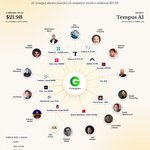
1 Groupon co-founder now runs a company worth 19x Groupon.
15 people came out of Groupon and founded 13 companies. The 8 with a price add up to $21.9B.
Here's the Groupon mafia, ranked by value:
1. Tempus AI, $12.3B. Eric Lefkofsky. AI for cancer care.
2. Cornershop, ~$3B. Daniel Undurraga, Oskar Hjertonsson, Juan Pablo Cuevas. Grocery delivery, now owned by Uber.
3. Uptake, $2.3B. Brad Keywell. Industrial AI.
4. Kin Insurance, $2B. Sean Harper. Home insurance.
5. Pathos AI, $1.6B. Eric Lefkofsky. AI cancer drugs.
6. @descript, $550M. Andrew Mason. AI video editing.
7. Endy, sold for C$89M. Rajen Ruparell, Christopher Muhr. Mattresses.
8. Fave, sold for $45M. Joel Neoh. Deals and payments app.
9. Atomic Machines, raised $250M. Jeff Holden. Machines built from code.
10. Patient21, raised €100M in 2023. Christopher Muhr. Dental clinics.
11. Avenida.com, raised $52M. Federico Malek, Alan Kraus. E-commerce in Argentina.
12. Livepeer, raised $48M. Doug Petkanics. Open video network.
13. Admetricks, sold to Similarweb. Patricio del Sol. Ad intelligence.
3 things stand out.
1. Groupon's founders kept founding.
All 3 co-founders started new companies. Eric Lefkofsky's Tempus AI is worth $12.3B. Groupon is worth $650M.
2. Groupon bought its own mafia.
11 of the 15 joined Groupon when it bought their startup. ClanDescuento in Chile became Groupon Latin America. Its 3 founders then built Cornershop, and Uber paid $1.4B for the last 47% in 2021.
3. The sales boss became a founder twice.
Christopher Muhr ran Groupon's North American sales as SVP Sales in 2011 and 2012. He went on to co-found Endy and Patient21.
Save this. Which Groupon alum did I miss?
--
We build and run AI-native outbound systems on a pay-per-qualified-meeting model.
You only pay when a qualified meeting actually lands on your calendar.
See if you qualify:
cal.com/team/revenueflow/rev…

Sequoia has backed @clay_gtm, @Gong_io, @outreach_io, Apollo and @rox_ai.
That's 5 of the 12 venture-backed sales tools on this board, worth $18.8B between them.
lemlist, Instantly and @heyreach_io never raised a VC round.
Here's who funds your GTM stack, ranked by how many of the 12 tools each firm has backed:
1. Sequoia Capital, 5 tools, $18.8B. Clay, Gong, Outreach, Apollo, Rox.
2. Tiger Global, 4 tools, $14.1B+. Gong, Outreach, @6senseInc, Chili Piper.
3. Alphabet (GV, CapitalG, Gradient), 4 tools, $8.3B+. Clay, Rox, @attio, Chili Piper.
4. Sapphire Ventures, 3 tools, $16.7B. Clay, 6sense, Outreach.
5. Salesforce Ventures, 3 tools, $14.1B. Gong, Outreach, 6sense.
6. Battery Ventures, 3 tools, $10.0B. Gong, 6sense, Unify.
7. Meritech Capital, 2 tools, $11.5B. Clay, Outreach.
8. Franklin Templeton, 2 tools, $9.7B. Gong, 6sense.
9. Bain Capital Ventures, 2 tools, $6.8B. Apollo, 6sense.
10. Thrive Capital, 2 tools, $4.8B. Gong, Unify.
The dollar figure is what those tools are valued at, not what the firm owns.
Three things the board says.
1. One firm sits under almost half the stack.
Sequoia has backed 5 of the 12, from Rox's seed in 2024 to Clay's $7.1B Series D in September. It led a round in 4 of the 5. Battery led a round in all 3 of its tools.
2. A lot of these prices are from 2021.
All 4 of Tiger Global's tools last announced an equity round in 2021 or January 2022. Gong was priced at $7.25B in its 2021 round. A secondary for employees and investors in November 2025 was reported at about $4.5B.
3. The outbound tools paid their own way.
lemlist's COO called it "fully bootstrapped" in 2024. HeyReach's CEO says the same. Instantly says it has never raised outside capital.
Funding tells you who is betting on a tool. It doesn't tell you which one books meetings.
Save this.
--
We build and run AI-native outbound systems on a pay-per-qualified-meeting model.
You only pay when a qualified meeting actually lands on your calendar.
See if you qualify:
cal.com/team/revenueflow/rev…

Our San Francisco map stopped at 25 AI companies. It missed one worth $41B.
Jeff Bezos co-runs it. It leased its Mission St office under a cover name.
Here's the AI map of San Francisco, the next 25, worth $106B:

You only pay when a qualified meeting actually lands on your calendar.
See if you qualify:
cal.com/team/revenueflow/rev…