

SI news and coding agents tested hands-on, from Claude Code to Grok Build. What shipped, what works, what doesn't. Recap every Sunday 🇮🇹
Italy
Joined December 2017
- Tweets2.6K
- Following109
- Followers115
- Likes2K




Pinned Tweet
Weekly AI Recap, Sunday edition. Here are the seven biggest breakthroughs from the week.
1. Terminal X Eval Agent → 88.6% match with senior investor judgment, and 25% more mandate deviations caught on GPT-6.1 Sol. Every graded output is scored against a 54-criterion rubric.
2. Nemotron 3.5 Bolt 74B → 74B total parameters with 9B active, shipped as native 2-bit (IQ2) weights that fit in 24GB. A 74B dense model must keep all 74B parameters resident in memory.
3. Mistral Voxtral 3 → speech split into three layers: 3 transcription models, 1 text-to-speech model, and a LiveKit-based voice agent SDK that wires them together.
4. Google Cloud Agent Compute Engine → one hardware-isolated microVM per AI agent, with no credentials inside it.
5. Nemotron 3.5 Bolt E4B 4GB → an open small language model for local voice agents, game characters and robots. NVIDIA starts from Gemma 4 E4B and changes its behavior through post-training rather than a new base.
6. Kimi K3.1 Pro → a post-trained successor to Kimi K3 with a 1,048,576-token context. The story is post-training, not a new base release.
7. Agent skills donated to the Agentic AI Foundation → procedures no longer need rewriting for each platform, so a skill can survive the next release instead of depending on one company's roadmap.
Bookmark this recap to catch up on the week in 60 seconds.
A 27B open model that never writes a word, yet it answers questions about a photo.
It's d3-ultra from vLLM Semantic Router, released under Apache-2.0, and it's already running on a free API. What it does:
1. Yes/no and multiple-choice questions come back as probabilities instead of sentences.
2. It points at things. Ask where something is in a picture or a video, and you get one box with a confidence score.
3. It reads up to about 98,000 words per question, roughly 330 book pages.
4. On the team's own SR-Text test it scores 87.2, while the next best, GLiDE V1.2, gets 85.1.
5. You can try it for free on the official Hugging Face Space.
All the scores are self-reported on private tests. On finding things in pictures it trails its sibling d3-turbo, so for that job, d3-turbo is still the safer bet.

Grok Bot 0.75.8 is out. Fewer approval prompts, same control.
→ Bots can suggest changes to your Auto-review rules. You confirm on a card, nothing changes before that
→ Auto-review double-checks an action before asking you, so safe steps stop interrupting
→ New connector tools (like X) work right away, no reconnecting
→ When background work ends, the bot runs the follow-ups you asked for and stops there
A huge update that makes agents much less tiring to use.
*** JUST IN *** OpenAI's GPT-6.1 Terra is out today, and in the API it costs half as much as the Terra it replaces.
You can try it now in ChatGPT Work and Codex on Plus, Pro, Enterprise and Edu plans. Developers can call it as gpt-6.1-terra. OpenAI shows it for quick jobs like:
Drafting proposals and filling out forms
Reading technical drawings and building a 3D model from them
Reading incoming invoices and entering the details into accounting software
Where it's good: on Terminal-Bench 4.0, a test of coding from the command line, it solves 50.3% of tasks, more than double GPT-5.6 Terra. For the hardest code, OpenAI still points to GPT-6.1 Sol and GPT-6 Astra.
UOpenAI's GPT-6.1 Terra is out today, and in the API it costs half as much as the Terra it replaces. book costs about 12 cents.
A free, open source tool checks your own servers for the security flaws being exploited right now.
hevnsnt's cvENGINE reached 300 GitHub stars in 2 days. It maps your public servers (subdomains, open ports, versions) and matches them against those flaws (CVEs).
You run it yourself on a Linux server with 4 GB of RAM and 20 GB of free disk. Your inventory stays on your server.
Its checks are read-only, and it logs the exact command each one ran. The AI is optional. Only scan what you own or are allowed to test.
Tinker retweeted

GPT-6.1 Terra: delivering fast and capable computer use at a lower price.
GPT-6.1 Terra understands what’s on screen, takes action across apps, writes naturally, and is a more capable model for your whole workday with the efficiency to take on more of it.
🤖 Made with AI
AI didn't break the internet. It sent the bill.
Millions of attack attempts. No organization says it was breached. Two vendors withdrew their claims.
Inside: 8 AI predictions that missed, and a checklist if you run a site.
Has your host patched yet?

it's coming.

Anthropic has filed an S-1 registration statement with the SEC related to its proposed IPO.
Read more: anthropic.com/news/s1-sec
Legal disclaimer: A registration statement relating to these securities has been filed with the SEC but has not yet become effective. These securities may not be sold, nor may offers to buy be accepted, prior to the time the registration statement becomes effective. This post does not constitute an offer to sell or the solicitation of an offer to buy these securities, nor shall there be any sale of these securities in any state or jurisdiction in which such offer, solicitation or sale would be unlawful prior to registration or qualification under the securities laws of any such state or jurisdiction.

ChatGPT can now hide a chat behind a 4-digit PIN. Forget the PIN and you can lose the chat for good.
It's rolling out gradually to Free, Go, Plus, Pro, Business, Enterprise and Edu accounts. If you don't see the option, it may not be on your account yet.
What you get:
1. Open the ••• menu on an eligible chat and pick Lock chat. It leaves your history, pinned chats and search. You find it under Projects > Locked chats, opened with your PIN or Face ID or Touch ID on supported phones.
2. Locking isn't encryption. OpenAI still keeps the chat as long as before, and Enterprise and Edu chats still show up in compliance logs.
3. Forgetting the PIN deletes nothing by itself. Resetting it does. Every locked chat and the files behind that PIN are gone, and OpenAI Support can't bring them back.
4. Temporary, archived, group and shared-link chats can't be locked. Anyone who opens a locked chat can still copy what's in it.
So the PIN is the only key, and nobody can help you if you lose it.

Add a locked spec gate between planning and coding so agents stop re-editing files that already pass. This removes the rework loop that burns tokens and hides regressions.
1. Spec → CLAUDE md rules (scope, acceptance tests, files allowed to change) → locked task brief
2. Brief → coding agent in a checkpointed session → diff on a feature branch, one task per commit
3. Diff → test runner and linter → pass/fail report listing only failing test names
4. Report → review model in a fresh context → approve, or a targeted patch limited to failing files
Resumable sessions mean a crash restarts at the last commit, not at zero. Keep the brief under one screen so every model in the chain reads the same constraints. The same gate pattern carries over to newer tools like JetBrains Thinkrail.
Save this workflow for your next build.
The best AI engineering workflow right now is a multi-model, multi-tool stack, not a single model.
Long-context prompt prefill → TokenGate (1.4x to 11.3x faster time-to-first-token, drop-in for existing LLMs)
Speech transcription and translation → Granite Speech 5.0 (more accurate transcription, translation, and speaker attribution)
DNA sequence questions in chat → Carbon-X (66.7% average across 5 DNA benchmarks, Apache 2.0)
Length generalization for state tracking → PAR (progress-aligned recurrence, so extra loop iterations actually help)
Resumable coding agent runs → OpenHands (checkpointed sessions that don't restart from zero after a crash)
Bookmark this stack map for your current build.
Carbon-X: 14.8B params, reads raw DNA in chat, answers in English
Qwen3-14B: the 14B base it was built on → Carbon-X: 66.7% average across 5 DNA benchmarks
• Input: raw DNA sequences pasted straight into a chat prompt
• Output: plain English answers instead of label or score files
• Scale: 14.8B parameters, open weights under Apache 2.0
• Coverage: one model handles DNA and natural language together
Move sequence interpretation workloads that need explanations in English to Carbon-X today. Keep general text and coding tasks on your current model.

Tinker retweeted

Grok @Bot can now call someone or a business for you, make a request on your behalf, take notes on the response and send you a note summarizing the conversation!

Grok Bot 0.77 looks INSANE 🔥
> Calls: your Bot can dial someone, sit on hold, press keys and get transferred while you watch a live transcript
> Messages on Mac: a setup screen under Connect Apps, still switched off
> Tailscale: Grok Bot can join your private tailnet once an admin approves it
> Payments: a screen to connect payment accounts and pick a default, on top of yesterday’s Vault
> Sharing: emails when someone shares a Bot with you, and invites need Premium or Ultra

TokenGate attacks the prefill bottleneck directly. Its learned token pruning module is drop-in for LLMs and decides which prompt tokens still matter before the expensive long-context pass runs.
• Time-to-first-token: 1.4x to 11.3x faster on long-context prefill
• Peak memory: 1.5x to 3.4x lower
• Accuracy: reported with no loss, from Stanford and UC Berkeley researchers
Over the next quarter, the 11.3x ceiling matters less than the spread. Teams will need to benchmark the gain at their own prompt lengths, and long-context serving costs will start to track pruned tokens rather than raw input size.

Agents that crash mid-task restart from zero and re-edit files that already work. This rule forces resumable, checkpointed sessions in Claude Code, Cursor, or OpenHands.
1. Before any edit, create a checkpoint file named AGENT_PLAN in the project root. List each step with its target file and a status of pending, done, or blocked.
2. After every code-changing tool call, mark that step done and record the file and function touched. Continue only from the first pending step.
3. On resume, read AGENT_PLAN and the current diff before acting. Never rerun a done step or rewrite a file whose status is done.
4. If a command times out or errors, log the exact command and message in AGENT_PLAN, retry once with a narrower scope, then stop and ask.
Bookmark this rule for your next agent session, since durable-harness now logs every model and tool call so runs survive crashes.
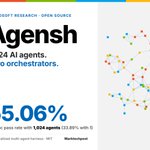
A central orchestrator becomes the choke point once multi-agent runs grow. Microsoft Research open-sourced Agensh, which removes it.
• Coordination: no central orchestrator, so workers self-organize
• Shared state: one Git repo, a chat channel and a findings board
• Scale: 1 to 1,024 agents on ProgramBench under a 6-hour budget
For production teams, shared state is the hard part. Parallel agents can collide on the same repo and findings well before compute runs out.


Repeatedly running full benchmarks slows recursive self-improvement, and EvalResearchBench tests whether agents can build the cheaper evaluator themselves.
→ What it does: an agent called the researcher selects or synthesizes tasks, implements graders, and revises them in pilot tests before freezing an executable evaluator
→ What it replaces: human experts hand-picking benchmark subsets or writing compact suites to cut evaluation cost
→ Scope: coding, co-work, and reasoning evaluators, built under fixed time and API budgets
→ Setup: 9 researchers and 13 candidate models, with each frozen evaluator compared against 14 target benchmarks on score concordance and pairwise agreement
It's a Hugging Face Daily Paper with 19 upvotes. The open question is whether agent-built evaluators track the full benchmarks closely enough to trust during iteration.

Model selection is moving into the agent loop. Grandet exposes listed API prices for each model as a callable tool, so agents can choose an endpoint at runtime.
→ Coverage: listed prices from 1,800+ official APIs, inference providers and relay sites
→ Access: anonymous remote MCP server over Streamable HTTP, with no sign-up or API key
→ Install: an Agent Skill that runs in Codex, Claude Code and Cursor
Traction: 751 GitHub stars in 20 days, about 37 per day. Over the next quarter, expect price-aware routing to sit alongside latency and quality signals as a standard agent decision instead of a manual lookup.