

Doctor of volcanoes and rock magnets. He/him. Investigador Titular A (Asst. Professor) @IPICYTciencia. @tyranakisaurus.bsky.social
- Tweets3.9K
- Following403
- Followers922
- Likes5.3K




ALT Landscape of the hills and farms in southern Colombia near to Galeras volcano. Many green coffee plants can be seen nearby with some trees, in the distance are green hills covered in farmland.


ALT First page and title information of our article, titled "Temporal and morphological eruption characteristics of lava flows from the Holocene La Taza monogenetic cone obtained from petrology and LiDAR imagery (Michoacán, Mexico)". The authors are Geoffrey A. Lerner, Claus Siebe, Israel Ramírez-Uribe, and Christopher T. Fisher. The affiliations of the authors include: Departamento de Vulcanología, Instituto de Geofísica, Universidad Nacional Autónoma de México, the Earth Observatory of Singapore, Nanyang Technological University, and the Department of Anthropology, Colorado State University. The page also shows the abstract of the article, as well as a Spanish-language version of the abstract (Resumen). Below this are the article keywords: Volcanic field; Monogenetic volcanism; Mexico; Michoacan; Viscosity; Lava flow

ALT A list of several volcanoes within the Michoacán-Guanajuato Volcanic Field for which eruption duration has been studied. The table order the eruptions by their duration and also lists other important characteristics for each eruption, including age, lava composition, lava viscosity, volume of the eruption, and output/eruption rate. La Taza is the 3rd shortest eruption (out of 11).

ALT A map of central Mexico, showing many of the important volcanoes in the area. The Michoacán-Guanajuato Volcanic Field is encircled by a red polygon. Several important volcanoes are noted with triangles. Many black triangles show important stratovolcanoes in central Mexico, red triangles show the two most recent eruptions in area--Paricutin and Jorullo volcanoes. And a yellow triangle shows the location of La Taza.

ALT Two different views of La Taza cinder cone. In A, we see La Taza in the distance, a green forested hill, with some smaller green hills to its left and a forest in the foreground. In B, we see the small green forested hill of La Taza from much closer, with a grey tephra deposit from its short Strombolian phase in the foreground.

ALT Table showing the velocity, mean effusion rate, and emplacement duration of two different lava flows using three different methods. The error % for each result is also shown. Below, the mean effusion rate and the duration of the entire eruption is shown.

ALT Microscope and microprobe images of the La Taza lava flows. Part A is an optical microscope image showing the representative texture of most of the lavas. Parts B, C, and D show high magnification microprobe images of specific mineral crystals. These include plagioclase and orthopyroxene, which were the most used in our analyses, as well as olivine.

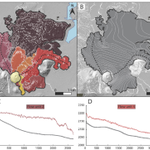
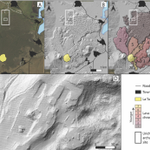
ALT Figure demonstrating how we determined the lava flow volume. Part A shows the current topography of the La Taza area. Part B shows our interpretation of the topography of the area prior to the eruption of the lava flows and creation of the scoria cone. Parts C and D show examples of how the difference between these topographies was used to interpret the volume of some flows and the entirety of the effusive eruption.