

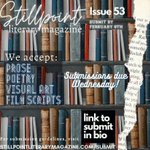
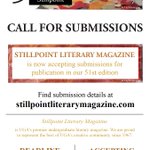
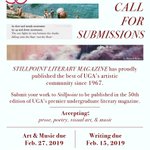
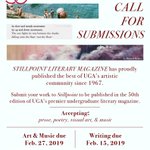
~~ONLINE AND PRINT SUBMISSIONS OPEN!~~ The University of Georgia's Undergraduate Literary Magazine serving as a forum for student writers and artists since 1967
- Tweets372
- Following185
- Followers193
- Likes107







ALT 5 We know ourselves by song Sound beams Of a well-made house The sounds of nothing But her hand Rearranging objects The little winds it makes Alive in the confines Of a voice In the home we make speaking As if the place Were water, ocean-rhythm To sing over Anything to live in counterpoint To the stones Emily Dickinson wrote: “Where melody is not Is the unknown peninsula”

ALT Emily Dickinson had an amazing imagination, but so did her nephew, who came home from school one day in tears, having been berated by his teacher—perhaps even whacked—for having told the class about the white goat who lived in the attic. He was attacked for being a dreamer, a liar, someone who made things up. Upon hearing this, Emily was furious, beside herself with fury, and said that the teacher could come to the house and see for herself the white goat in the attic, for indeed it lived there, Emily had seen it, there it was, munching a pile of grass under the beams. This anecdote is the only thing I remember from reading a five-hundred-plus-page biography of the poet. I am not even vaguely interested in the men, or the women, or any of that other stuff; I am interested in the goat, whom I love as if it were mine own, and though I don't have an attic, I have a place in my head where it can live, and go on living, as I feed it daily with mounds of fresh cut grass.

ALT Poetry is the great stimulation of life. Poetry leads past possession of self to transfiguration beyond gender. Poetry is redemption from pessimism. Poetry is affirmation in negation, ammunition in the yellow eye of a gun that an allegorical pilgrim will shoot straight into the quiet of Night's frame. Childe Roland at the moment of sinking down with the sun, like Phaeton in a ball of flame, sees his visionary precursor peers ringed round him waiting To Edward (Ned) Dickinson mid-may 1880 Phoebus- "I'll take the Reins." Phaeton. (L642)

ALT LXXXI. LIFE, and Death, and Giants Such as these, are still. Minor apparatus, hopper of the mill, Beetle at the candle, Or a fife's small fame, Maintain by accident That they proclaim.


ALT The Mariachi Sol de México de José Hernandez at the University of Georgia Performing Arts Center.

ALT The Georgia Museum of Art’s 75th anniversary celebration featuring Hairy Dawg.

ALT Pulitzer Prize-winning author Colson Whitehead giving the UGA Department of History’s Ferdinand Phinizy Lecture.

ALT UGA Theatre students performing at Student Spotlight.