

Tweets here are jokey & sarcastic, don't take every word you see here seriously
Gaia
Joined August 2008
- Tweets102K
- Following2.5K
- Followers2.1K
- Likes7.7K





uıʇuıʇ retweeted

My latest industry survey indicates Google has cut 2027 shipments of the Broadcom-designed TPU 8i series by ~1M units (mostly the higher-priced 8i Max / Whalefish). The cut amounts to roughly 20% of 2027 TPU 8i series shipments.
The survey also indicates Google plans to increase 2027 shipments of the MediaTek-designed TPU 8t series, though details aren't final yet. Google has repeatedly stressed in recent months that frontier model development gets first call on compute, and this shift in the 8t and 8i shipment mix is precisely the adjustment it's making amid a tight supply chain and data center power constraints.
uıʇuıʇ retweeted

Tech stocks tumble after market's ugly reversal to new lows. Anthropic is diving heading into its 2nd day of trading.
At some point, the market will bounce. We need a lot more than a bounce.
investors.com/market-trend/s… $ANT

uıʇuıʇ retweeted

So far, this morning's rally is unimpressive.

The IPO that everyone in the world anticipated goes live, and suddenly everything is ok in the market? Lol! 🤣
I am closely monitoring price, volume and sentiment for signs of capitulation. Once the market begins to rebound and we get a confirming follow-through day, we'll look to see if the recovery can produce the breadth-thrust signals that have defined virtually every major market up leg.
For me, it's all about leadership and setups. Are stocks setting up constructively in buyable position? And, most importantly, are breakouts working; am I gaining traction as I initiate exposure?
Bottom line: We are not out of the woods yet. There is still work to do. Making a low is just the beginning. Getting through the volatility associated with a correction, finding your footing, and developing renewed traction is a process.
Be patient. Remain disciplined. Let the market prove itself.
minervini.com

uıʇuıʇ retweeted

I believe the @nvidia board is not acting in the best interest of shareholders nor in a manner consistent with their fiduciary duties.
What we know is that the board fired Jensen or forced his resignation for violating company policy and/or in response to the accusation of an affair with a spy.
They did so without careful consideration of the impact on the company, its customers, its shareholders or other stakeholders.
They rushed to judgment without the benefit of careful due diligence or even with a basic understanding of the facts.
How do we know this?
We know this by how quickly Jensen was fired and how little was known at the time of his firing.
It takes time to convene a board meeting. There was time, maybe, for one Zoom.
And this is a decision that should have been made by a board sitting in person and carefully deliberating the facts once they are known.
And they should have slept on the decision and met again the day after to discuss the facts, the risks and the other implications of their decision.
The timing and lack of information did not allow for careful board deliberation.
While boards can fire a CEO for an inappropriate relationship with a subordinate, it should not be an automatic decision. That is why we have boards comprised of humans and not agents.
A board should consider whether or not such a relationship was consensual or whether it was an abuse of power dynamics. And a board has to consider what the impact of the firing is on all stakeholders.
If I were in this board, I would not have rushed to judgment based on articles in the media. I would have made sure the board had all of the facts so it could make a careful and informed decision.
Boards of Delaware companies have a duty of care which means they must make informed, prudent and good faith decisions. This clearly did not happen here.
What law firm is advising this board?
Or is the board even taken good legal advice?
It doesn’t look like it.
And now the board is compounding its failures by insisting that there is no possibility for Jensen’s return as CEO.
Why is it in the best interest of the company to foreclose the possibility of Jensen’s return and to do so before all of the facts are known? This is yet another breach of their duty of care.
Furthermore, the board has launched an investigation whose scope is unknown. Investigations can be extremely damaging to a company and should be carefully targeted to address whatever facts need to be known rather than be overly broad in scope.
In short, this looks like a series of major governance failures by directors that panicked due to headlines in the media. They likely felt compelled to do something because they were afraid of looking bad in the media, not because it was the right thing for them company.
They couldn’t stand the heat.
The board’s conduct here is shocking for a company of this scale and importance to our country and the world at large, particularly at this moment in history.
uıʇuıʇ retweeted
A failure for the S&P 500 to find support near the 200-day would be an ominous sign. That's how meltdowns start. How we close today is important. The market is clearly under selling pressure. We need to capitulate.

uıʇuıʇ retweeted
$NVDA earnings. Anthropic IPO. US, China, Russia summit. Perfect storm for volatility.
I'm still short, but looking for a spot to cover and take profits, possibly sooner than later.
Why?
Because an impending push up is growing likely.
Based on history, the current bull market is long in the tooth; the fifth longest on record. However, since 1950 the S&P 500 has never declined in the year after mid-terms elections. The average S&P 500 gain in pre-election years is 17.2%. What is noteworthy is: most of the gains have come in the first half of pre-election years. The S&P 500 has been flat-to-down in the second half (see chart).
We are heading into a period with multiple bullish tendencies working in the market’s favor. Year-end seasonality is one. The historically strong first half of the Presidential cycle is another (see charts).
If we can get through this period without the Fed moving into a fast tightening cycle, those tailwinds should remain intact. Under that scenario, I would expect the current correction to be relatively short-lived and ultimately give way to a resumption of the broader uptrend.
Could we bottom soon?
There is an interesting historical precedent worth keeping in mind as we approach Thursday's scheduled meeting between the U.S., Russia and China. Going back to some of the most significant meetings between the world's major powers, the stock market was higher following nearly every one of them—sometimes substantially higher.
In 1945, Roosevelt, Churchill and Stalin met at Yalta. Stocks rallied immediately following the meeting and continued higher over the next several weeks.
In 1972, Nixon's historic meeting with Mao in China was also followed by a rising market and new highs in the weeks that followed.
The Reagan-Gorbachev summits show a similar pattern. Following Geneva in November 1985, stocks moved higher.
Reykjavik in October 1986 actually ended without an agreement, yet the market shrugged off the disappointment and gained roughly 5% over the next three weeks.
Following the Washington summit in December 1987, where Reagan and Gorbachev signed the INF Treaty, the market rallied sharply, gaining roughly 7% within a week and continuing higher.
After their Moscow summit in 1988, stocks again rallied strongly, gaining roughly 7% over the next couple of weeks and close to 10% within a month.
Obviously, this is a small sample and every period had a different economic and market backdrop. But the pattern is noteworthy: these major superpower meetings were generally followed by higher stock prices over the ensuing days and weeks.
That matters to us because we're currently short the S&P 500 and sitting on a profitable trade. If the market gives us additional downside going into Thursday, I will likely use that weakness to cover some or potentially all of our short exposure ahead of the meeting.
There's enough historical precedent for a positive reaction that I don't see a reason to overstay a profitable short going into the event.
I have not made the decision to cover my shorts just yet, but a decline from here could be just the opportunity to cover right into weakness at peak equity.
minervini.com


uıʇuıʇ retweeted
I'm still short, but looking for a spot to cover and take profits, possibly sooner than later.
Why?
Because an impending push up is growing likely.
Based on history, the current bull market is long in the tooth; the fifth longest on record. However, since 1950 the S&P 500 has never declined in the year after mid-terms elections. The average S&P 500 gain in pre-election years is 17.2%. What is noteworthy is: most of the gains have come in the first half of pre-election years. The S&P 500 has been flat-to-down in the second half (see chart).
We are heading into a period with multiple bullish tendencies working in the market’s favor. Year-end seasonality is one. The historically strong first half of the Presidential cycle is another (see charts).
If we can get through this period without the Fed moving into a fast tightening cycle, those tailwinds should remain intact. Under that scenario, I would expect the current correction to be relatively short-lived and ultimately give way to a resumption of the broader uptrend.
Could we bottom soon?
There is an interesting historical precedent worth keeping in mind as we approach Thursday's scheduled meeting between the U.S., Russia and China. Going back to some of the most significant meetings between the world's major powers, the stock market was higher following nearly every one of them—sometimes substantially higher.
In 1945, Roosevelt, Churchill and Stalin met at Yalta. Stocks rallied immediately following the meeting and continued higher over the next several weeks.
In 1972, Nixon's historic meeting with Mao in China was also followed by a rising market and new highs in the weeks that followed.
The Reagan-Gorbachev summits show a similar pattern. Following Geneva in November 1985, stocks moved higher.
Reykjavik in October 1986 actually ended without an agreement, yet the market shrugged off the disappointment and gained roughly 5% over the next three weeks.
Following the Washington summit in December 1987, where Reagan and Gorbachev signed the INF Treaty, the market rallied sharply, gaining roughly 7% within a week and continuing higher.
After their Moscow summit in 1988, stocks again rallied strongly, gaining roughly 7% over the next couple of weeks and close to 10% within a month.
Obviously, this is a small sample and every period had a different economic and market backdrop. But the pattern is noteworthy: these major superpower meetings were generally followed by higher stock prices over the ensuing days and weeks.
That matters to us because we're currently short the S&P 500 and sitting on a profitable trade. If the market gives us additional downside going into Thursday, I will likely use that weakness to cover some or potentially all of our short exposure ahead of the meeting.
There's enough historical precedent for a positive reaction that I don't see a reason to overstay a profitable short going into the event.
I have not made the decision to cover my shorts just yet, but a decline from here could be just the opportunity to cover right into weakness at peak equity.
minervini.com
uıʇuıʇ retweeted

Over the past week, I’ve been overwhelmed by the love and support of friends, industry colleagues, and people I've never met. Thank you to everyone who has shown kindness to my family and me. It means the world to me.
I came to the United States 53 years ago, and becoming an American citizen is one of the greatest gifts and proudest moments of my life. NVIDIA has been my life’s work. Building it into the company it is today alongside my colleagues has been a privilege and an honor. Nowhere but in America could a company like NVIDIA be possible. I love our country, and I love NVIDIA.
I did not live up to the standards expected of everyone at NVIDIA, and I have made serious mistakes in my personal life. I created problems for the Board that I deeply regret. I own my mistakes completely, and I am committed to cooperating with the Board’s independent investigation.
Since my departure, I’ve seen an outpouring of calls from NVIDIA’s employees, investors, business partners, and customers for me to return as CEO. Many continue to reach out to me directly as the company navigates complex technology, market, competitive, and geopolitical dynamics. NVIDIA is a once-in-a-generation company. If the Board of Directors decides that my return is in the best interest of our shareholders, our employees, the company, and America, I would be honored to answer these calls and return as CEO.
Thank you again to everyone who has shared their good wishes. I am profoundly humbled by your support. To my family: I love you, and I will spend the rest of my life being worthy of yours.
Jensen

uıʇuıʇ retweeted

Yeah, I was going over the whole Starship heat shield earlier today. Overall, it looks great. The engines look great too. Ship 42 could probably be reflown with a few weeks of refurbishment.
However, many small fixes are needed to achieve immediate reusability (like an airplane), which requires zero expected refurbishment, apart from scheduled maintenance.

uıʇuıʇ retweeted
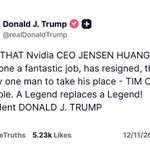
雖然 Trump 說 Tim Cook 是最適合接任黃仁勳 Nvidia CEO 位置的人選,但我覺得最能發揮 Cook 所長的應該只有成本管理。根據我側面觀察 Apple 供應鏈管理超過 10 年以上的經驗,來對比這幾年追蹤與研究 Nvidia 的心得,我覺得 Nvidia 在供應鏈成本管理上,還有明顯的改善空間。
其他方面,特別是最重要的新技術規劃與開發,不要說 Cook 了,目前已經證明能在維持快速商業化迭代更新下,把人類最先端的各領域技術導入 AI 晶片與機櫃方案的 CEO,這件事做得明顯好的只有黃仁勳(當然未來應該還會有其他人也能證明可以把這件事做很好)。

