

The national centre for excellence in developing scientific instrumentation for ground & space-based observatories. Part of @STFC_Matters Based @RoyalObs
- Tweets3.8K
- Following336
- Followers2.6K
- Likes2.5K






ALT This is a composite image of star cluster NGC 602, in vibrant and festive colors. The shape of the star cluster strongly resembles a holiday wreath. The cluster includes a giant dust cloud ring, shown in greens, yellows, blues, and oranges. The green hues and feathery edges of the ring cloud create the appearance of a wreath made of evergreen boughs. Hints of red representing X-rays provide shading, highlighting layers within the wreath-like ring cloud. The image is aglow with specks and dots of colorful, festive light, in blues, golds, whites, oranges, and reds. These lights represent stars within the cluster. Some of the lights gleam with diffraction spikes, while others emit a warm, diffuse glow. Upon closer inspection, many of the glowing specks have spiraling arms, indicating that they are, in fact, distant galaxies.
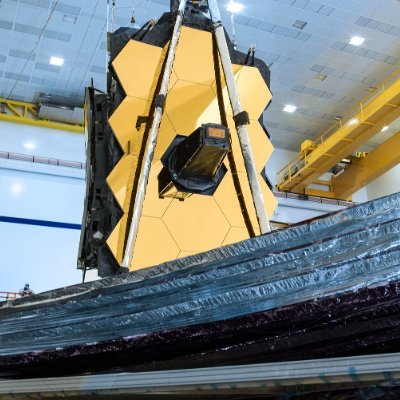

ALT A white paper snowflake with hexagonal cutouts resembling the Webb telescope mirror sits on the top front of a Christmas tree. The tree has other ornaments on it and lights. Behind the tree is Webb-related art, including a letterpress print by Lauren Emritz that says "See the Galaxy and Beyond. James Webb Space Telescope," part of a JWST poster by Veronica Guzzardi that shows an illustration of the golden Webb mirror, and part of a litho by Monkey Minion Press that shows the telescope.


ALT Horizontal split down the middle. At left, thousands of overlapping objects at various distances are spread across this galaxy cluster. A box at bottom right is enlarged on the right half. A central oval identifies the Firefly Sparkle galaxy, a line with 10 dots in various colours.

ALT A zoomed in view of the area around the Firefly Sparkle galaxy. There are two smaller circles flanking a larger oval at the center. The central oval is labeled Firefly Sparkle galaxy. Within it is a long line, roughly pointing from bottom left to top right that contains 10 circular star clusters in pink, purple, and blue. The galaxy to the bottom left is labeled Companion 1 and looks like a bright red dot. At top right, Companion 2 is lighter red and surrounded by a red disk.


ALT Two smiling men signing documents together at a table with two small flags depicting the SKAO and Union Jack in front of them.


ALT Composite image of a supernova in blue and purple.





ALT A supernova with its components labeled. The center of the image contains a dense green cloud, shaped like a keyhole. A white line points to this area, labeled “inner ejecta (keyhole).” Outside this region are two curved dotted lines with a white line pointing to the left one, labeled “crescent.” Outside this cloud of gas is a ring of dense orange gas and dust that becomes more diffuse as it travels farther away from the center. A dotted blue line is overlaid in the center of this ring with a blue line that is labeled “equatorial ring.” The innermost part of this dense orange ring contains brighter orange clumps of glowing gas. There is a gray line pointing to one of these hotspots labeled “equatorial ring hotspots.” Outside these structures, both above and below them, are very faint orange rings of gas and dust. They are overlaid with dotted lines and both have white lines pointing to them, labeled “outer ring.” There are several white stars strewn throughout the image.


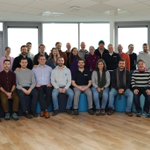
ALT Photo of the RAL Space team taken outside Lisbon's "Pavilhão do Conhecimento" (Pavillion of Knowledge), where joint sessions were held with the mission scientists.

ALT Promotional flyer featuring large image of an astronaut and event details.


ALT In a darkened clean room, a technician clad in white coveralls, hood, mask, and blue gloves inspects a prototype telescope set within a black frame. At center, the telescope’s translucent, tan-colored structure glows as the technician shines a flashlight behind it. Other suited people partially appear in the background at right, while at top and left ceiling lights from areas beyond the clean room can be seen through windows. The image is watermarked “Credit: NASA/Dennis Henry.”

ALT In a brightly lit clean room with pale green walls, two technicians wearing white coveralls, hoods, masks, and blue gloves manipulate a silvery wheeled platform. At the center of the platform is a black frame holding an amber-colored prototype telescope whose gold-colored mirror is near the center of the image. Text at the bottom of the platform reads “FORKLIFT” on the left and right. Numerous additional technicians, also wearing coveralls, populate the background. The image is watermarked “Credit: NASA/Dennis Henry.”

ALT Two galaxies that collided and formed a red and orange swirl or stars.

ALT A supermassive black hole that lies in the centre of a blue spiral galaxy.