

proto-astronomer @Harvard @CenterForAstro @mpi_astro | previously @JohnsHopkins @STScI |
Cambridge, MA
Joined January 2009
- Tweets723
- Following505
- Followers547
- Likes4.3K





Pinned Tweet
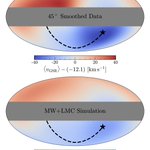
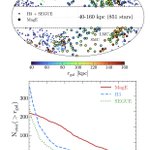
Paper day! A central result from our survey of the Milky Way's outskirts:
"All-Sky Kinematics of the Distant Halo: The Reflex Response to the LMC"
arxiv.org/abs/2406.01676

Thanks for sharing our work @McMillan_Astro!

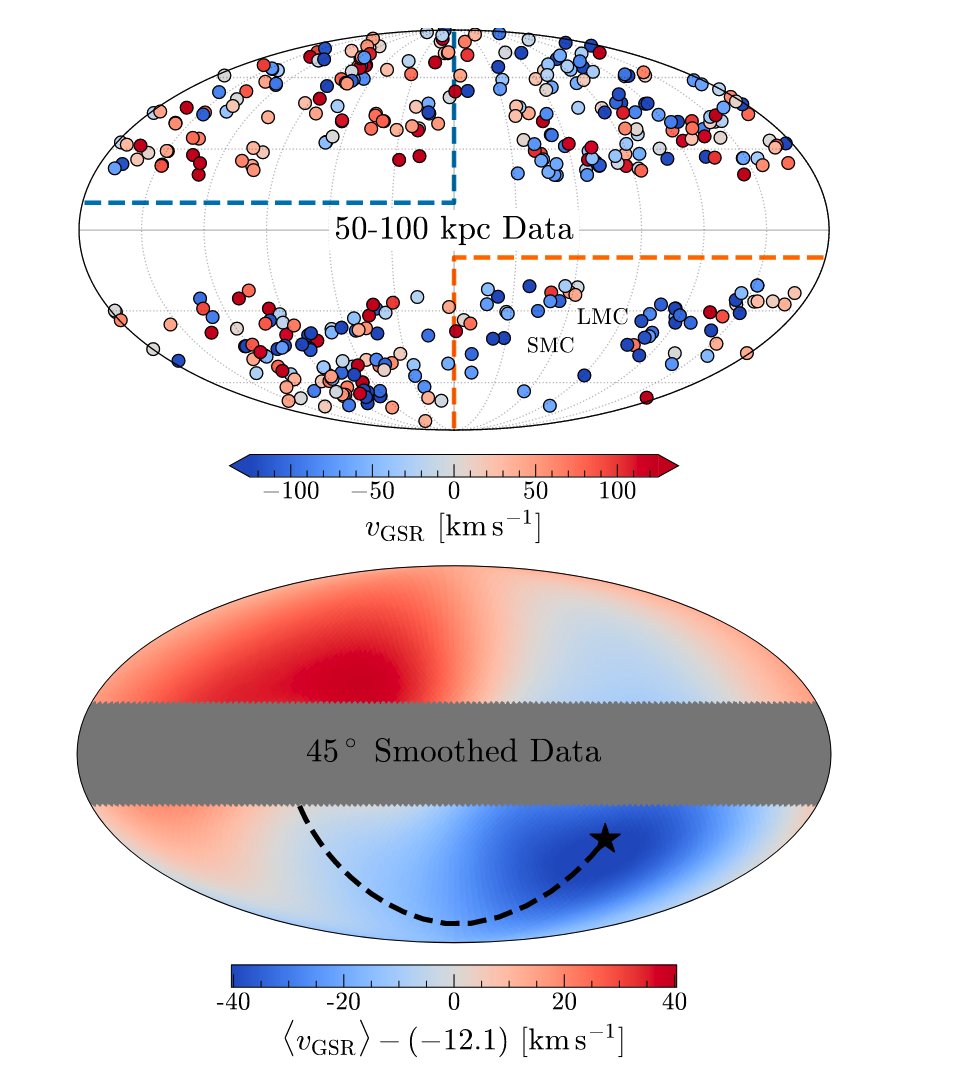
I'm heading to the outer Milky Way for an #arXivoftheweek: Chandra et al measuring the Milky Way's response to the pull of the Large Magellanic Cloud (arxiv.org/abs/2406.01676) [1/6]
11
747
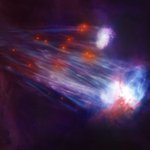
Grateful to @CenterForAstro for featuring our recent discovery of the Magellanic Stellar Stream, along with this beautiful artwork by Melissa Weiss
cfa.harvard.edu/news/distant…

ALT Artist's rendition of the Magellanic Stellar Stream. The Milky Way's nearest neighboring galaxies—the Small and Large Magellanic Clouds—are shown on the right side of this artist's illustration. As these galaxies move to the right, the gaseous Magellanic Stream billows behind them, intertwining and stretching across the southern sky. The illustration also shows the 13 red giant stars discovered in the Magellanic Stellar Stream by Chandra et al. Image Credit: CfA / Melissa Weiss
It's a pleasure to share our new paper using the wealth of data from @ESAGaia DR3:
'The Three-Phase Evolution of the Milky Way'
arxiv.org/abs/2310.13050

We assemble an all-sky sample of 10 million red giant stars with metallicities and 6D motions from @ESAGaia to ask a simple question: how did the the orbital structure our galaxy evolve over time?

Beautiful work by @joshnguyen99 @TingAstro and collaborators, and I'm honored that they chose one of my paper abstracts to demonstrate the model in this paper!

Absolutely thrilled to announce 🚀 AstroLLaMa from @universe_tbd! Introducing our specialized Llama-2 models tailored for astronomers 🌌. This is just the beginning! But our tests already show extraordinary text generation and embeddings for astronomy!💫
arxiv.org/abs/2309.06126

5
528
Grateful to @newscientist for covering our recent paper!

Astronomers have spotted 13 stars that appear to be part of a cloud of dust and gas near the Milky Way - the first time stars have ever been seen in this location. newscientist.com/article/238…

4
355
Grateful to @WhatDaMath for putting together a wonderful summary based on our most recent paper (arxiv.org/abs/2306.15719): youtu.be/YwMV8zEYPIU

6
279
I'd encourage everyone to instead use the Andrae et al 2023 catalog of 175 million metallicities from Gaia XP spectra, which are data-driven and perform much better than the GSP-Phot results
ui.adsabs.harvard.edu/abs/20…

I've recently seen (accepted) papers using @ESAGaia metallicities (GSP-Phot) of globular clusters stars claiming interesting results. Unfortunately, Gaia metallicities are not reliable because of systematics, as you can read below (Andrae et al. 2022). Please be careful!

Excited to share our latest paper, the first result from our ongoing spectroscopic survey of the Milky Way's distant outskirts: Discovery of the Magellanic Stellar Stream Out to 100 Kiloparsecs
arxiv.org/abs/2306.15719

As a major component of my PhD thesis, I've been leading (with @Rohan_Naidu and Charlie Conroy) a focused spectroscopic survey of giants in the > 50 kpc outer halo, using the MagE instrument at @LCOAstro.
(photograph by @YBeletsky, who is also an ace observer for this survey!)

Such a pleasure to be involved with this work, in which we break the Galactic velocity record twice, and draw some interesting conclusions about the SNIa origin of these hypervelocity stars. Moral of the story: when @kjb_astro asks you to get a spectrum of a star, do it!

New paper! We search for – and find – hypervelocity white dwarfs that were launched at 2000+ km/s when their companion white dwarfs exploded. arxiv.org/abs/2306.03914 1/n

17
957
Grateful to @lyndie_chiou for writing about our recent paper on the Milky Way's oldest 'proto-Galactic' component!

Recent findings suggest that the first stars in the Milky Way formed from gas coalescing within the violent, chaotic “proto-galaxy.” quantamagazine.org/with-ai-a…
I'm excited to share our new catalog of > 120 million stellar metallicities inferred from Gaia DR3 low-resolution XP spectra, including a vetted sample of 10 million giants with radial velocities! Led by René Andrae at @mpi_astro: arxiv.org/abs/2302.02611

Paper day! Using an unprecedented dataset from @ESAGaia DR3, we explored the furthest outskirts of the Galaxy, and here's what we found: Distant Echoes of the Milky Way's Last Major Merger.
arxiv.org/abs/2212.00806

@WhatDaMath just put up an excellent summary of our paper on his channel: youtu.be/vwX-lJnN2es


Paper day! Led by Hans-Walter Rix, the culmination of an exciting summer at @mpi_astro working on new data from Gaia DR3: The Poor Old Heart of the Milky Way.
arxiv.org/abs/2209.02722

1
Paper day! Led by Hans-Walter Rix, the culmination of an exciting summer at @mpi_astro working on new data from Gaia DR3: The Poor Old Heart of the Milky Way.
arxiv.org/abs/2209.02722
Excited to share our new paper on the discovery of an exceptionally faint disrupted dwarf galaxy stream; a ghost in the Boötes constellation named 'Specter' 👻
arxiv.org/abs/2207.13717

Our latest paper was just accepted to @RAS_Journals, on the detection of circumstellar material and surface rotation in a runaway star that was thrown out from a Type Ia supernova! arxiv.org/abs/2110.06935 (1/11)

@kenjshen and collaborators predicted that when a white dwarf (WD) binary produces a Type Ia supernova, one of the WDs could survive the explosion and be flung away as a hypervelocity runaway. Then, they found 3 such stars in Gaia DR2: arxiv.org/abs/1804.11163 (2/11)
1
1


Beautiful result from @gfezenko @hc_hwang and Nadia Zakamska!

Congrats to our @JHUPhysicsAstro undergrad, @gfezenko ! In arxiv.org/abs/2202.00021, we found that double-close-binary quadruples are more common (by a factor of ~7) than expected! The one below is my favorite, separated by 0.1 pc/0.3 light year! But WHY?

1
4