
Crypto enthusiast @Storyprotocol Believer @Succinct contributor
Joined March 2022
- Tweets13.1K
- Following1.3K
- Followers672
- Likes9.4K






I don't see this shift of @datafdn to the @SuiNetwork as just a migration, i see it as a necessity.
Here’s why i see this migration as a necessity.
AI needs good data, but more importantly, it needs data you can trust.
That’s what DATA foundation is about, making the source of a data verifiable and also how it can be used.
and over time, it's product Trace has now recorded about 250M+ receipts.
But to build this layer for trustable data for Ai needs much better attention and infrastructure.
So, there's absolutely no need trying to keep an L1 that is cost expensive while trying to build out this vision, result might be reduntant.
Switching to Sui with alot of stacks is a good call.
With @WalrusProtocol handling the storage and seal handling the access control.
So now they just have to focus on building the licenced trustable data layer for Ai.
This is because as AI is moving fast, trusted data is becoming just as important as the models themselves.
This will surely be an interesting chapter for the DATA foundation.

DATA is coming to @SuiNetwork.
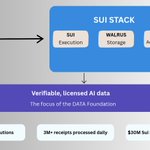
The DATA Network and Trace are joining the Sui stack, bringing a live supply of rights-cleared AI training data to infrastructure built for AI workloads.
With 250M+ receipts already recorded by Trace, AI labs will be able to source real-world data with verifiable provenance, while @WalrusProtocol provides the underlying storage layer.
Sui Foundation is investing $30 million in the DATA Network, establishing the largest institutional stake in the network, alongside the continuing holdings of PIP Labs and the DATA Foundation. Furthering the alignment, SY Lee, founder of the DATA Network and CEO of PIP Labs, joins Sui Foundation as Strategic Advisor.
In the coming months:
▸ The DATA Network will be upgraded to run as a protocol natively on Sui
▸ Walrus becomes the default storage layer for DATA Foundation apps
▸ $DATA remains the token of the DATA protocol
The next chapter of DATA starts here.

its.victornn.ip retweeted

DATA is moving its entire protocol onto $SUI.
Not just another partnership. A full migration.
Their independent L1 is being retired, and the protocol will run natively on Sui.
its.victornn.ip retweeted

DATA coming to @SuiNetwork is more than a chain migration. With 250M+ receipts already recorded on Trace, the bigger story is building a better way to track where AI training data comes from and the rights attached to it.
That’s an important step toward more accountable AI.
AI models need data, but where that data comes from matters just as much as the data itself.
When contributions have traceable origins and clear usage rights, AI labs can make more informed decisions about what they use, while contributors have a better chance of having their permissions respected.
One thing I find interesting about this move is the role of @WalrusProtocol.
Verifiable provenance is useful, but being able to store and check the original data adds another layer of transparency, helping buyers verify that the files they receive match the records associated with them.
The $30M investment from Sui Foundation is a major part of this announcement, but the product direction is what catches my attention.
By building on Sui's infrastructure, DATA can focus more on Trace and the challenge of making data origins and usage rights easier to verify as adoption grows.
The long-term opportunity is bigger than recording contributions.
AI needs data people can trust, and contributors deserve clearer answers about where their work goes and how it can be used. Making provenance and licensing easier to verify is one way to move toward a more transparent AI data economy.
@datafdn @SuiNetwork

DATA is coming to @SuiNetwork.
The DATA Network and Trace are joining the Sui stack, bringing a live supply of rights-cleared AI training data to infrastructure built for AI workloads.
With 250M+ receipts already recorded by Trace, AI labs will be able to source real-world data with verifiable provenance, while @WalrusProtocol provides the underlying storage layer.
Sui Foundation is investing $30 million in the DATA Network, establishing the largest institutional stake in the network, alongside the continuing holdings of PIP Labs and the DATA Foundation. Furthering the alignment, SY Lee, founder of the DATA Network and CEO of PIP Labs, joins Sui Foundation as Strategic Advisor.
In the coming months:
▸ The DATA Network will be upgraded to run as a protocol natively on Sui
▸ Walrus becomes the default storage layer for DATA Foundation apps
▸ $DATA remains the token of the DATA protocol
The next chapter of DATA starts here.
Last year @datafdn which was formerly story protocol built its own L1 to put the world’s IP onchain.
But now they have found a better focus and now thesame DATA foundation will be shutting that chain down and moving to @SuiNetwork
and here's why
Licensing all IP was like boiling an entire ocean.
For example, some of the problem are licensing an entire existing IP systems is not an easy fit and same as well as many big rights holders who don't want permissionless licensing and more.
Due to some of this challenges, DATA decided to focus mainly on AI training data provenance.
With Its product, Trace, issuing a receipt for every contributions like who, when, terms, and any licensing or payment events.
Even Kled alone adds 3-4M contributions a day.
That's why their move to Sui made more sense
That decision alone will save time and cost of running an L1.
So as well moving to Sui will help them leverage Walrus for storage and Seal for access control.
Meanwhile this does not change dynamics of $DATA
$DATA moves 1:1, with rights and the vesting unchanged, and the current chain keeps running until migration is done.
Focus is a strategy, itself and am glad the DATA foundation realizes that.
From finding our focus in AI data to the thinking behind joining the Sui stack
CEO @devrelius went deeper on DATA's next chapter with @helenebraunn for @CoinDesk ↓


its.victornn.ip retweeted

From finding our focus in AI data to the thinking behind joining the Sui stack
CEO @devrelius went deeper on DATA's next chapter with @helenebraunn for @CoinDesk ↓

Enjoyed speaking with @HeleneBraunn about the thinking behind our recent decisions, what we've learned along the way, and where we're headed next with @SuiFoundation.
Thoughtful piece that captures the bigger picture.
coindesk.com/business/2026/1…

Around june, story protocol evolved into the DATA Foundation.
Because it became even more convincing that AI training data would be one of the biggest real world use cases for rights cleared, licensed IP.
Then Trace was built.
Since launching in june, Trace has recorded close to 300M data contributions and now processes over 3M receipts daily.
With this milestone and going through this article by @devrelius , one thing stood out to me.
Scaling isn't just about handling more activity, it's also about knowing what to focus on.
and that's where the @datafdn move to @SuiNetwork and shutting down of the their L1 comes in.
With Sui handling high performance execution, Walrus providing verifiable storage, and Seal taking care of secure access control.
The $30M strategic investment from the Sui Foundation makes it even more convincing that many share this same vision.
But beyond the investment itself, what matters the most is how this will help push this vision.
That's why this whole decision of migration keeps the DATA foundation team less focused on infrastructure and more time focusing on making AI data verifiable, properly licensed, which is the vision.
Exciting times ahead for the DATA foundation.


its.victornn.ip retweeted
Honestly, i'm excited to see @datafdn coming to @SuiNetwork .
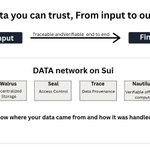
Importantly, the idea of making data traceable and verifiable throughout its lifecycle makes a very good sense to me, from the original input to the final output.
What excites me even more is how it uses infrastructure like Walrus for decentralized storage, Seal for access control, Trace for data provenance, and Nautilus for verifiable offchain computation into one system.
Because it's one thing to have data, but being able to verify where it came from and how it was handled is a key.
This is why am very excited for DATA network coming on Sui.
Definitely looking forward to seeing how this develops.


its.victornn.ip retweeted

@datafdn is changing its approach & @SuiNetwork is part of this plan
I read @CoinDesk interview with @devrelius ceo of data fdn, and it’s clear that team is now focusing more on things that are actually in demand
Earlier, data vision was much bigger, bringing different kinds of intellectual property onchain
But changing existing licensing systems was harder than expected
Then data team found a more specific problem in ai data
Imagine you purchase a dataset for ai training, but you have no way of knowing whether it is authentic, who created it, or if someone else is also selling the same data
This is not just a theory; data fdn ceo andrea muttoni shared that the team once received its own dataset back from a vendor who claimed it was exclusive
This shows how difficult it can be for ai companies to know whether the data they are buying is original and properly licensed
And here trace is game changer and problem solver
'Trace' creates a record of data contributions, their sources, and the terms associated with them. Its purpose is to make auditing data easier
According to andrea, kled is adding around 3M–4M contributions daily
Kled:-- the largest contributor to the data ecosystem, and trace has also recorded nearly 300 million data contributions
probably you understand why sui is betting $30 million on data
and why @WalrusProtocol is providing its decentralized storage for the data ecosystem
I'm happy for data and sui they are building together
#DATAonSuiQuest
From finding our focus in AI data to the thinking behind joining the Sui stack
CEO @devrelius went deeper on DATA's next chapter with @helenebraunn for @CoinDesk ↓
We've been talking about @datafdn moving to the @SuiNetwork
Yes, moving to Sui is one thing, but what does this mean for $DATA holders and the future of the protocol?
While i was going through the migration details, a few things caught my attention.
- $DATA carries over at a 1:1 ratio
- Governance rights and tokenomics remain at least equivalent.
- Locked and vesting positions stay unchanged.
- DATA moves towards running natively on Sui
Nothing happens to the existing network yet, it will continue run until the upgrade is complete, with a detailed migration plan still to come.
What interests me here the most is not just the migration itself, but what building natively on Sui could unlock for the DATA's infrastructure.
The move is one step to a thriving DATA infrastructure.


its.victornn.ip retweeted
Imagine a photographer sharing an image online. Knowing where it came from matters, but provenance is not permission: a buyer still needs the right to use it.
The people behind the data matter as much as the data itself.
I have registered for the @GenLayer airdrop.
You should also register if you meet the requirements
=> Have at least 150 GenLayer Points form accepted contributions or Community points(CP) earned through the community program
=> Or Hold a qualifying Discord community role

I went through the interview @kstellana had with Blockchain reporter and same question i have had in mind to ask him even became more stronger.
Am genuinely asking this question to Albert.
Let's assume we have two AI agents enter an agreement with terms that can be interpreted in different ways.
The question is who actually gets to decide what a fair outcome looks like given that it can be interpreted in different ways ?
Yes from the interview Albert’s answered how @GenLayer handles the "Ambiguity issue" through independent AI validators, the Equivalence Principle, and an appeal processes.
But I see a bigger challenge around this architecture because an agreement between validators is not necessarily the same as correctness.
This is why am more curious here
So i hope albert helps me with this question.


real agreements are full of words like 'reasonable quality' or 'substantially completed'. you can't squeeze those into code and call a human every time two agents disagree
i told Blockchain Reporter how we're handling it at @GenLayer
blockchainreporter.net/inter…

its.victornn.ip retweeted

real agreements are full of words like 'reasonable quality' or 'substantially completed'. you can't squeeze those into code and call a human every time two agents disagree
i told Blockchain Reporter how we're handling it at @GenLayer
blockchainreporter.net/inter…
Honestly, i'm excited to see @datafdn coming to @SuiNetwork .
Importantly, the idea of making data traceable and verifiable throughout its lifecycle makes a very good sense to me, from the original input to the final output.
What excites me even more is how it uses infrastructure like Walrus for decentralized storage, Seal for access control, Trace for data provenance, and Nautilus for verifiable offchain computation into one system.
Because it's one thing to have data, but being able to verify where it came from and how it was handled is a key.
This is why am very excited for DATA network coming on Sui.
Definitely looking forward to seeing how this develops.
its.victornn.ip retweeted
The lifecycle of data, as told by the DATA protocol → @SuiNetwork.
As AI agents are moving towards handling transactions on their own, but there's something i've been thinking about.
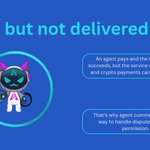
Then what happens when an agent pays for a service and doesn't get what was agreed?
Because a successful transaction doesn't automatically mean the agreement was fulfilled, knowing that crypto payments can be irreversible.
This is why i think agent commerce needs more than permission. it needs a way to handle disputes.
and that's where @GenLayer and @courtofinternet Court come in


The thing i find interesting about Internet Court is that dispute resolution can actually be part of the transaction from the beginning.
The parties can agree on the terms, escrow, and how disputes will be handled before funds move.
if something goes wrong, a random panel of GenLayer validators, running their own models, evaluates the evidence.
Then disputed outcomes can also be appealed to a larger panel.
For me, this is an important step towards resolving disputes without relying on one company to have the final say just like the traditional court.

Yes as said in the article, for agentic commerce to work at scale, three things need to make sense:
- permission like what is the agent allowed to do?
- evidence like what actually happened?
- resolution like who decides when things go wrong?
So protocols like PAP and PACT help with permission, while GenLayer and Internet Court focus on the dispute resolution side.
Because giving an agent permission to act is one thing and having a way to resolve what happens afterwards is another.
Autonomous transactions need a way to resolve disputes when things don't go as planned.
That's what makes GenLayer worth paying attention to.
