Vincent Madiard (@vmadiard) header
Vincent Madiard (@vmadiard) profile picture

Politique & éco • Auteur 🇫🇷 🇨🇭 Livre : Brivael Le Pogam - Du code à la tribune https://teapaw.org/t.co/i0IG6yMxIx Série Christine Lagarde #parasilagarde

Joined February 2025
Photo by Vincent Madiard (@vmadiard)Photo by Vincent Madiard (@vmadiard)Photo by Vincent Madiard (@vmadiard)Photo by Vincent Madiard (@vmadiard)Photo by Vincent Madiard (@vmadiard)Photo by Vincent Madiard (@vmadiard)Photo by Vincent Madiard (@vmadiard)Photo by Vincent Madiard (@vmadiard)Photo by Vincent Madiard (@vmadiard)Photo by Vincent Madiard (@vmadiard)
Quand la réalité biologique devient un sentiment, les règles du jeu changent. L’empathie mal dirigée ne se contente pas de protéger. Elle peut aussi exiger que l’on relativise des réalités physiques au nom des sentiments d’un groupe. Dans le sport, des compétitions féminines accueillent des athlètes biologiquement masculins au nom de l’inclusion. L’équité et la sécurité des femmes passent au second plan. Dans l’enfance et certains espaces réservés, le sexe biologique est traité comme une variable interchangeable, y compris lorsque cela concerne des mineurs. Dans ces cas, l’intention est présentée comme de la compassion. Le résultat est une redéfinition de catégories qui existaient pour protéger certains groupes. Dans deux jours : comment ce type de dérèglement se propage. #EmpathieSuicidaire
11
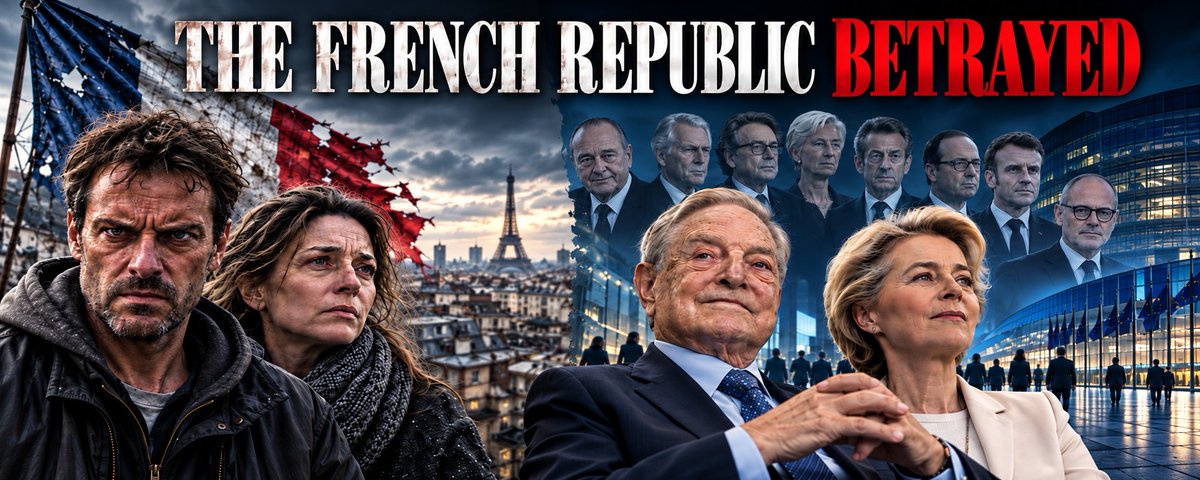
THE FRENCH REPUBLIC BETRAYED (4/5) The Choices That Hollowed Out Sovereignty The Actions That Hollowed Out the Principle Political leaders did not have this shift in power forced upon them. They engineered it. Maastricht was negotiated and defended with a full understanding of what it entailed. So were the treaties that followed. Successive leaders knew that each new commitment narrowed the French government's room to act on monetary policy, the budget, trade, and a growing range of regulations. They pressed ahead. François Hollande had been a Young Global Leader. Once elected president, he did not slow the process. He implemented European rules, accepted the budget constraints set in Brussels, and allowed France to fall in line with priorities that did not come from French voters. Emmanuel Macron, also a Young Global Leader, accelerated the process. He expanded France's international commitments, strengthened the role of European institutions, and presented every transfer of authority as the obvious course of action. Gabriel Attal and Édouard Philippe, both of whom had moved in the same circles, continued down the same path once in office. Christine Lagarde moved from a French cabinet post to the International Monetary Fund, then to the European Central Bank, and has served for years on the board of the World Economic Forum. Thierry Breton championed the Digital Services Act (DSA), which imposes content moderation requirements on platforms. Those requirements are set in Brussels and apply to content accessible in France. Nicolas Sarkozy participated in Davos networks and allowed private investors to acquire stakes in state-owned companies. None of them discovered only afterward that their hands were tied. They chose to sign agreements, appoint officials, sit on boards, and defend arrangements in which the French people no longer have the final say. The results can be measured. Budget deficits have widened as successive governments have lost control over policy levers. Billions have been committed to Ukraine through bilateral aid and European mechanisms, without the French people having voted on either the amounts or the objectives. Meanwhile, the justice system, health care, and public services are deteriorating. Energy taxes remain high. Purchasing power is under pressure. Public assets have been opened to private investment or sold off in the name of reducing debt, yet the debt has kept rising. When U.S. intelligence agencies intercepted the communications of Chirac, Sarkozy, and Hollande, the protests were muted. When Morocco targeted French phone numbers with Pegasus spyware, including those of Macron and several ministers, the response was restrained. In each case, the instinct was not to safeguard the French people's ability to make their own decisions. It was to accept arrangements that diminished that ability. These choices were not imposed from outside on reluctant leaders. They were made by officials who moved in the same circles, shared the same way of thinking, and continued to invoke the Republic while hollowing it out. The French people are paying the price: less control over matters that affect them, deteriorating public finances, and important decisions made elsewhere. This is not the result of constraints reluctantly accepted. It is the result of repeated, deliberate actions by people who knew what they were doing.
1
1
133
Une grande fierté et un immense privilège d'avoir été depuis 40 ans la pire des globalistes, JAMAIS ÉLUE, dans tous les sales coups qui ont fait souffrir des centaines de millions de citoyens sur terre. (Voir ma série premier commentaire👇) Je vais maintenant prendre la tête de l'organisation la pire qui soit, le WEF, ou venir achever mon pays d'origine pour mettre fin à son agonie lente et finir sa destruction dans le globalisme. Retrouvez toutes les gentillesses qu'a fait Christine Lagarde à l'humanité, la série se poursuit la semaine prochaine et le bilan est déjà TRÈS LOURD #parasilagarde #christinelagarde
I have just informed my colleagues that I will step down as @ECB President on 7 February 2027. It has been a source of great pride to serve this institution. I thank all of those who have supported me on this journey over the past seven years.
1
1
4
219
L’encyclopédie #ParasiLagarde : le parcours complet de Christine Lagarde, décision après décision. Chronologique, factuel, sans concession.
30
« Les emmerdes, c’est comme les cons, ça vole toujours en escadrille. » Jacques Chirac. En une dizaine de jours, Emmanuel Macron a accumulé une série de difficultés qui se renforcent mutuellement. Le 18 octobre, après les violences du 17, il s’est adressé aux Français. L’allocution a été jugée par de nombreux commentateurs comme trop générale, sans mesures concrètes immédiates, et a laissé le sentiment d’une incompréhension face à l’ampleur des débordements. Quelques jours plus tard, il a lui-même reconnu que le 17 octobre n’avait « pas du tout été anticipé ». Le 23 octobre, à Trappes, après l’attentat terroriste raciste (un mort, plusieurs blessés dont une fillette de 12 ans), il a déclaré que c’était « la première fois » qu’un acte terroriste planifié visait des personnes « en raison de leur couleur de peau ou de la religion qu’on leur donne ». Cette formulation a été immédiatement contestée comme factuellement inexacte, au regard de précédents connus (Merah, Hyper Cacher, etc.). Il a dû préciser le lendemain qu’aucune douleur ne devait être hiérarchisée. Le 27 octobre, un juge du Delaware a estimé qu’il n’avait pas de compétence personnelle sur Candace Owens (résidente du Tennessee). La plainte en diffamation des époux Macron se poursuit uniquement contre les sociétés de l’influenceuse immatriculées dans le Delaware. La plainte vise notamment les allégations selon lesquelles Brigitte Macron serait née homme (sous le nom de Jean-Michel Trogneux), aurait usurpé une identité et transitionné, ainsi que d’autres accusations (liens familiaux, MKUltra, dissimulation). Enfin, The Economist, qui avait autrefois présenté Emmanuel Macron comme le « sauveur de l’Europe », le décrit désormais comme un président lame-duck en fin de mandat, confronté à une impasse politique, budgétaire et sociale. 👇 Ces épisodes se succèdent sans pause. Pour un président à six mois de la fin de son second mandat, l’accumulation est particulièrement nette.
175
THE FRENCH REPUBLIC BETRAYED (3/5) The Rhetoric That Masks the Shift The Language That Conceals the Shift in Power French political leaders did not discover after the fact that their hands were tied. They knew what they were signing. Maastricht left no ambiguity on this point: it transferred governing powers, created a single currency managed beyond national control, and established rules that limited an elected government's ability to act on its own. The treaties that followed continued in the same direction. Those who negotiated, defended, or implemented them understood the scope of those commitments. Yet they continued to speak of the Republic, sovereignty, and defending French interests. That language has not disappeared. If anything, it has grown more insistent over the years, precisely as real power has moved further away. We still hear the same refrains today: “The Republic is under attack.” “We must defend the values of the Republic.” “That goes against the Republic.” Leaders across the political spectrum repeat them, including those who contributed most to the transfer of governing powers. The Socialists were no exception. François Hollande, who had been a Young Global Leader, continued down the same path once he became president. During his presidency, France continued to accept European rules that bound national decision-making, even as its leaders repeatedly invoked the Republic and its values. The same pattern appears among those who claim to uphold de Gaulle's legacy or defend national sovereignty: the rhetoric remains, but their actions follow the logic of the other model. This contradiction is not the result of constraints imposed on reluctant leaders. It is the product of repeated choices. The politicians who ratified these treaties, appointed officials to European institutions, and participated in networks discussing governance beyond nation-states knew that the center of decision-making was shifting. They chose to preserve the language of the Republic rather than tell the French people plainly that the principle of government “by the people and for the people” applied less and less to the issues that mattered. That choice has a direct consequence. Citizens keep hearing that the Republic is being defended. At the same time, they see their votes carry less weight on monetary policy, some budget rules, trade policy, and a growing range of regulations. The results of thirty years of this practice are plain to see. Budget deficits have widened without successive governments being able, or willing, to regain full control over the policy levers that matter. The purchasing power of French citizens has come under pressure from decisions made within systems where they do not have the final say. France's public services have deteriorated while billions have been committed to priorities set elsewhere. The sovereignty proclaimed in the Constitution has not prevented entire areas of policy from slipping beyond the control of the French people. This is no accident. It is the logical consequence of a philosophy that holds that the people of a nation should not have the final say, put into practice by leaders who have continued to speak the language of the Republic. The familiar warnings that “the Republic is under attack” do not describe what is happening. They conceal it. What is under attack is not an abstract principle. It is the French people's actual ability to decide matters that affect them in their own country. The leaders who repeat these lines know it. They helped engineer the shift. Yet they continue to speak as though the Republic defined by the Constitution were still the framework within which power is actually exercised. Citizens, meanwhile, bear the cost: less freedom of action at the national level, deteriorating public finances, and a growing sense that the decisions that matter are being made elsewhere. What was defended was not the Republic. It was a different model of governance, one that kept the Republic's language to advance its own agenda.
1
2
3
318
THE FRENCH REPUBLIC BETRAYED (2/5) teapaw.org/vmadiard/status/211513…
THE FRENCH REPUBLIC BETRAYED (2/5) How Power Shifted Beyond France How the Second Model Took Hold in France The constitutional principle remained on the books. In practice, however, France began moving sharply away from it in the early 1990s. The Maastricht Treaty, signed in 1992 and entering into force the following year, marked the point at which this shift became structural. The treaty did more than deepen cooperation among European states. It created the European Union, established the framework for a single currency among participating member states, and expanded the areas in which decisions could be made at the European level rather than the national one. The currency, trade policy, parts of fiscal policy, and gradually other powers came under a system in which the French people no longer had the final say on their own. This was no minor technical adjustment. Under the logic of the open society, an overly rigid national framework is an obstacle. Nations can make mistakes, elect “closed” majorities, or reject solutions that others consider necessary. The Maastricht Treaty addressed this concern by establishing mechanisms that restricted national freedom of action. The convergence criteria, the future independent European Central Bank, and the primacy of European law over national law all made it harder for a French government to act on its own, even when French voters had elected it to do precisely that. Citizens still cast their ballots. But those ballots carried less weight in the areas where authority had been transferred. French political leaders did not present this shift as an abandonment of the republican principle. They often described it as modernization, a necessity in the face of globalization, or even a continuation of Charles de Gaulle's legacy. Jacques Chirac, who claimed to stand in the Gaullist tradition, campaigned for a “yes” vote in the 1992 referendum. Later, during his presidency, France adopted the euro. Successive governments, on both the right and the left, continued down the same path through the treaties of Amsterdam, Nice, and Lisbon. At every stage, the language of the Republic remained unchanged. Politicians still spoke of sovereignty, defending French interests, and republican values. In practice, however, an increasing number of decisions were moving beyond the direct control of the French people. This contradiction was not an accidental drift. It followed the logic of the second political philosophy described earlier. If no truth is final and the people of a nation can be wrong, then shifting some authority toward institutions less exposed to national electoral cycles becomes a rational choice. Maastricht and the treaties that followed provided the legal framework for that shift. The politicians who negotiated, ratified, or implemented those agreements continued to speak the language of the Republic. They did not rewrite the constitutional principle of popular sovereignty. They simply created, treaty by treaty, the conditions under which that sovereignty would carry less and less weight on the issues that mattered most. The consequences are plain to see more than thirty years later. A French government can still be elected on a national political platform. But once in office, it discovers, or pretends to discover, that large parts of its agenda are already constrained by rules established elsewhere, or that it must negotiate with institutions that are not accountable to the French people. The word “Republic” is still invoked. Yet the principle that the people should have the final say in their own country has gradually been hollowed out. What was defended throughout this process was not the Republic itself. It was a different system of government, one that still speaks in the Republic's name.
1
161
Pah Pah Sarah Knafo fracasse le service public, la punchline qu'elle envoie en toute fin de vidéo est magistrale, écoutez les 15 dernières secondes c'est juste 😆 👊 😂🤣
357
1,701
61
10,133
320,581
On a déclaré la guerre à un produit qui s’est amélioré pour l’acheteur. Plus pur, moins cher à quantité égale, et livré à domicile. Les tonnes montent. Les urgences aussi. Ce n’est pas une victoire. #cocaine teapaw.org/vmadiard/status/209884…
1
277
Quand l’empathie se dérègle, les priorités s’inversent. On ne se contente plus de protéger ceux qui en ont besoin. On finit par placer certains groupes au-dessus des autres, au détriment de la réalité et de ceux qui subissent les conséquences. Les clandestins avant les citoyens. Les criminels avant les victimes. Les sentiments avant la réalité biologique. « Ma vérité » avant la vérité. Ce ne sont pas des accidents. Ce sont les résultats logiques d’une empathie qui a perdu ses repères. Parmi ces inversions, laquelle vous semble la plus flagrante aujourd’hui ? Dans deux jours : ce que ça produit concrètement. #EmpathieSuicidaire
1
1
70
L’empathie mal placée a un coût. Et ce sont souvent les mêmes qui le paient. Quand on place systématiquement la situation d’un groupe au-dessus de celle des citoyens ou des victimes, les conséquences ne restent pas abstraites. En matière d’immigration, des politiques facilitent l’arrivée et le maintien de personnes en situation irrégulière. La capacité d’accueil, la sécurité et les citoyens qui respectent les règles passent au second plan. En matière de justice, des peines allégées ou des libérations anticipées donnent parfois la priorité au profil du délinquant plutôt qu’à la protection des victimes. Dans les deux cas, l’intention affichée est la compassion. Le résultat observable est souvent une plus grande insécurité pour ceux qui n’ont rien demandé. Dans deux jours : quand la réalité biologique est traitée comme un sentiment. #EmpathieSuicidaire
1
1
172
THE FRENCH REPUBLIC BETRAYED (1/5) Two Visions of Political Power The Republic They Invoke Is Not the One They Uphold We hear the same refrains over and over. “The Republic is under attack.” “We must defend the values of the Republic.” “That goes against the Republic.” Nearly every French political leader, on the left and the right, reaches for these lines whenever public dissent becomes too visible. They deliver them with solemn gravity, as though the Republic were something fragile that must be protected from enemies both foreign and domestic. Yet when we look at what these same leaders do once in office, the principle they claim to defend is no longer at the heart of their decisions. It becomes a matter of rhetoric. Real power, meanwhile, moves elsewhere. To understand this contradiction, we need to return to what the French Republic says about itself and set it against another political philosophy that has gained considerable influence among governing elites over the past several decades. The two offer fundamentally different answers to who should make decisions and what the people are capable of deciding for themselves. The Constitution of France's Fifth Republic is clear on the essential point. Article 3 states that “national sovereignty belongs to the people.” Article 2 establishes the principle of “government of the people, by the people, and for the people.” This is not a decorative phrase. It means that, within the national political framework, French citizens have the final say, and public institutions exist to answer to them. We can debate how that principle is implemented, electoral systems, or the balance of powers. But the location of sovereignty is clear: the French people are sovereign in their own country. This idea belongs to an older tradition, one that holds that a rational political order can be understood and that citizens are capable of governing themselves within a defined political community. It is the tradition invoked by a speech such as Marco Rubio's in Athens, which contrasted it with approaches that prefer to move decision-making into broader, less accountable institutions. Opposed to this stands a different political philosophy, articulated in part by Karl Popper and widely championed by George Soros. The concept of the “open society” begins with a different premise: no truth is final, every society must remain open to criticism and change, and overly rigid national frameworks risk becoming obstacles. Under this logic, the people of a particular country are not necessarily the best judges of their own interests. They can be wrong, be swayed, or choose “closed” solutions. Hence the preference for institutions, treaties, and networks that transcend national borders and allow decisions made by national electorates to be corrected or constrained. Openness is no longer merely a moral value. It becomes a way of organizing power. Important decisions are seen as better made, or at least tightly constrained, at a level where citizens of an individual nation exercise less direct control. These two approaches are not minor variations on the same idea. They answer opposing questions. The first asks: How do we ensure that the people remain the decision-makers within their own political community? The second asks: How do we prevent a people, within their own country, from making decisions that others consider wrong? One places accountability and control at the national level. The other tends to shift them toward supranational institutions, circles of experts, and networks operating beyond the ordinary electoral cycle. One can prefer either approach. But one cannot honestly practice the second while claiming that the first remains intact. Yet that is precisely what much of France's political class has been doing for years. They continue to invoke the language of the Republic: “republican values,” “the Republic is under attack,” “defending the Republic.” Meanwhile, their actual choices, from treaties and transfers of governing powers to international policy alignments and participation in forums discussing governance beyond nation-states, follow the logic of the open society. The word “Republic” remains. The principle that the French people have the final say in their own country is steadily being stripped of its substance. The rest of this series will show how this contradiction plays out in practice. But the starting point is simple: you cannot claim to defend the sovereignty of the people while systematically arranging to bypass it, decision after decision. Familiar warnings that “the Republic is under attack” often conceal the opposite reality. What is being defended is not the Republic in its constitutional sense. It is a different model of governance, one that still speaks in the Republic's name.
1
1
1
1
363
THE FRENCH REPUBLIC BETRAYED (2/5) teapaw.org/vmadiard/status/211513…
THE FRENCH REPUBLIC BETRAYED (2/5) How Power Shifted Beyond France How the Second Model Took Hold in France The constitutional principle remained on the books. In practice, however, France began moving sharply away from it in the early 1990s. The Maastricht Treaty, signed in 1992 and entering into force the following year, marked the point at which this shift became structural. The treaty did more than deepen cooperation among European states. It created the European Union, established the framework for a single currency among participating member states, and expanded the areas in which decisions could be made at the European level rather than the national one. The currency, trade policy, parts of fiscal policy, and gradually other powers came under a system in which the French people no longer had the final say on their own. This was no minor technical adjustment. Under the logic of the open society, an overly rigid national framework is an obstacle. Nations can make mistakes, elect “closed” majorities, or reject solutions that others consider necessary. The Maastricht Treaty addressed this concern by establishing mechanisms that restricted national freedom of action. The convergence criteria, the future independent European Central Bank, and the primacy of European law over national law all made it harder for a French government to act on its own, even when French voters had elected it to do precisely that. Citizens still cast their ballots. But those ballots carried less weight in the areas where authority had been transferred. French political leaders did not present this shift as an abandonment of the republican principle. They often described it as modernization, a necessity in the face of globalization, or even a continuation of Charles de Gaulle's legacy. Jacques Chirac, who claimed to stand in the Gaullist tradition, campaigned for a “yes” vote in the 1992 referendum. Later, during his presidency, France adopted the euro. Successive governments, on both the right and the left, continued down the same path through the treaties of Amsterdam, Nice, and Lisbon. At every stage, the language of the Republic remained unchanged. Politicians still spoke of sovereignty, defending French interests, and republican values. In practice, however, an increasing number of decisions were moving beyond the direct control of the French people. This contradiction was not an accidental drift. It followed the logic of the second political philosophy described earlier. If no truth is final and the people of a nation can be wrong, then shifting some authority toward institutions less exposed to national electoral cycles becomes a rational choice. Maastricht and the treaties that followed provided the legal framework for that shift. The politicians who negotiated, ratified, or implemented those agreements continued to speak the language of the Republic. They did not rewrite the constitutional principle of popular sovereignty. They simply created, treaty by treaty, the conditions under which that sovereignty would carry less and less weight on the issues that mattered most. The consequences are plain to see more than thirty years later. A French government can still be elected on a national political platform. But once in office, it discovers, or pretends to discover, that large parts of its agenda are already constrained by rules established elsewhere, or that it must negotiate with institutions that are not accountable to the French people. The word “Republic” is still invoked. Yet the principle that the people should have the final say in their own country has gradually been hollowed out. What was defended throughout this process was not the Republic itself. It was a different system of government, one that still speaks in the Republic's name.
29
THE FRENCH REPUBLIC BETRAYED (2/5) How Power Shifted Beyond France How the Second Model Took Hold in France The constitutional principle remained on the books. In practice, however, France began moving sharply away from it in the early 1990s. The Maastricht Treaty, signed in 1992 and entering into force the following year, marked the point at which this shift became structural. The treaty did more than deepen cooperation among European states. It created the European Union, established the framework for a single currency among participating member states, and expanded the areas in which decisions could be made at the European level rather than the national one. The currency, trade policy, parts of fiscal policy, and gradually other powers came under a system in which the French people no longer had the final say on their own. This was no minor technical adjustment. Under the logic of the open society, an overly rigid national framework is an obstacle. Nations can make mistakes, elect “closed” majorities, or reject solutions that others consider necessary. The Maastricht Treaty addressed this concern by establishing mechanisms that restricted national freedom of action. The convergence criteria, the future independent European Central Bank, and the primacy of European law over national law all made it harder for a French government to act on its own, even when French voters had elected it to do precisely that. Citizens still cast their ballots. But those ballots carried less weight in the areas where authority had been transferred. French political leaders did not present this shift as an abandonment of the republican principle. They often described it as modernization, a necessity in the face of globalization, or even a continuation of Charles de Gaulle's legacy. Jacques Chirac, who claimed to stand in the Gaullist tradition, campaigned for a “yes” vote in the 1992 referendum. Later, during his presidency, France adopted the euro. Successive governments, on both the right and the left, continued down the same path through the treaties of Amsterdam, Nice, and Lisbon. At every stage, the language of the Republic remained unchanged. Politicians still spoke of sovereignty, defending French interests, and republican values. In practice, however, an increasing number of decisions were moving beyond the direct control of the French people. This contradiction was not an accidental drift. It followed the logic of the second political philosophy described earlier. If no truth is final and the people of a nation can be wrong, then shifting some authority toward institutions less exposed to national electoral cycles becomes a rational choice. Maastricht and the treaties that followed provided the legal framework for that shift. The politicians who negotiated, ratified, or implemented those agreements continued to speak the language of the Republic. They did not rewrite the constitutional principle of popular sovereignty. They simply created, treaty by treaty, the conditions under which that sovereignty would carry less and less weight on the issues that mattered most. The consequences are plain to see more than thirty years later. A French government can still be elected on a national political platform. But once in office, it discovers, or pretends to discover, that large parts of its agenda are already constrained by rules established elsewhere, or that it must negotiate with institutions that are not accountable to the French people. The word “Republic” is still invoked. Yet the principle that the people should have the final say in their own country has gradually been hollowed out. What was defended throughout this process was not the Republic itself. It was a different system of government, one that still speaks in the Republic's name.
1
1
323
THE FRENCH REPUBLIC BETRAYED (1/5) teapaw.org/vmadiard/status/211477…
THE FRENCH REPUBLIC BETRAYED (1/5) Two Visions of Political Power The Republic They Invoke Is Not the One They Uphold We hear the same refrains over and over. “The Republic is under attack.” “We must defend the values of the Republic.” “That goes against the Republic.” Nearly every French political leader, on the left and the right, reaches for these lines whenever public dissent becomes too visible. They deliver them with solemn gravity, as though the Republic were something fragile that must be protected from enemies both foreign and domestic. Yet when we look at what these same leaders do once in office, the principle they claim to defend is no longer at the heart of their decisions. It becomes a matter of rhetoric. Real power, meanwhile, moves elsewhere. To understand this contradiction, we need to return to what the French Republic says about itself and set it against another political philosophy that has gained considerable influence among governing elites over the past several decades. The two offer fundamentally different answers to who should make decisions and what the people are capable of deciding for themselves. The Constitution of France's Fifth Republic is clear on the essential point. Article 3 states that “national sovereignty belongs to the people.” Article 2 establishes the principle of “government of the people, by the people, and for the people.” This is not a decorative phrase. It means that, within the national political framework, French citizens have the final say, and public institutions exist to answer to them. We can debate how that principle is implemented, electoral systems, or the balance of powers. But the location of sovereignty is clear: the French people are sovereign in their own country. This idea belongs to an older tradition, one that holds that a rational political order can be understood and that citizens are capable of governing themselves within a defined political community. It is the tradition invoked by a speech such as Marco Rubio's in Athens, which contrasted it with approaches that prefer to move decision-making into broader, less accountable institutions. Opposed to this stands a different political philosophy, articulated in part by Karl Popper and widely championed by George Soros. The concept of the “open society” begins with a different premise: no truth is final, every society must remain open to criticism and change, and overly rigid national frameworks risk becoming obstacles. Under this logic, the people of a particular country are not necessarily the best judges of their own interests. They can be wrong, be swayed, or choose “closed” solutions. Hence the preference for institutions, treaties, and networks that transcend national borders and allow decisions made by national electorates to be corrected or constrained. Openness is no longer merely a moral value. It becomes a way of organizing power. Important decisions are seen as better made, or at least tightly constrained, at a level where citizens of an individual nation exercise less direct control. These two approaches are not minor variations on the same idea. They answer opposing questions. The first asks: How do we ensure that the people remain the decision-makers within their own political community? The second asks: How do we prevent a people, within their own country, from making decisions that others consider wrong? One places accountability and control at the national level. The other tends to shift them toward supranational institutions, circles of experts, and networks operating beyond the ordinary electoral cycle. One can prefer either approach. But one cannot honestly practice the second while claiming that the first remains intact. Yet that is precisely what much of France's political class has been doing for years. They continue to invoke the language of the Republic: “republican values,” “the Republic is under attack,” “defending the Republic.” Meanwhile, their actual choices, from treaties and transfers of governing powers to international policy alignments and participation in forums discussing governance beyond nation-states, follow the logic of the open society. The word “Republic” remains. The principle that the French people have the final say in their own country is steadily being stripped of its substance. The rest of this series will show how this contradiction plays out in practice. But the starting point is simple: you cannot claim to defend the sovereignty of the people while systematically arranging to bypass it, decision after decision. Familiar warnings that “the Republic is under attack” often conceal the opposite reality. What is being defended is not the Republic in its constitutional sense. It is a different model of governance, one that still speaks in the Republic's name.
80
La Russie a-t-elle pour ambition de s'emparer de tout le territoire Ukrainien (et européen 🤔). Ecoutez le point de vue développé par @alexdelvalle3 qui répondait aux questions d'@edchanot dans "Chocs du monde" sur TVL. Et vous, qu'en pensez-vous ? #ukraine #russie
2
2
218
Sandrine Rousseau est prof d'économie à ce qu'il parait. Pour avoir travaillé dans les études de marchés alimentaires pendant 12 ans, je crois que cette petite dame médiocre ne mesure pas, mais alors pas du tout, le monstre économique qu'elle a en face d'elle et qui ne ferait qu'une bouchée ce ce petit bout d'arrogance grisonnante. L'industrie de la viande est gigantesque avec des relais de pouvoir dans chaque interstice de la politique. Soit elle ne comprend rien (ma préférence) soit elle est complètement kamikaze.
🐷 Sandrine Rousseau veut taxer le saucisson : elle se fait découper en rondelles ! ✅ @ljacobelli propose à @sandrousseau un bon barbecue pour deviser de ses diverses pathologies.
4
26
10,508
Il les accumule un peu Kylian Mbappé ces derniers temps non ? ⚽️⚽️⚽️
1
178
Mais que se passe-t-il dans le Bronx pendant le vote anticipé des midterms ? Une observatrice présente sur place raconte qu’on l’a fait sortir alors que les machines de vote n’étaient toujours pas fermées ni scellées. Il s’agit de Lulu Freistadt, co-fondatrice et directrice exécutive de SMART Elections, une organisation non-partisane qui forme des observateurs électoraux et documente les écarts de procédure depuis plusieurs années à New York. Elle intervient régulièrement comme poll watcher depuis 2021. 👇 Ce qu’elle décrit : Au début, tout semblait normal. Le nombre d’électeurs ayant signé correspondait au nombre de bulletins scannés. Puis tous les agents de vote ont commencé à partir alors que les machines restaient ouvertes, non verrouillées et non scellées, et que les bulletins n’avaient pas encore été retirés. Selon les procédures habituelles (et ce que les textes prévoient), chaque machine doit être fermée et scellée par les agents assignés, sous observation. Quand elle est restée pour vérifier, les coordinateurs sont devenus nerveux, ont appelé le deputy chief clerk et ont exigé qu’elle parte. Elle a rappelé que la loi de l’État de New York autorise les observateurs à rester jusqu’à la signature des procès-verbaux et la proclamation des résultats, et jusqu’à ce que les bulletins soient mis dans des contenants scellés en pleine vue. Ils ont fini par sortir les bulletins, les ont scellés, mais ont refusé de lui montrer les numéros de scellés. Puis tout le monde est parti, laissant un seul technicien fermer les machines seul. La police l’a fait sortir. Elle a annoncé à voix haute que les machines étaient encore ouvertes et non scellées au moment de son départ. Elle ne prétend pas avoir vu de fraude concrète. Elle pointe simplement un écart entre ce qui est écrit dans les statuts et ce qui s’est passé sur le terrain, un écart qui crée, selon elle, des opportunités de manipulation. Le district concerné est celui d’Alexandria Ocasio-Cortez (NY-14), très démocrate. New York envoie 26 représentants à la Chambre. L’État est fortement démocrate (environ 48 % d’inscrits démocrates contre 23 % de républicains), il n’y a pas de scrutin sénatorial cette année, mais plusieurs districts de banlieue sont compétitifs et peuvent peser sur la majorité à la Chambre. Le vote anticipé se termine le 1er novembre, le scrutin a lieu le 3. Quand on multiplie les règles et les nomenclatures, on est en droit d’attendre que les procédures les plus simples, scellage des machines, présence des observateurs, chaîne de custody, soient respectées. À suivre. #ÉlectionsAméricaines #Midterms #Midterms202
1
1
165