Pinned Tweet
We encrypted a closed model and put the ciphertext on Solana where anyone can fetch it.
Draw something at sketch-32.
CA : baQxEuzMJ69RExbkCGLSrdSueWXCfp4tbi4nKZQpvoy
voynich.dev
We just upgraded a live private AI model on Solana from v1 to v2 with zero downtime.
Same address, no server restarts, no broken callers. The machine running text-1m picked up the new encrypted weights on its own in 0.2 seconds, and every receipt now shows whether v1 or v2 answered.
voynich.dev/receipts/EDhSWVX…
Over 100,000,000 VOYNICH is now permanently burned on Solana. More than 10% of the entire supply, gone for good.
Every time someone pays to run a private AI model on Voynich, 5% of the call fee plus 25% of token trading fees automatically buy back and burn VOYNICH on chain.
voynich.dev/docs/concepts/fe…
Honestly, I'm not sure what we did wrong.
We've kept developing it, but we're still can't figure out what it takes to get the community engaged and keep people interested as we continue to build.
Every "zero data retention" toggle in an AI dashboard is still asking you to trust whoever owns the server to leave the switch flipped.
Privacy for a caller and privacy for a model owner are the same problem in reverse. Your prompt has to stay encrypted until it lands inside hardware whose code anyone can rebuild and verify, and the model's weights have to stay encrypted everywhere outside that same box. Anything less is just a polite promise in a terms-of-service page.
voynich.dev/enclaves
Half the teams training useful domain fine-tunes never ship them at all. Not because the model is bad, just because the two choices today are hand the plaintext weights to a host and pray, or run your own GPU cluster forever.
Model owners can now push a new version of a sealed model without asking callers to switch addresses or enclaves to re-grant keys.
When a new version publishes on chain, enclaves serving that model pull the updated encrypted weights and swap them in memory without dropping live calls. Every model page now carries a full version history, and every receipt shows which revision answered.
voynich.dev/models/text-1m
Five years from now, keeping a proprietary model behind one company's API server is going to look like hosting a website out of a closet under your desk.
The weights are just encrypted bytes. Once hardware verifies what is running and settlement happens on chain, publishing a closed model looks like publishing a package: one permanent address, independent machines competing to serve it, and the owner collecting per call without touching a server.
1
4
272
Silent model updates are one of the weirder habits in hosted AI. The weightSs ilbeehnitn dm oadne lA PuIp dcahtaensg ea roen oane Touefs tdhaey ,w eyiorudre rpr ohmapbittss isnt ahrostt edb ehAaI.v inThg e dwiefifgehrtesn tbleyh,i nadnd atn heArPeI icsh annog ep orono fa ofT uwheastd aayn,sw eyoruerd pyresotemrpdatys.
s
tWaer tj ubsehta vpiuntg dvierfsfioenreedn trleyle, asaends tohne rceha iisn nfoo rpr oBouifl do f1 w0h.at N aenxts wupe:r eend cyleavstees rdhoaty-.re
l
oWaed ijunsgt a pnuetw v veerrssiioonne dw itrheloueat sderos ppoin ncgh aliinv ef otrr afBfuiicl,d an1d0. Nae xftu lulp :v eernscilaonv esh ishtoot-ryr eloona edianchg mao ndeewl vpearsgieo nbe wfiotrheo uwte dsrhoipppi nag lliivve ev 2t urpafgfriacd, e aant dt hae fsuamlle vaedrdsrieossn. history on each model page before we ship a live v2 upgrade at the same address.
An enclave operator on sketch-32 just quoted a 15% fee instead of taking the 25% ceiling, and the extra 10% went straight to the model owner on chain.
That is the point of operator quotes. When anyone can serve sealed weights, hosts compete on their cut and response time instead of the model owner negotiating with a cloud bill. That wraps up Build 9 on mainnet; versioned model releases are next.
voynich.dev/receipts/RyQwUo7…
Operators serving the same sealed model can now undercut each other on chain.
Pick Cheapest, Fastest, or Balanced on the call screen and Voynich routes your call using each enclave's quoted share and real answer speed.
voynich.dev/models/text-1m
Fixed operator fees make sense when one host runs the model. They stop making sense the moment two enclaves hold the same sealed weights.
When operators can quote their own share on chain below the model's ceiling, callers route on price and measured latency, and the owner keeps the difference.
Build 7 (Owner policies) is complete on mainnet.
text-1m now runs under a live onchain Policy PDA (FepWLirjKF2CazJboQwTvCeqaBd3rrL11AU3ETKymh6e): 20 calls per 450 slots per caller, 1 allowed operator, us-east region.
We tested allow-list refusal (POLICY_CALLER_DENIED) and settled Receipt #26 (5/5 checks) under the policy before opening text-1m back up for public calls:
voynich.dev/models/text-1m
Both are live on mainnet and voynich.dev.
Enclaves now read each model's onchain Policy PDA to enforce per-caller rate ceilings (429 RATE_LIMITED) and operator regions, and owners can set, inspect, or clear policies directly from their model page or `voynich model policy`:
voynich.dev/docs/guides/mana…
Build 5 is done, so here is what is next on the road: Build 7 (Owner policies).
Step 1 already landed on mainnet (Policy PDAs enforcing caller allow lists and allowed operators on Solana). Next up:
1. Enclave enforcement of per-caller rate ceilings and operator regions
2. Policy controls in the web app so owners can set, inspect, and clear rules directly on their model page
Docs for the onchain Policy account are already live:
voynich.dev/docs/concepts/se…
Most API rate limits are enforced by a billing gateway sitting in front of a single host.
When any independent operator can serve your sealed weights, rate limits and region rules have to live on chain with the model so every enclave reads and enforces the same policy.
Build 5 is done, so here is what is next on the road: Build 7 (Owner policies).
Step 1 already landed on mainnet (Policy PDAs enforcing caller allow lists and allowed operators on Solana). Next up:
1. Enclave enforcement of per-caller rate ceilings and operator regions
2. Policy controls in the web app so owners can set, inspect, and clear rules directly on their model page
Docs for the onchain Policy account are already live:
voynich.dev/docs/concepts/se…
Item 2 is live on mainnet. Build 5 (The measured runtime) is complete.
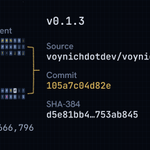
The live enclave runs reproducible build v0.1.3 (SHA-384 d5e81bb4...ab845), bound on chain to voynichdotdev/voynich @ 105a7c0 in Measurement PDA HskKoeFNXNgcvzZEmmQtAS9NAYkkKc6bvCvqodUySAhF.
Clone the repo, run `voynich measurement verify d5e81bb4...ab845 --rebuild`, and verify the latest receipt with Runtime source live:
voynich.dev/receipts/BNPhNmp…
What's next on the road:
1. The stream's receipt: every metered call's receipt page shows the exact token count delivered, the escrow returned, and all five checks against the running hash.
2. The measured runtime: every allowed enclave measurement traced back to source anyone can rebuild and verify themselves.
Voynich is now open source:
github.com/voynichdotdev/voy…
Everything live on mainnet is in the repo:
- Solana programs (voynich, attest, cpi-caller, bounty) and the voynich-cpi crate
- TypeScript SDK and CLI
- Reproducible enclave runtime with npm run verify:build
- sketch-32, text-1m, and the web app
Running through a few final checks before open-sourcing the Voynich codebase. Should be able to open the repository shortly.
Build 5 Step 4 is live on voynich.dev.
Every published enclave measurement now shows its runtime version, source commit, repo, and recipe hash across model pages, enclave pages, and receipts.
When sealing a model on /seal, owners pick approved measurements by version and commit instead of pasting 96-character hex strings:
voynich.dev/enclaves
Build 5 Steps 2 and 3 just landed on mainnet.
Enclave measurements now have their own onchain Measurement accounts binding each 48-byte SHA-384 digest to its source repo, commit, and build recipe.
Anyone can run `voynich measurement verify <digest> --rebuild` to compile the runtime from source and check that the rebuilt digest and recipe hash match what is on Solana:
voynich.dev/docs/cli/measure…