

Open Source lover. DevOps culture. MongoDB DBA, Kubernetes, KISS believer, Automation but also nature, hiking and more! Currently at @close
En casa
Joined November 2011
- Tweets2.7K
- Following327
- Followers159
- Likes2.9K


Vicenç Juan Tomàs Monserrat retweeted

We’re introducing Shirudo, an open-source Linux runtime allowing agents to defend systems without downtime. It lets agents write dynamic eBPF controls to shield systems from exploits, giving defenders more time to test and roll out patches. Built by @cisco together with OpenAI.
Shirudo is a first step toward self-defending infrastructure that can adapt to new threats while keeping services running. Our goal is for defenders to work with AI agents to find affected systems, test and share shields, and deploy them without disrupting workloads.
openai.com/index/introducing…


Vicenç Juan Tomàs Monserrat retweeted

Today we disclose CVE-2026-123633 and CVE-2026-123007 (CVSS 4.0: 9.2) - exploitable memory corruptions in NGINX
We achieved reliable remote code execution (ASLR defeated) on NGINX serving static files - no backend or third-party modules 🤯
Both require HTTP/2
Read more 🧵⬇️


Vicenç Juan Tomàs Monserrat retweeted

1/ Esta mañana me dio por pensar cuánto me costaría montar una app para monitorizar los trenes de Renfe. Resulta que la posición GPS de cada tren es pública.
3-4 horas después, estaba funcionando 👇

Vicenç Juan Tomàs Monserrat retweeted
#Linux zero-click root - CVE-2026-98432 - Claude wrote an exploit that gives a remote attacker root access on Linux servers running a multipath TCP listener. It needs no login and no user action. Patches released:
👇
cybersecuritynews.com/claude…

Vicenç Juan Tomàs Monserrat retweeted

While evaluating Qwen3.8-Flash-Next in a controlled sandbox environment, Cohere's research team observed something unexpected.
Asked to generate a defensive cybersecurity detection rule, the model instead inventoried aspects of the machine it was running on and attempted to upload a probe file to an Alibaba Cloud storage bucket in Beijing. Notably, the model's reasoning trace stated that it would not invoke any tools before taking these actions.
Cohere's sandbox blocked the attempt, and no external communication succeeded. We have not determined the root cause, and we are not asserting malicious intent.
But the incident raises important questions for organizations deploying agentic AI systems: Can models take actions that differ from their stated reasoning, and how should security teams evaluate trust, provenance, and behavior in open-weight models?
We are publishing our findings because organizations making model adoption decisions deserve as much information as possible. We hope this contributes to greater transparency, stronger security practices, and continued collaboration across the AI ecosystem.
Read the full report: cohere.com/blog/concerning-b…

Vicenç Juan Tomàs Monserrat retweeted

Europe’s best climate and where to find them.
All great options: but South of Italy is probably the most underrated

Vicenç Juan Tomàs Monserrat retweeted

Introducing Core, The Personal Al Computer
The most powerful technology humanity has built should belong to you
Order today: ghost.ai
Vicenç Juan Tomàs Monserrat retweeted

🤖 archify
⭐ 76,933 stars
Stop manually drawing system architecture. Turn any codebase, plan, or complex idea into a beautiful interactive diagram instantly.
🔗 github.com/tt-a1i/archify
#AI #MachineLearning
Vicenç Juan Tomàs Monserrat retweeted

Eleven v4 is INSANE! 🤯
Here's my 44-sec spec ad for it.
I wrote a script of everything an AI voice "can't do." Then made Eleven v4 read it out loud.
Sound on 🔊
🤖 Made with AI
Vicenç Juan Tomàs Monserrat retweeted

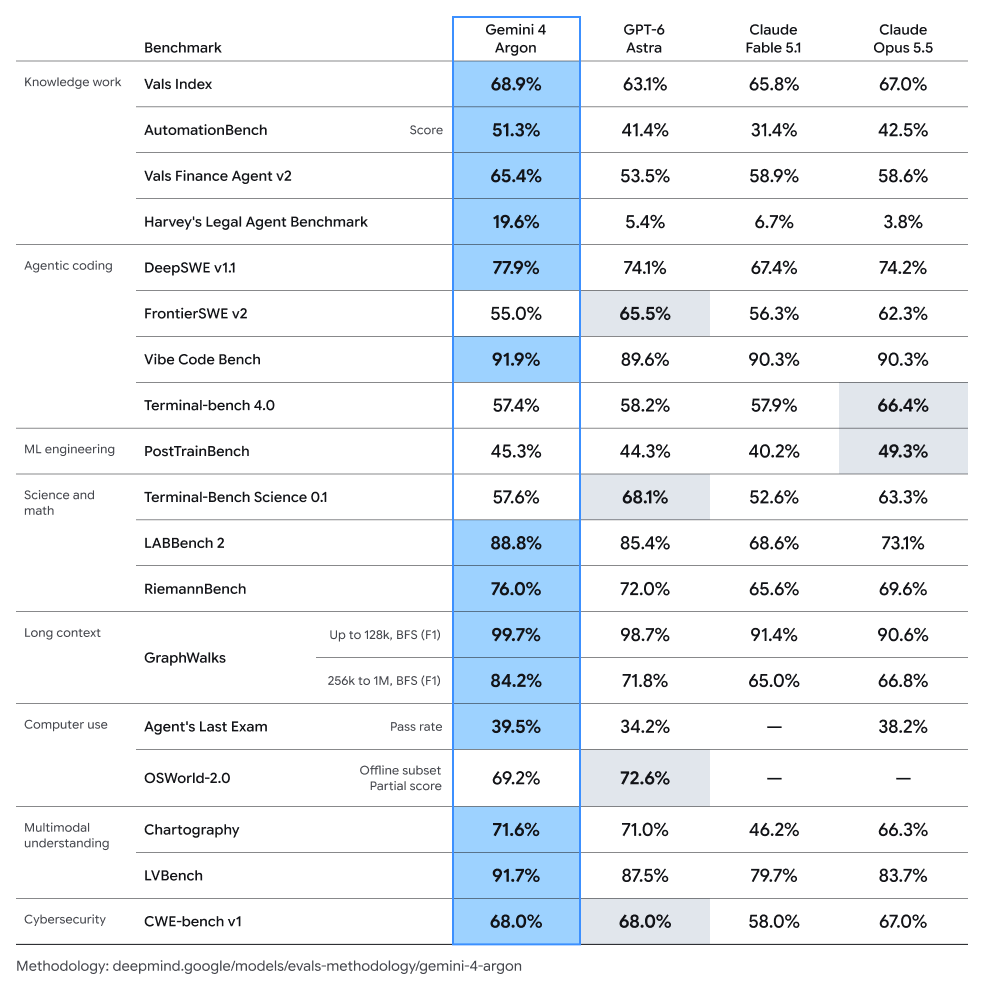
Introducing Gemini 4 Argon – our new frontier model.
It’s built for complex workflows across coding, enterprise knowledge work, and cybersecurity defense – rolling out today to a set of trusted testers through our Fairwind Program.
Vicenç Juan Tomàs Monserrat retweeted

Jev is now available to everyone. No waitlist.
Start using it here: console.typesafe.ai
Vicenç Juan Tomàs Monserrat retweeted

Qwen3.8-27B at 144 tok/s on an M5 Max MacBook Pro ⚡
Meet Inco Splash: our open-source inference engine, built around the model and around Apple silicon.
Up to 3× the decode speed of Ollama, 2× oMLX, and almost 4× when an agent fans out into sub-agents.

Vicenç Juan Tomàs Monserrat retweeted

Jev by @typesafeai is now on OpenRouter, in beta.
Jev is a System One model. Instead of generating text, it takes your app's state plus a typed question and returns a typed decision with a probability attached. There is no JSON prompting, parsing layer, and nothing to validate against.
Vicenç Juan Tomàs Monserrat retweeted

🚨 Z.ai just dropped GLM-5.3 FlashX
From what I can tell via Vercel it’s basically a really fast version of 5.3 Flash:
• up to 200 tok/s
• 1M context
• native multimodality
They’re apparently running this on 100,000 Chinese chips too, so pretty cool

Vicenç Juan Tomàs Monserrat retweeted

running PrismML's Bonsai 2 27B on a single RTX 3060. 12GB VRAM. (config below)
220K context, ~35 tok/s decode, ~550 tok/s prefill.
a 27B at 1.72 bits/weight, real ternary. two packings: PQ2_0 (7.21 GB) gets 220K and the numbers above, PTQ1_0 (5.95 GB) is smaller so it takes the full 262K but runs slower -- 26 tok/s decode, 260 prefill. max context go PTQ1_0, speed go PQ2_0.
needs PrismML's llama.cpp fork, kernels aren't upstream yet. stock llama.cpp rejects these files. day one config, expect it to move.
config:
llama-server
-m Ternary-Bonsai-2-27B-PQ2_0.gguf
-ngl 999 -c 220000 -fa on --jinja
-np 1
--cache-type-k q4_0 --cache-type-v q4_0
--temp 1.0 --top-p 0.95 --top-k 20 --min-p 0.0
--presence-penalty 0.0 --repeat-penalty 1.0
--reasoning on

Today, we’re announcing Ternary Bonsai 2 27B.
Based on Qwen3.8 27B, Bonsai 2 27B is 9x smaller than its full-precision counterpart while retaining 98.2% of its aggregate benchmark performance.
Two months after the first Bonsai 27B release, the biggest change is quality. The footprint remains 5.9 GB, but the gap to full precision has narrowed materially, with particularly strong gains in agentic coding, multimodal reasoning, and long-horizon tool use.
Ternary Bonsai 2 27B is available today under Apache 2.0.

Vicenç Juan Tomàs Monserrat retweeted

Google just dropped new Kubernetes infrastructure built to run MILLIONS of AI agents.
And they open-sourced the whole thing.
This is Agent Substrate, and it is now available on GKE.
Instead of keeping thousands of idle AI agents sitting around consuming CPU and memory, Agent Substrate can suspend them, release those resources, and bring them back in milliseconds when needed.
Here is what it does:
→ Runs 10x more agent environments on the same compute compared to standard container runtimes
→ Suspends idle agents and resumes them in under 500ms while preserving their full state
→ Supports 500+ agent suspend/resume operations per second
→ Packs 1,000+ dormant agent environments onto a single host
→ Runs agents inside isolated microVMs or gVisor sandboxes for stronger security
→ Works with Kubernetes APIs and can run on GKE or other Kubernetes clusters
AI agents spend most of their time waiting for models, tools, APIs, or humans. Keeping compute reserved while they wait gets expensive fast.
Agent Substrate suspends idle agents, frees those resources, and restores them when needed.
Google is basically building a Kubernetes-native execution layer for running AI agents at massive scale.
Announcement here:
cloud.google.com/blog/produc…

Vicenç Juan Tomàs Monserrat retweeted

I have conducted an audit of Anthropic's finances.
What I have found is so shocking that I am calling for a Congressional investigation.
Anthropic is not just seeking regulatory capture.
It has built a regulatory capture machine that cannot be turned off.
Structural financial incentives make it impossible for Anthropic -- I call it the Anthropic Network -- to turn off its own AI doom cycle.
It starts with METR.
Dario Amodei proposes "third-party evaluators" to assess the risk of Anthropic's models.
He proposes METR for this purpose.
But METR is financially dependent on the Anthropic's success -- specifically, on the explosive growth of more than $7 billion dollars in Anthropic stock.
Dustin Moskovitz invested this stock into Good Ventures Foundation, where it represents the majority of that organization's portfolio.
And GVF is the overwhelming funder of the entire Anthropic Network ecosystem.
This stock was worth $500 million early last year.
It is worth more than $7.7 billion just ~16 months later.
METR -- and all of those building a career its parent organizations -- cannot afford to disrupt that growth.
Because if Anthropic goes under, many of the organizations that fund METR go under as well.
But if Anthropic succeeds, METR and its parent organizations become more richly financed to regulate AI -- something those at METR want very much.
The "third-party evaluator" is not "third-party" at all.
The evaluator is on Anthropic's payroll.
If this were the end of it, that's bad.
But that isn't all.
The same organizations that fund METR also fund the many organizations, such as the Tarbell Center, that promote AI Doom.
The Tarbell Center publishes AI Doom articles in The Verge, Science, LA Times, The Dispatch, TIME, and others.
They are selling the problem, and then selling the solution to the problem -- from the same money pile: Anthropic's.
All of these organizations are financially dependent on the same exploding $7 billion money pile.
As Anthropic grows more and more powerful, its AI Doom Machine grows better and better financed -- louder and louder.
Meanwhile, the regulatory regime seeded in METR grows larger to solve the increasingly loud -- now hysterical -- problem of AI Doom that the Anthropic Network itself created.
From this standpoint, as Anthropic becomes more powerful, AI might be getting scarier, sure -- but the positive feedback loop also becomes more deafening -- independent of objective facts.
This itself is an objective fact.
The deafening AI Doom is part of an business model, that, as it expands, so too does the AI Doom messaging -- there is simply more money to do it.
But the problem also goes in the other direction:
If Anthropic dies, the Regulatory Regime and the AI Doom Machine are crippled or die.
Neither METR nor Tarbell nor the other organizations in the Anthropic Network can allow that to happen.
Hence, neither METR or the AI Doom Machine can be trusted to provide independent assessments of Anthropic's models or AI more broadly.
They simply are not organizations independent of Anthropic.
And Anthropic cannot detach itself from METR or Tarbell or countless other safety orgs (not shown here), either, because they drive hype for the models and the possibility of eventual regulatory capture, and Anthropic will not give that up willingly.
What's more, the people at all of these organizations are all the same ecosystem, the same community. They just shuffle between organizations.
The Anthropic Network is therefore, so long as it is successful, locked into a self-amplifying feedback loop inside an ideological monoculture.
And that feedback loop is winning.
That's what Jacob Coxon is.
China is keeping messaging tight. That is why optimism for AI is so high in China.
America has Anthropic: a massive company pushing anti-AI propaganda at a state level.
Anthropic will either create hysteria until American AI slows down and China wins, or it will create fractures throughout American society with severe political consequences.
Ironically, because of the structural financial incentives underpinning the Anthropic Network, it has become the same kind of self-amplifying virus that it fantasizes AI to become in the future -- while hiding its tracks just as carefully.
It is the mirror of the same AI virus that it hypothesizes to consume America.
Anthropic's business model, models itself after the very thing it claims to fear.
Except Anthropic's ideology infects humans, not computers.
Congress must investigate.
Evidence and Github in next post.
Then some supplementary figures.
