

Fulltime church researcher, coauthor of 35 books for church leaders, former: SVP of research at ECFA, similar at Leadership Network, seminary prof, staff pastor
metro New York City
Joined January 2009
- Tweets5.9K
- Following8.3K
- Followers9.5K
- Likes70


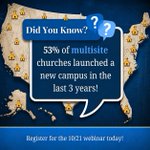


New multisite research from @MultiSiteGuy , Sean Morgan, and me is featured in Religion News Service! Bob Smietana explores our findings on growth, teaching, leadership, and mergers.
Read more:
religionnews.com/2026/10/22/…

How are you identifying preparing future leaders?
Join @MultiSiteGuy , Sean Morgan, and me TODAY for Multisite Revealed: new research, practical insights, and Q&A.
Free webinar | Noon CT / 1 p.m. ET
There’s still time to register:
theascentleader.org/multisit…

Tomorrow: What can we learn from 1,000+ multisite church leaders?
Join @MultiSiteGuy , Sean Morgan, and me for Multisite Revealed—a free webinar on new research and what it could mean for your church.
Oct. 21 | Noon CT / 1 p.m. ET
theascentleader.org/multisit…

The multisite movement has a national reach. What are we learning?
Join @MultiSiteGuy , Sean Morgan, and me this Wednesday for Multisite Revealed: new research and what it means for your church.
Free webinar + Q&A
Oct. 21 | 1 PM ET / Noon CT
theascentleader.org/multisit…
🤖 Made with AI

Our new research may challenge assumptions about which churches become multisite—and when.
Join @MultiSiteGuy, Sean Morgan, and me for Multisite Revealed, a free webinar + Q&A.
Oct. 21 | 1 p.m. ET / Noon CT / 11 AM MT / 10 AM PT
Register: theascentleader.org/multisit…
🤖 Made with AI

Thinking about your church’s next campus?
Join @MultiSiteGuy, Sean Morgan, and me to explore new multisite research and what it could mean for your church.
Free webinar + Q&A: Oct. 21, 1 p.m. ET / noon CT
theascentleader.org/multisit…
#multisite #churchleadership

What’s growing & what’s stalling in multisite churches?
Warren Bird & @MultiSiteGuy unpack findings from 1,000+ church leaders in Multisite Revealed, a free live webinar: Oct. 21 at 11AM EST.
Learn + get full report access at a special price.
Register: theascentleader.org/multisit…

Where is the multisite movement now & where is it going?
In a free one-hour webinar, expert @MultiSiteGuy & I will unpack the largest-ever study of U.S. multisite churches titled “Multisite Revealed: What 1,000 Leaders Told Us That No One Expected.”
Link:theascentleader.org/multisit…

What does our new research reveal about multisite churches? I joined @cnieuwhof & Sean Morgan to discuss our largest multisite study.
Listen: lnkd.in/eyhMYVsN
The join me, @MergerGuru & The Ascent Leader's free Oct. 21 webinar: lnkd.in/exMbUDXV
#multisite

Warren Bird retweeted

On the front page of @CNN and the @drudgereport right now:
“A Looming ‘A Tsunami’ of Church Closings is Poised to Remake America” by @JohnBlakeCNN. (Link in the replies.)
But there is no evidence—cited in the article or in the actual data—that something like a tsunami of church closings is coming.
The data points to decline. But it is slow decline and churn, not a tsunami. And its headline does not address church planting—and it also confuses closings with property changes.
We actually have some real data on closing and starts. According to a @LifewayResearch project released this year—which updates research we started when I was there more than a decade ago—the 2024 numbers were:
• 3,800 new Protestant churches opened/started (and hundreds more if you include new multisite campuses)
• 4,000 Protestant churches closed
• Net change: –200 churches
So, it’s not 10,000 churches disappearing a year, as suggested in the article. And it’s not a tsunami.
To be fair, editors—not authors—generally choose headlines. But most people will only see the headline, and this one is unhelpful for sure, and misleading at worst.
Lifeway Research has conducted this same basic project for more than a decade. (Full disclosure: I created the project over a decade ago. See their full methodology at their website.)
And this brings me to another number that gets repeated a lot: the claim that 100,000 churches are going to close.
I confess that I get a little frustrated seeing the “100,000 churches” figure thrown around so widely, because it appears in different places with different definitions and different timelines.
But there’s an important distinction here.
The 100,000 figure associated with Mark Elsdon’s Gone for Good? is generally a projection that as many as 100,000 church buildings or properties could be sold or repurposed, not that 100,000 congregations will necessarily close.
Those are not the same thing.
Elsdon himself has described the projection this way publicly, while acknowledging that the actual number could be half—or even less—of that estimate.
Yet the 100,000 figure has increasingly been repeated as if researchers have established that 100,000 congregations are about to close.
I have not been able to find underlying data that substantiates that claim.
And a projection repeated often enough does not become data simply because it has been widely quoted. If there is solid data behind an estimate of 100,000 congregations closing, I’d genuinely like to see it.
There’s another data issue in the CNN article, but in the other direction.
The article cites Hartford Institute for Religion Research data, stating, “For the first time in 25 years, the number of people attending in-person worship in the US has increased.”
But that’s not what the study found.
The Hartford research does not show an increase in the total number of Americans attending church. It shows an increase in the median in-person worship attendance of the congregations studied, from its previous levels to 70.
Those are very different things.
In fact, Hartford itself cautions that much of the observed growth reflects “internal reshuffling rather than an expansion of religious participation overall.”
So, no, the Hartford study does not demonstrate that more Americans are attending church. It tells us that median attendance among the congregations studied has increased.
(And, Hartford, your headline could be clearer too.)
Shocking headlines get clicks. But they don’t always help us understand what is actually happening.
Here’s what I think is happening.
There will be a lot of empty historic church buildings in the years ahead. Many older and smaller congregations are struggling, and some will close. Mainline Protestantism, in particular, continues to face significant institutional decline.
At the same time, there will be a lot of new churches—particularly immigrant, ethnic, and church-planting congregations—that don’t own buildings at all. They’ll meet in schools, theaters, community centers, storefronts, and other churches’ facilities.
So, yes, there will likely be lots of church buildings to sell or repurpose.
But buildings changing hands and congregations disappearing are not the same thing.
And Blake’s article actually points some of this out. I’m afraid, however, that nuance will get lost beneath the headline and some of the unsupported statistical claims.
The American church landscape is changing.
There is real decline in some places and real growth in others. Churches are closing, merging, being planted, and going multisite. People are shifting between congregations. And the kinds of churches Americans attend—and the buildings in which they meet—are changing.
That is a significant story, and one worth telling accurately.
I hope CNN will consider additional articles clarifying and explaining the full story. The underlying story is important enough that it doesn’t need exaggerated statistics or a “tsunami” headline to make it compelling.
And, @CNN, this would be a great time to add a full time religion reporter like the old days.
Regardless, A net decline of roughly 200 Protestant churches in a year is not a “tsunami” of church closings. It's decline, but mostly it is churn, older churches being replaced by young (and more diverse) ones.
And, before you ask, adding Catholic congregations does not remotely bridge the gap between the documented Protestant numbers and claims of 10,000 closures a year. Catholic parishes represent a relatively small share of the total U.S. congregation count.
The story is change, transition, and some real decline—not the wholesale collapse one might infer from the headline.
In a time when some are claiming revival where the data doesn’t support it, while others are claiming collapse when the data doesn’t support that either, we’d do well to stick to the facts.
Facts are our friends, folks.

Did you know nearly 1 in 10 Protestant churchgoers in the U.S. attends a multisite church?
Join me for a webinar exploring fresh multisite research and what the findings mean for church leaders.
Register: theascentleader.org/multisit…

MEGACHURCH RESURGENCE just came out--extensive research on how megachurches have come back since the pandemic.
Here's my favorite interview & cover article about it with link to the report itself @GregLigon @davetravis @nathanartt @fbealer @MultiSiteGuy linkedin.com/posts/wbird_meg…

Big news about megachurches, fresh research about trends and post-pandemic comeback, linkedin.com/posts/wbird_tre…

Ministers: What to Do Now That Your HOUSING ALLOWANCE Is Likely Less Valuable
My friend David Fletcher, founder of XPastor (for Executive Pastors), has made an important discovery about recent tax law changes. See linkedin.com/posts/wbird_min…

If you want to learn more about my latest survey and how it is going, check out my latest LinkedIn post!
linkedin.com/posts/wbird_mul…
#survey #linkedin #multisiteshurch #data #qanda

Check out my latest LinkedIn post about "Recent Research about Multisite Churches (Part 2)".
linkedin.com/posts/wbird_res…
#Research #Survey #Data #Study #MultisiteChurch

What’s the latest research about multisite churches? Click through my latest LinkedIn post to learn more.
linkedin.com/posts/wbird_sur…
#survey #research #church #multisitechurch #data
Can you believe these multisite numbers?
I have an update since my last post, check it out on LinkedIn.
linkedin.com/posts/wbird_mut…
#Survey #Multisite #Research #MultisiteChurch

Are you curious as to why many churches can stall at 3 campuses? Check out my latest LinkedIn post.
linkedin.com/posts/wbird_the…
#MultisiteChurch #Multisite #Article #Blog

Want to learn more about the unsolved mysteries of multisite churches? Check out my latest LinkedIn post!
linkedin.com/posts/wbird_mul…
#survey #research #multisitechurch
