
@DamonRunyon Fellow at Baker lab @UWproteindesign. PhD with @JShendure. mainly at https://xitter.cf/t.co/WpSk6RTizP
Seattle, WA
Joined October 2013
- Tweets372
- Following730
- Followers896
- Likes876





Pinned Tweet
Thrilled to share my freshly "baked" Baker lab paper. We took a bottom-up approach to designing transcriptional regulators. Instead of relying on natural activation domains, we designed compact proteins that recruit specific cofactors. Activators for now, repressors to come!

I would like to thank David @uwproteindesign
for his support and guidance. and @ruopu22 @kinasekid @isaacbhilton and other x-free authors for their help and discussions.
And most importantly, I need to thank @DamonRunyon for their support on this risky project!
RFD4 is amazing!

Avengers assemble: 1 year BakerLab + NVIDIA GenAIR = 🔥 rfd4-proteina.org
Presenting RFD4-Proteina, our latest protein design model, significantly better and faster than everything we compared against, both in silico and in the lab! 1/30
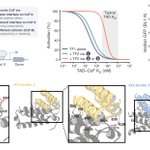
To test this experimentally, we designed p300 KIX binders with affinities ranging from nano- to micromolar and measured their transcriptional activity. We found a switch-like response around 500 nM! Stronger binding beyond this threshold provided little additional activation.

Kinetic simulations suggest that two TADs engaging distinct interfaces of the same cofactor or cofactor complex can cooperate to achieve efficient recruitment, even when individual interactions are weak.

We first used AF3 to systematically map interactions between TADs and transcriptional cofactors. Interestingly, the predictions revealed distinct cofactor-binding preferences. Some cofactors were highly selective, whereas others showed broader interaction profiles.


Will Chen retweeted

Every cell in our body comes from 1 fertilized egg — & now we can trace that dev. #HHMIInvestigators Jonathan Weissman & Jay Shendure & teams have created new tools that generate maps of the origin & outcome of vast numbers of cells in a developing mouse: bit.ly/4dVhnhe

ALT Two stacked portraits. Top: HHMI Investigator Jonathan S. Weissman of the Whitehead Institute for Biomedical Research smiles in a research lab, wearing glasses and a white lab coat with “Weissman” stitched on the chest. Pipettes and lab equipment fill the bench beside him. Bottom: HHMI Investigator Jay Shendure of the University of Washington smiles at his desk, wearing glasses and a gray collared shirt with a small clip-on microphone. Behind him are framed photos, a child’s drawing pinned to the wall, and a computer monitor displaying lines of green text on a dark terminal window.
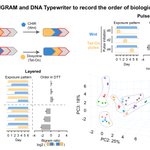
What a wonderful day for recording community! Such beautiful paired work mapping the lineage from embryo to mouse! Let's decorate some "trees"

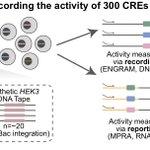
Exciting day for DNA Typewriter w/ 2 papers from the lab & SeaHub out today :)
1. Mouse lineage from E0 to E13.5
science.org/doi/10.1126/scie…
2. A fluctuation test for gastruloid heterogeneity
cell.com/cell/fulltext/S0092…
Paper #1 covered in quoted thread. More on paper #2 here. 1/n

Will Chen retweeted

Excited to share Shotgun Genetic Engineering, developed by @julie_trolle, out in @NatureBiotech!
Read on to learn how Julie enabled mammalian cells to grow without 2 essential amino acids for the first time in >500 million years using highly multiplexed metabolic engineering!

Highly multiplexed mammalian metabolic engineering with a shotgun approach - @sudpinglay @JefBoeke nature.com/articles/s41587-0…

Will Chen retweeted

Thrilled to post thread re: new single-cell lineage of mouse embryo reconstructed w/ DNA Typewriter. One animal, zygote to late organogenesis (E13.5). Tree has 1,340,794 transcriptionally profiled, annotated tips (cells), 1,142,588 dated internal nodes, rooted at zygote
1/n
Will Chen retweeted

Could the folding of synthetic gene circuits in 3D shape how genes are expressed? Today @ScienceMagazine we report on the role of gene syntax in shaping feedback between transcriptional activity and genome folding for advanced circuit design🧵 (1/n)

Will Chen retweeted

New preprint! @JShendure @CXchengxiangQIU Can we learn regulatory grammars of human cell types we'll never be able to profile - by training on mouse development and transferring across 241 mammalian genomes?biorxiv.org/content/10.64898…

Will Chen retweeted

Our Human Multiomic Development Atlas paper is out in Nature today! A heart-felt "thank you" to all co-authors for their tireless work on this complex yet exciting project! Congrats all! nature.com/articles/s41586-0…

absolutely excited to see @CXchengxiangQIU starting his own lab at Dartmouth! Great adventure awaits!

Thrilled to share I’ve started my lab at Dartmouth’s Geisel School of Medicine! We focus on mapping cellular trajectories & TF networks in development and Mendelian disorders, exploring new therapies. Join us—postdocs, grads, and scientists welcome! sites.dartmouth.edu/qiulab/
