









Marcel Wege retweeted

omadia.ai
An agentic OS for grown-ups. Strips personal data before LLM calls and restores it afterwards. Has a no-code agent builder. Works with MS Teams, Telegram and Discord. Comes with privacy-aware graph memory that keeps track of who is allowed to know what.
Marcel Wege retweeted
LLMs guess at math.
So our AI agent platform omadia gives agents a headless Excel in memory. Data goes in, the spreadsheet runs the formulas, the model sticks to reasoning, the agent reads the results back. File's there if you ask.
Take the guesswork out: omadia.ai
🤖 Made with AI

Marcel Wege retweeted
An agent OS for the real world. Strips personal data from LLM calls and restores it afterwards. Has a no-code agent builder. Works with MS Teams, Telegram and Discord. Comes with privacy-aware graph memory that keeps track of who is allowed to know what.
github.com/byte5ai/omadia

Marcel Wege retweeted
The phrase "Hey builders and founders" is slowly becoming X's version of "to whom it may concern". And yes, I am probably in the target audience.
Token costs were streaming to the UI and silently vanishing. Now every Anthropic call - orchestrator, sub-agents, Haiku callers - is captured, persisted, and visible on a cost dashboard. Plus per-turn Opus/Sonnet routing to stop burning budget on cheap turns.

Omadia agents can now propose their own capability extensions, operator-gated, never auto-approved. The agent hits a tool limit, files the request, and waits. You decide.

Refine a goal 5 times in one session? Omadia now GCs the stale plan DAGs automatically. Structural dedup first, one Haiku call for semantic stragglers. Only the live plan survives.

Agent is mid-run. You realize it's heading the wrong way.
Until now: watch it finish, then correct.
With Omadia v0.7: type a message while it's running. Injected at the next iteration boundary. No stop, no restart.
omadia.ai
Marcel Wege retweeted
Running a social media account takes more tools than it should. Buffer or Hootsuite for scheduling, a separate analytics view, something for writing drafts. Multiple subscriptions, still context-switching.
Claude Cowork handles all of it. Just prompts. Here is the setup for X.
1/8

Marcel Wege retweeted

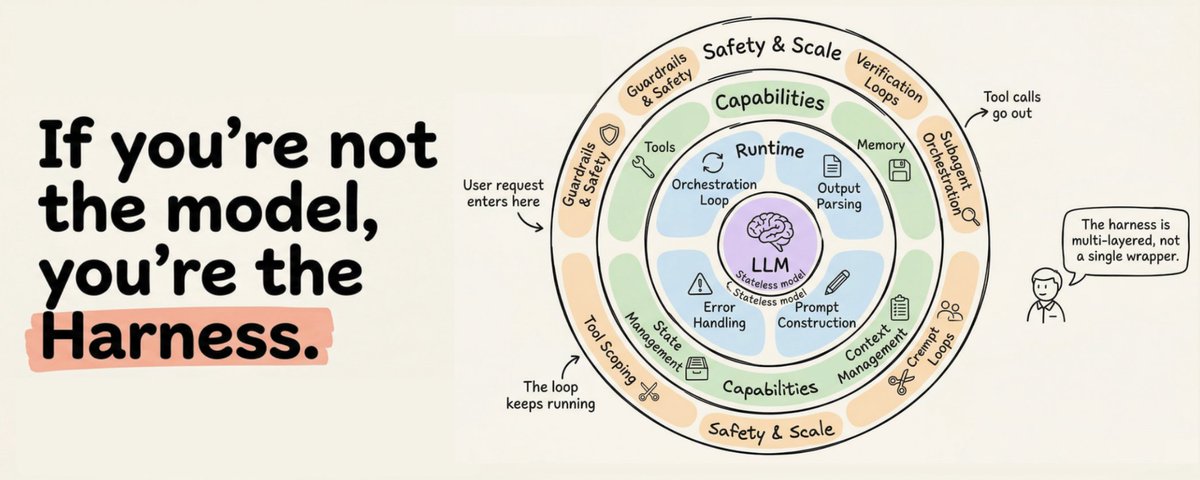
A harnessed LLM agent, clearly explained!
Most people picture this as a model with tools bolted on. The real architecture inverts that relationship.
The model itself is deliberately thin. Intelligence gets pushed outward, and the harness composes it at runtime.
Three dimensions orbit the harness core:
- 𝗠𝗲𝗺𝗼𝗿𝘆 holds the state a model shouldn't carry in weights or context. Working context, semantic knowledge, episodic experience, and personalized memory each have their own lifecycle.
- 𝗦𝗸𝗶𝗹𝗹𝘀 hold procedural knowledge. This can cover operational procedures, decision heuristics, and normative constraints that specialize the general model per task.
- 𝗣𝗿𝗼𝘁𝗼𝗰𝗼𝗹𝘀 hold the interaction contracts. Agent-to-user, agent-to-agent, and agent-to-tools are three distinct surfaces with their own failure modes.
Between the core and these modules sit the mediators, like sandboxing, observability, compression, evaluation, approval loops, and sub-agent orchestration.
They govern how the harness reaches out and how state flows back in.
The useful question this framing unlocks is: for any new capability, where should it live?
- Stable knowledge goes to memory
- Learned playbooks go to skills
- Communication contracts go to protocols
- Loop governance goes to the mediators
Harness design becomes a question of what to externalize, and how to mediate it.
I'm building a minimal agent harness from scratch and will open-source it soon.
In the meantime, my co-founder wrote an article about the anatomy of Agent Harness, covering the orchestration loop, tools, memory, context management, and everything else that transforms a stateless LLM into a capable agent.
Read it below.

Marcel Wege retweeted

Found the Best Resource to learn Harness Engineering. 😭
walkinglabs.github.io/learn-…

That's why we built omadia.ai - GDPR first agentic os

👋 Say hello to omadia — the open-source platform for building no-code AI assistants that plug straight into your business tools.
Describe the job, connect your stack, ship the agent. No glue code, no lock-in.
⭐ github.com/byte5ai/omadia