

Trustee at The London Luminaries. Historic buildings operations manager. Loves Meissen/Jacobite/symbolism/ collections/Turner/Soane/Wedgwood/Meissen
twickenham
Joined April 2013
- Tweets22.4K
- Following4.2K
- Followers4.6K
- Likes7.1K






Pinned Tweet
In the Footsteps of the Emperor Augustus: Augustan Coinage and the Statu... youtu.be/LSHGdql987g?si=fxMr… via @YouTube

‘Alexander Pope and Jonathan Swift: A Celebration of Satire[
Hosted by The Pope’s Grotto Preservation Trust.
Join three renowned authors and speakers for an engaging evening exploring how close friends Alexander Pope and Jonathan Swift created a literary sensation in the eighteenth century and shaped the landscape of satire forever.
To mark the 300th anniversary of the publication of Gulliver's Travels, our panel will explore the extraordinary friendship between two of Britain’s greatest wits, their brilliant literary collaboration, and the enduring power of satirical writing.
Featured Speakers
Hester Grant – Discussing her new book, ‘The Twitnam Summer: Friendship, Satire and the Writing of Gulliver's Travels’ (HarperCollins), which celebrates the 300th anniversary of Swift's masterpiece.
Judith Hawley – Introducing her work, ‘Satire: A Very Short Introduction’ (Oxford University Press).
John Mullan – Leading a wider panel discussion and Q&A on the rich history, wit, and cultural impact of satire.
Event Details
Date: Monday 30th November
Venue: Stewart House, London
Tickets: £10
🎟️ Book your place online: popesgrotto.org.uk/events/
We look forward to seeing you there!


Ricky Craig Pound retweeted

We are open Fridays and Saturdays 11-3pm and Sunday 2-4pm. FREE entry! Plus children’s activity trail, model of Hampton Court Palace, Professor Cockles and much much more! Come and support your local heritage!


Ricky Craig Pound retweeted
Did you know that the building in which the Twickenham Museum is housed today once belonged to the Twining family, giants in the tea trade? We have a small collection of tea wears including this rare Kangxi period double dragon handled chocolate cup c. 1700. Come and see!


Ricky Craig Pound retweeted

On Thursday 5th November at 7pm Gabriella Esser will be talking online about ‘Practically Magic: William Morris at Home in Hammersmith’. Tickets are free but donations are very welcome and will be split between participating properties
Book here-
londonluminaries.com/talk/pr…


A lovely memorial service held this afternoon at St Mary’s Church at Barnes for the late-and-great Jane Clark. I had known Jane for over 30 years and regarded her as my mentor for all things Burlington and Chiswick House. My own research was in many ways, a continuation of hers.
But Jane was so much more (as described below).
Goodbye my friend Jane.
Jane Clark, as she was known professionally, was a highly respected historian, author, harpsichordist, teacher and leading authority on François Couperin and Domenico Scarlatti. She was also married to composer Stephen Dodgson.
Before her death, she looked back on the achievements that were particular highlights for her. She'd decided to write her highly esteemed book The Mirror of Human Life on Couperin (cowritten with Derek Connon) at the insistence of pianist, conductor, broadcaster and BBC controller Lionel Salter, who apparently rang her to prompt her about it the night before he died. She was delighted that her recording Handel’s Rivals with her chamber group on the Janiculum label was named a Best of the Year recording by International Record Review, and she explained that her CD An Italian in Spain had its foundations in “telling Basil Lam of the BBC he didn’t know what he was talking about” in relation to Scarlatti!
She wrote: “Having spent years playing for a Spanish dance group I did understand. Scarlatti was fundamentally influenced by Andalucian folk music – I play the Spanish sonatas as a flamenco guitarist would & set them beside typically Italian ones.”
After she was granted a dedicated hour-long slot on the then Third Programme (for which she “had to spend days analysing chord patterns and finding hidden tunes”), the recording received a rave review in The Listener and “sent me spinning round the globe on a Scarlatti ticket”.
Her work on Scarlatti also led to researching and writing about Lord Burlington, often credited with sponsoring and engineering the Palladian revival in England. Prompted by Chiswick House Friends, Jane Clark produced publications in Apollo and The Georgian Group Journal, and the book Lord Burlington: Architecture, Art and Life, edited jointly with T. C. Barnard.
Latterly, following the death of her husband, composer Stephen Dodgson, she founded the Stephen Dodgson Charitable Trust in 2015 to support musicians and raise awareness of Dodgson’s manifold compositions, ranging from intimate entirely solo works for instruments such as viola, horn and guitar to large orchestral works and operas.
In this, as in everything, Jane Clark Dodgson was a force of nature. She had a quick mind, barely touched by advancing age, and would immediately see connections and ways to create opportunities and build wonderful, fruitful relationships. She could be fairly direct but warm with it, and she had a wonderfully distinctive little giggle.
She was proud of the work of the Trust, including supporting students and emerging artists, helping bring about some 17 Dodgson recordings since the Trust was founded, as well as producing a centenary book, Born by the Thames, in 2024 and many other projects – most recently the newly confirmed year-long collaboration with the International Guitar Foundation & Festivals. In more practical terms, she loved to have musicians such as the Magnard Ensemble come and use the large rooms at the house in Barnes for their rehearsals.
But most of all, Jane looked back at “SO many wonderful friends and extended family. I am just SO lucky.”


Just 39 miles left to run before the end of this month to reach my 150 mile target!
support.prostate-cancer-rese…

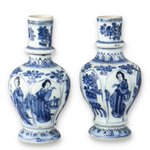
Latest acquisition, and it’s a good one!
‘The Decorative Arts of The China Trade’. Carl L. Crossman.


A lovely pair of miniature Chinese blue and white baluster vases, Kangxi period, circa 1700. The bases are marked with a small artemisia leaf, a common symbol painted on the bases of Kangxi export porcelain wares. These would originally have had some type of lids and would probably have been used for either elite dollhouses (Poppenhuizen) or for porcelain cabinets & chimneypieces.
The pair originally would have had lids.
During the Kangxi period, the Emperor issued an edict in 1677 forbidding the use of his imperial reign mark on export porcelain, fearing that if the pieces were broken or discarded, it would disrespect the Emperor. In response, the potters at Jingdezhen began using auspicious symbols instead. The Artemisia leaf is one of the Eight Precious Things in Chinese symbology, representing good luck, health, and protection against evil spirits.


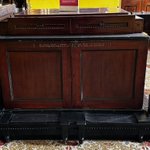
John Soane’s “The Dance Cabinet” (also referred to as “The Shrine”), an English plan chest dating from circa 1800–1825, was built for the neo-Classical architect George Dance the Younger (1740–1825) and is housed in the North Drawing Room at Sir John Soane's Museum in London.
Looking at the form of the cabinet and the added Soane base, I can’t help but think of the Ark of the Covenant, which was found in the ‘Holy of Holies’ at King Solomon’s Temple. This was indeed Soane’s own ‘Holy of Holies’, as it contained designs by his architectural mentor, George Dance.
In 1813, Sir John Soane was also raised a Freemason, passing through all three Craft degrees in a single evening. This happened because Soane was asked to design a new Masonic building, and its architect needed to be a Freemason.
1813 was also a monumental year in Freemasonry, as it marked the historic union of the rival ‘Moderns’ and ‘Antients’ grand lodges into a new overarching governing body known as the United Grand Lodge of England (UGLE). Soane served as a kind of poster boy for this new organization, providing it with immense dignity and respectability.
The most important building in #Freemasonry is Solomon’s Temple, from which the vast majority of Masonic symbolism is drawn.
@SoaneMuseum @MuseumFreemason


In the ceiling of the Duchess’s Private Closet at Ham House is a painting called ‘The Penitent Magdalene surrounded by Putti holding Emblems of Time, Death and Eternity
by’ Antonio Verrio (c. 1698). It is often suggested that the lady of the house, Elizabeth Dysart, is portrayed as Mary Magdalene due to her harbouring secret Catholic loyalties. However, I believe the real explanation is quite different.
Rather than signaling religious heterodoxy, Elizabeth Dysart may be using the figure of Mary Magdalene—the first of the disciples to see Christ resurrected—to tap into the potent messianic symbolism cultivated by the Stuarts. Following the trauma of the English Civil War and the execution of Charles I, Stuart propaganda framed the King’s death as a political crucifixion endured for his people. The return of the monarchy in 1660 under Charles II was similarly framed as a resurrection and a fulfillment of divine right. Texts like the Eikon Basilike famously depicted the martyred Charles I holding a crown of thorns, trading an earthly crown for a heavenly one.
Within this context, the symbols in Verrio’s ceiling painting reinforce themes of martyrdom, divine right, and royal restoration:
*The hourglass denotes time, patience, and eternity.
*The skull links directly to Golgotha (literally "the place of the skull"), the site of Christ’s crucifixion.
*The Ouroboros (the self-eating snake) acts as a classic emblem of cyclical renewal, eternity, and restitution—symbolising the shedding of the old era and the rebirth of the crown
Elizabeth Dysart was a royalist by birth who played a high-stakes political game, corresponding with the exiled Charles II using ciphers and invisible ink as a member of the secret "Great Trust." When Charles II was finally restored in 1660, Elizabeth’s calculated risks paid off, and she was rewarded with a pension of £800 per annum from the Exchequer for life. Her ceiling is not merely a testament to personal piety, but a monument to a hard-won royal restoration.
academia.edu/90097711/The_Co…


The fantastic new book by Dan Jones simply called ‘Castles- A Fortified History of the World’ has now been added to my library! @dgjones


Ricky Craig Pound retweeted
I totally agree with you Waldemar. Trump is the worst excuse for a human being there is. Everything about him I hate- his bloated ego, his narcissism, his rejection of global warming, his bare faced bullying, his treatment of minorities, his obvious admiration for Putin, his distain of the underdog- I could go on forever!
76 miles down 74 to go in October
I’m delighted to say that on day number 12 of my October run that I have completed 76 of my target 150 miles.
Time for a rest for a day or two before a long run this Thursday. Currently on target for those miles
I'm taking on the Run 150 Miles Challenge this October for Prostate Cancer Research. Please support me by donating what you can. Every donation helps advance the mission to create a world free from the impact of prostate cancer. Thank you for your support. support.prostate-cancer-rese…


