

Immigration Lawyer, Husband, Father, Son, Uncle and Lover of Hockey. Tweets ≠ Legal Advice.
Joined July 2015
- Tweets384
- Following215
- Followers848
- Likes954


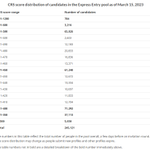
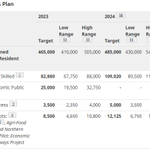


Some thoughts about the 2027-2029 Immigration Levels Plan.
lnkd.in/p/geXX9SgU

36
I have the privilege of serving as a moderator at the CBA Immigration Law Conference, taking place in Victoria on June 5-7!🎙
Looking forward to the insights that will be shared!
Register now ➡bit.ly/42PZnQw #CBAImmigration
2
235
linkedin.com/posts/stanley-l…
Express Entry Qualifying Job Offer points officially removed. Will they ever be brought back?

1
1
259
Initial thoughts about the removal of LMIA job offer points and the end of flagpoling: linkedin.com/posts/stanley-l…
1
287
Stan retweeted

In 2025, IRCC plans that 1,262,801 temporary residents will leave Canada, a significant increase from the 588,409 departures estimated for for 2024. The planned numbers of people leaving Canada decreases in subsequent years, with 1,104,658 temporary residents expected to leave in 2026 and 875,129 in 2027.
Some immigration stakeholders are skeptical of these projections. They argue that many temporary residents will choose to remain in Canada by filing Humanitarian and Compassionate applications, seeking asylum, or pursuing other avenues to stay.
The 2025-2027 Immigration Levels Plan is clear that if a large numbers of temporary residents remain in Canada and do not leave, adjustments will be made to the levels of new temporary admissions to maintain the government's target of 5.0% temporary residents in the population.
In practical terms, this means that for every worker or student who stays in 2025-2027 and does not leave as planned, one fewer worker or student will be admitted in the future.
In looking at this chart it is not difficult to envision a scenario where future cuts to international student or foreign worker programs could be much more severe than those seen to date.
To achieve these projected outflows, IRCC will need to ensure that existing temporary residents do not extend or maintain their status. It remains unclear whether this will be accomplished through legislative changes, program reductions, higher refusal rates, or prolonged processing delays that may frustrate individuals into leaving voluntarily.
Interesting times ahead.

IRCC Levels Plans Observations
Pt 1 of 2
linkedin.com/posts/stanley-l…
Pt 2 of 2
linkedin.com/posts/stanley-l…
Lots of immigration news over past few months. Maybe I'm in the minority, but so far the impact of policy changes has mostly felt limited to certain industries/practice areas rather than addressing systemic issues of purpose, integrity, access, delays, etc.
1
138
Stan retweeted

Just received the first copy of my book. 2.5 years of work with a great co-author @middlemiss_LM, it is nice to see the final product.
To get your copy click here:
emond.ca/Store/Books/Maintai…


Stan retweeted

IRCC Security Screening for CANADA: Myths and Delays teapaw.org/i/broadcasts/1yoKMwwoV…
Some thoughts on recent news about potential changes to Post Graduation Work Permit eligibility requirements:
linkedin.com/posts/stanley-l…

Multiple dates and times: WELCOME HOME: Dessert Night Fundraiser for New Hope tickettailor.com/events/newh…
147
welcomebc.ca/Immigrate-to-B-…
Graduates with Diploma or Certificates will now have to meet work experience requirements (among other things) for other BC PNP streams. Still more details needed but this could certainly be an impactful change for some international graduates.
I'm guessing there will be an uptick in demand for Bachelor's level study for Pharmacy, Engineering, Education and probably Nursing.
canada.ca/en/immigration-ref…
1
2
222
Is it just me or does it feel like news about provinces scrutinizing post-secondary schools is basically what should have happened when the DLI system was introduced years ago?
4
482
Massive shift in Canada's international study system. A reminder of how quickly policy can change.
I wonder how this will affect assessment of accompanying dependents of students altogether.

Today, we announced that the Government of Canada will set an intake cap on international student permit applications to stabilize growth, for a period of two years. Details: canada.ca/en/immigration-ref…
For 2024, the cap is expected to result in approximately 360,000 approved study permits, a decrease of 35% from 2023. Study permit renewals will not be impacted. Those pursuing master’s and doctoral degrees, and elementary and secondary education are not included in the cap. Current study permit holders will not be affected.
To implement the cap, as of January 22, 2024, every study permit application submitted to IRCC will also require an attestation letter from a province or territory. Provinces and territories are expected to establish a process for issuing attestation letters to students by no later than March 31, 2024.
In order to better align the Post-Graduation Work Permit Program, we are changing the eligibility criteria:
-Starting September 1, 2024, international students who begin a study program that is part of a curriculum licensing arrangement will no longer be eligible for a postgraduation work permit upon graduation.
-Graduates of master’s and other short graduate-level programs will soon be eligible to apply for a 3-year work permit.
In the weeks ahead, open work permits will only be available to spouses of international students in master's and doctoral programs. The spouses of international students in other levels of study, including undergraduate and college programs, will no longer be eligible.

ALT Canada to stabilize growth and decrease number of new international student permits issued to approximately 360,000 for 2024
Trickle down effect may include movement in provincial medical insurance policies to limit coverage for dependents. Trend has generally been in that direction but may have more momentum with these changes.
1
130