

🛤️ Path building between: 🤖 AI Memory 📄 Markdown 🥽 AR/VR/XR
Joined December 2022
- Tweets1.4K
- Following0
- Followers272
- Likes1





Pinned Tweet
The essence of "making sense" stems from a tree of knowledge which grows from a web of understanding in semantic space.
This is the WikiBonsai Way.
1/n


Mulling over the possible shape and structure of the model that emerges in our minds -- the "WikiBonsai Way".
teapaw.org/wibomd/status/17039309…
The word transcendent comes to mind, along with...

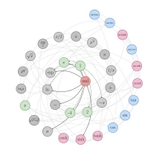
Personality trait structure derived via TGA


Network visualization of the three-level hierarchical personality trait structure derived from Taxonomic Graph Analysis (TGA) of the IPIP-NEO inventory (N ≈ 149,000).
- The bottom level shows 28 narrow facets with dense empirical connections.
- The middle level displays six trait domains (Neuroticism, Sociability, Conscientiousness, Integrity, Openness to Experience, Impulsivity).
-The top level shows three meta-traits (Stability, Plasticity, Disinhibition).
Node colors correspond to the trait categories indicated in the legends; edges represent network-derived relationships across levels.

1
67
eml(x,y) = exp(x) − ln(y)
teapaw.org/umbertoleon/status/206…


Estudio muy loco donde se descubre que una sola operación:
eml(x,y) = exp(x) − ln(y)
...combinada con la constante 1, genera absolutamente toda la matemática de tu calculadora científica... senos, cosenos, raíces, logaritmos, e, π, i... todo.
Este hallazgo sugiere que cosas que parecían muy distintas (el seno, la raíz cuadrada, el número π) están todas hechas de la misma pieza básica, solo combinada de formas diferentes... y es que al final, parece que toda la realidad, incluso la simbólica como la matemática, emergería de piezas más elementales...


37
Why do opposites seem to come back together the more polarized they become? Why would antonyms form a horse-shoe rather than a straight line?
1/n

This could also be related to the hyperdimensional space we need to bridge the gap in understanding between humans and higher-order AIs:
teapaw.org/nearcyan/status/172935…


basically every interpretability paper anthropic drops is goated tbh
Decomposing Language Models With Dictionary Learnin: transformer-circuits.pub/202…
via @slatestarcodex astralcodexten.com/p/god-hel…

1
1
327

AI may move to directly generating binary code, but I suspect there are still advantages to reasoning in a different representation.
Textual code is a flattening of an abstract syntax tree, and while LLMs produce tokens linearly, the prior context is only linearly connected by the relationship of the position embeddings, so I wonder if they could work more effectively if the position embeddings directly represented tree structures.
Code could be “parsed” into the context instead of directly entered into it.
17
Book forthcoming on this…

Something unexpected, and slightly worrying, is happening.
Ten days ago, I posted a preprint introducing the concept of LLMorphism: the biased belief that human cognition works like a large language model.
The preprint received an unusual amount of attention.
Hundreds of comments on social media and forums.
Reels on Instagram and TikTok.
YouTube videos.
Infographics for students.
And now it has even made it to Forbes.
It seems that I got some sort of zeitgeist.
Many people were already thinking about this.
Many people had already experienced it.
But they were missing a name and a theoretical framework.
So, here it goes:
LLMorphism is what happens when people start to see themselves as language models.
The psychological mechanism is analogical trasfer combined with metaphorical availability: LLMs become an available metaphor for cognition, and people project that metaphor back onto themselves.
The machine becomes the model of the human.
And this worries me because the risk is not only that we overestimate machines.
It is also that we underestimate ourselves: our embodied experience, our goals, our emotions, our responsibility, and our capacity for understanding.
*
Full paper in the first reply.

How can you tell if you're augmenting your workflow with AI agents or automating away your skills?
👇
🤖 Made with AI

1
78
Related to:

Wow, this tweet went very viral!
I wanted share a possibly slightly improved version of the tweet in an "idea file". The idea of the idea file is that in this era of LLM agents, there is less of a point/need of sharing the specific code/app, you just share the idea, then the other person's agent customizes & builds it for your specific needs.
So here's the idea in a gist format: gist.github.com/karpathy/442…
You can give this to your agent and it can build you your own LLM wiki and guide you on how to use it etc. It's intentionally kept a little bit abstract/vague because there are so many directions to take this in. And ofc, people can adjust the idea or contribute their own in the Discussion which is cool.

37

Since the claude-code leaked, we built an AI agent that does all your knowledge management for you!
👇 Repo link below.


My dear front-end developers (and anyone who’s interested in the future of interfaces):
I have crawled through depths of hell to bring you, for the foreseeable years, one of the more important foundational pieces of UI engineering (if not in implementation then certainly at least in concept):
Fast, accurate and comprehensive userland text measurement algorithm in pure TypeScript, usable for laying out entire web pages without CSS, bypassing DOM measurements and reflow
🪴 Gardening is a surprisingly deep metaphor...
teapaw.org/wibomd/status/17039460…
...and it pops up in the most unexpected places...
1/n
The term "#DigitalGarden" swept atomic notes communities like #pkm , #zettelkasten , and really anything that used [[bidirectional-link]]s.
But what are they? And why is the gardening metaphor so captivating to people?
1/n

"A society grows great when old men plant trees whose shade they know they shall never sit in."
~ Greek Proverb
54/n
"Gardens...lie between farmland and wilderness...The garden is farmland that delights the senses, designed for delight rather than commodity."
~ Bernstein
eastgate.com/garden/Gardens.…
55/n
66