



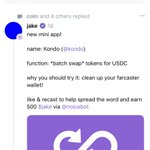


从可持续发展角度看,hype降一降回购力度其实更好,比如收入销毁比例降低到50%左右—现有持仓者多半会骂娘:)
现在绝大部分收入都拿去回购token了,自家公司储备少,遇到一些重大问题需要处理可能导致公司储备不够,另外遇到一些新的重大整合和收购机会可能够不上去。
反脆弱的特性之一是冗余,金钱层面的冗余对于长期发展的公司尤为重要。
71
真实的商业大多是这样开展的:找一个交易行为--> 验证后先跑起来--> 再沿交易链扩张-->基础设施。
很多失败项目是沿着相反的节奏开展的(比如说基础公链项目):先基础设施-->找交易行为(基本是硬找)
Hype 做的好的地方是,他是从 Perp 交易行为开始的,再沿交易链扩张(顺带做底层链)。
这几年活下来的项目基本也是从交易行为开始的,比如Uniswap、AAVE、Ploymarket等,都有具体的交易行为。
1
88
去年下半年开始用 claude 和 codex时,发现他们越来越强大,我开始有点害怕和焦虑。
特别在自己手搓了一个 app 上架 AppStore 后,怕他们吃掉 Software,吃掉很多可以创业和创作的机会……
但最近我又开始变得乐观了,Ai 有自己的局限面,长任务或者复杂任务就不行了,容易失去精准度,就需要人判断参与(对 Ai骂骂咧咧)
AI 不会有欲望,想要 build一个复杂产品和优秀作品时,ai 能做的是强大辅助。
没人把握方向盘制定约束,一直长时间运行产生的基本是垃圾,而这种垃圾产品和内容,消费者不会愿意买单,甚至看多了容易反胃。。。
而好的产品和内容却需要人参与打磨和调试,背后还是会回到人身上,这也是最近一两年虽然 ai 发展迅猛,但用 ai 创造出来的好作品和好内容很少的缘故(垃圾内容到时遍地都是)。
好的内容需要优秀的剧本和编剧,好的产品需要优秀的产品经理和懂市场用户的人,而且依然需要时间发育。
这利好原本就喜欢单打独斗的优秀创作者和创作者,ai 会成为他们新的杠杆。
1
213

认识到以前的自己对护城河的理解很肤浅了。以前把 uniswap和 Liauto的先发优势和暂时第一就作为护城河当成投资决策做了。
而真正的护城河是那种给你5-10 年市场对手也难以复制的那种。
正面例子是ASML、TSM和 spaceX。今天这几家公司如果倒闭了, 5-10 年里大概率都没有那个对手能够达到相同的水平。
ASML的光刻录机、TSM的先进晶圆厂、spaceX的最新星舰,给你 5年时间让你抄你都不一定能赶上。
1
132
SpaceX 和 Tesla 的成功靠的错位竞争(早期根本看不到什么像样的竞争对手),加长期迭代积累,慢慢形成属于自己的结构性优势。
Xai 缺乏这样的过程,一上来就去对标最强对手 Claude 和 GPT最强的产品,根本没什么多少赢的可能性。
Xai 要想突破重围要重新聚焦于局部,想办法在局部取得一些胜利(比如说,成为全球最能造火箭最懂星际迁移的 ai?),而不是在编程工具、图片和视频等方面竞争。
126


视频制作整条商业链有两个核心问题,制作成本和授权发行。
seedance 2.0算是解决制作成本问题的典范,后者还需要一个重大的产品。
不解决后者,允许任何人免费拿别人的东西随意生成获利(严格意义讲,这是在白嫖),再牛逼的视频产品基本也会被大幅度封应能力。
现阶段,利好那些有好故事、有优秀原创设定能力的人,因为这意味着不需要找任何人授权。
1
238
看来终于要慢慢结束用户体验和流动性分割的阶段了。
这几年的L2相互切换链已经用麻了

There have recently been some discussions on the ongoing role of L2s in the Ethereum ecosystem, especially in the face of two facts:
* L2s' progress to stage 2 (and, secondarily, on interop) has been far slower and more difficult than originally expected
* L1 itself is scaling, fees are very low, and gaslimits are projected to increase greatly in 2026
Both of these facts, for their own separate reasons, mean that the original vision of L2s and their role in Ethereum no longer makes sense, and we need a new path.
First, let us recap the original vision. Ethereum needs to scale. The definition of "Ethereum scaling" is the existence of large quantities of block space that is backed by the full faith and credit of Ethereum - that is, block space where, if you do things (including with ETH) inside that block space, your activities are guaranteed to be valid, uncensored, unreverted, untouched, as long as Ethereum itself functions. If you create a 10000 TPS EVM where its connection to L1 is mediated by a multisig bridge, then you are not scaling Ethereum.
This vision no longer makes sense. L1 does not need L2s to be "branded shards", because L1 is itself scaling. And L2s are not able or willing to satisfy the properties that a true "branded shard" would require. I've even seen at least one explicitly saying that they may never want to go beyond stage 1, not just for technical reasons around ZK-EVM safety, but also because their customers' regulatory needs require them to have ultimate control. This may be doing the right thing for your customers. But it should be obvious that if you are doing this, then you are not "scaling Ethereum" in the sense meant by the rollup-centric roadmap. But that's fine! it's fine because Ethereum itself is now scaling directly on L1, with large planned increases to its gas limit this year and the years ahead.
We should stop thinking about L2s as literally being "branded shards" of Ethereum, with the social status and responsibilities that this entails. Instead, we can think of L2s as being a full spectrum, which includes both chains backed by the full faith and credit of Ethereum with various unique properties (eg. not just EVM), as well as a whole array of options at different levels of connection to Ethereum, that each person (or bot) is free to care about or not care about depending on their needs.
What would I do today if I were an L2?
* Identify a value add other than "scaling". Examples: (i) non-EVM specialized features/VMs around privacy, (ii) efficiency specialized around a particular application, (iii) truly extreme levels of scaling that even a greatly expanded L1 will not do, (iv) a totally different design for non-financial applications, eg. social, identity, AI, (v) ultra-low-latency and other sequencing properties, (vi) maybe built-in oracles or decentralized dispute resolution or other "non-computationally-verifiable" features
* Be stage 1 at the minimum (otherwise you really are just a separate L1 with a bridge, and you should just call yourself that) if you're doing things with ETH or other ethereum-issued assets
* Support maximum interoperability with Ethereum, though this will differ for each one (eg. what if you're not EVM, or even not financial?)
From Ethereum's side, over the past few months I've become more convinced of the value of the native rollup precompile, particuarly once we have enshrined ZK-EVM proofs that we need anyway to scale L1. This is a precompile that verifies a ZK-EVM proof, and it's "part of Ethereum", so (i) it auto-upgrades along with Ethereum, and (ii) if the precompile has a bug, Ethereum will hard-fork to fix the bug.
The native rollup precompile would make full, security-council-free, EVM verification accessible. We should spend much more time working out how to design it in such a way that if your L2 is "EVM plus other stuff", then the native rollup precompile would verify the EVM, and you only have to bring your own prover for the "other stuff" (eg. Stylus). This might involve a canonical way of exposing a lookup table between contract call inputs and outputs, and letting you provide your own values to the lookup table (that you would prove separately).
This would make it easy to have safe, strong, trustless interoperability with Ethereum. It also enables synchronous composability (see: ethresear.ch/t/combining-pre… and ethresear.ch/t/synchronous-c… ). And from there, it's each L2's choice exactly what they want to build. Don't just "extend L1", figure out something new to add.
This of course means that some will add things that are trust-dependent, or backdoored, or otherwise insecure; this is unavoidable in a permissionless ecosystem where developers have freedom. Our job should make to make it clear to users what guarantees they have, and to build up the strongest Ethereum that we can.

104