







Will retweeted

In 1982, David Ogilvy sent his employees 10 rules on how to write.
But he died 7 years before Twitter was founded.
44 years later, creators like Alex Hormozi, Shaan Puri, and Nikita Bier are getting millions of views with writing that follows those same rules.
Apply them to your X posts:


Will retweeted

I’m looking to connect with US SaaS founders on X.
- I'm Nick.
- 17+ years in data.
- Founder of Valiotti Data.
- Fractional Chief Data Officer for SaaS companies.
If you run a SaaS company, tell me what you're working on.
Let's connect.

Will retweeted
Want prospects to show up on a Zoom call with their credit cards ready for your $1,500 service?
You need to understand "The Explanation Tax".
Say you're a B2B ghostwriter charging $1,500.
Your offer says, "I help founders build their personal brands."
A US founder likes your portfolio. He's interested in hiring you.
But before he can pull out his credit card, he needs answers.
- How many posts will I get?
- Who researches my industry?
- How much time will you need from me?
- What happens after I pay?
- How many revisions are included?
So you spend half the call explaining things he should've known before booking it.
And even worse:
You have to explain those things to every new prospect who walks through your door.
20 prospects. 30 minutes each.
That's 10 hours spent answering the same basic questions.
At $100/hour, you've burned $1,000 worth of your time.
And you haven't even counted the prospects who disappeared because figuring out your offer felt like too much work.
That's The Explanation Tax.
Just like a tax adds a cost to a transaction, your vague offer adds a cost to every potential sale.
Every new prospect triggers another bill.
And the more leads you generate, the more often you pay it.
This is how to reduce it:
1. Put your deliverables on the table.
Show exactly what clients receive, how often, and in what format.
2. Show what happens after payment.
Walk buyers through onboarding, research, first drafts, delivery, and revisions.
3. Give buyers evidence they can inspect.
Relevant portfolio samples, client results, and proof you understand their industry.
4. Kill obvious questions before the sales call.
Answer them in your content, website, portfolio, and proposal.
Now your sales calls can focus on the buyer's business, their problems, and whether you're the right person to solve them.
Because every question your marketing leaves unanswered becomes another question your sales process has to handle.
And unlike a real tax, you can reduce this one without waiting for the government to change the rules.
Will retweeted
At 17, @jayyanginspires sent Noah Kagan a 19-slide audit.
It got him hired as Head of Content.
Now Jay's hiring his first writer.
I'm using his own playbook on him.
Jay, I'll be the reason you can take on twice as many founders without doubling your workload. Here's my case:

Will retweeted
Your SaaS might already have features customers would pay extra for.
How to find them:
I helped a company find pricing opportunities across boosting, coaching, and account services for 20+ online games.
Our margin analysis revealed that some high-volume services had thin profit margins, while certain niche services commanded premium prices.
This is how we spotted these opportunities:
The company had plenty of sales data, but its spreadsheets made it difficult to compare profitability across different services.
So my team built a reporting system to track:
- Revenue by game and service
- Profit margins across offerings
- Average order value
- Customer lifetime value
- Seasonal demand
So the company could see which services generated the most orders, which had the highest margins, and how demand changed over time.
With that information, the team could identify which services deserved more attention and where premium pricing was possible.
And look, this same opportunity could exist in your SaaS.
Your most popular plan might generate the most revenue, but another plan or add-on could have a much higher profit margin.
You might also have a small group of customers willing to pay extra for specialized features.
Exactly how I'd find those opportunities:
1. Compare the profit margins of your plans and add-ons, including delivery and support costs.
2. Spot which customer segments already buy your premium plans or pay extra for add-ons.
3. Look at which features those customers use most and which ones they frequently request.
4. Find offerings with strong demand and healthy margins that you could sell to more customers.
Once you've found those opportunities, I'd run 2 tests:
- If a profitable add-on has strong demand, test offering it to more customers who could benefit from it.
- If certain customers show a higher willingness to pay, test a premium package with features they value.
Then measure how many customers buy, how much additional revenue you generate, and whether profit increases after costs.
You might discover that your next opportunity to increase profit comes from a feature or add-on you already offer.
And you could grow revenue from your existing customers without building an entirely new product.


Will retweeted
Would you rather win 30 new SaaS customers or get 10 existing ones to pay 3x more?
Let's put some numbers behind this.
Say your SaaS charges $500/month.
Option A:
30 new paying customers = $15,000 in new MRR.
Option B:
10 existing customers upgrade from $500 to $1,500/month = $10,000 in additional MRR.
At first glance, acquiring 30 new customers looks like the better deal.
But this is where I'd dig deeper into the data.
How much did it cost to acquire those 30 customers?
If your CAC is $2,000, that's $60,000 in acquisition costs before considering the cost of serving them.
Now look at those 10 existing customers.
Suppose your product data shows that:
- They're close to their usage limits
- Their teams use your product almost every day
- They've already asked about features on your higher plan
Those are signals worth investigating.
You could test an upgrade offer with those accounts, measure how many accept it, and calculate the cost of generating that additional $10,000 in MRR.
Then compare the two options using expected contribution profit, acquisition or expansion costs, and retention.
Maybe acquisition still wins.
But suppose those 10 upgrades cost far less to secure and the accounts remain subscribed for longer.
You could generate more profit from fewer additional sales.
That's why I'd want your subscription data, product usage data, and sales data in the same analysis.
Because the opportunity with the biggest increase in MRR isn't necessarily the one that produces the highest return.
Will retweeted
Bookmark this hack to becoming the go-to authority in your niche:
Explain what can go wrong AFTER someone follows common advice.
Let's look at this example:
Common advice tells freelancers to raise their rates. Ok cool. So they double their prices.
- Now sales conversations take longer
- Prospects need more proof before they buy
- Some clients start comparing them with more established competitors
They've solved one problem and created three more.
This happens because advice changes the conditions under which the next decision gets made.
And when those conditions change, yesterday's good advice might stop working.
This is where you need to post personal stories.
You can show:
- What happened after you followed the popular advice
- Which assumptions turned out to be wrong
- What you had to change next
Anyone can explain the first move.
But clients want to hear from the operator who's already seen the next three.
Will retweeted
If you're a SaaS founder using AI analytics, read this.
I helped a venture-backed company make its AI analytics more reliable for pricing and revenue decisions.
We tested 150+ questions, fixed data errors, and set rules for human review.
This company had rolled out an AI analytics agent that answered business questions in seconds.
Its answers were already appearing in board decks, marketing spend decisions, and pricing discussions.
But nobody had properly tested which answers were right.
So we compared the agent's answers against verified results across revenue, retention, and attribution.
And here's what we found:
Many wrong answers came from the data underneath the AI.
For example, revenue could include or exclude refunds depending on which tables the agent used.
So we corrected the underlying definitions and joins, then we put 3 things in place:
- A scorecard showing which types of questions the agent could answer reliably
- Clear rules for when answers needed human review
- Monthly tests to catch new errors as the data changed
Now the company has a repeatable way to evaluate the agent before relying on its numbers for important decisions.
If you're a SaaS founder investing in AI analytics, start by testing the questions your team uses for pricing, marketing budgets, and board reporting.
That gives your team a way to know which AI answers they can act on, and which still need to be checked.

Will retweeted
Every time you post a bold opinion on X, you're creating a "proof debt."
If you say "Most creators have no strategy."
Okay. Show me how you'd audit 20 posts, what you'd flag and what you'd change.
If your feed is full of verdicts but no demonstrations, your debt keeps growing.
Will retweeted
In 2022, I promoted Gumroad affiliate products on X.
In 2023, I started getting paid to write for founders and businesses.
Paid founder writing gave me a clearer picture of the work I enjoy.
A founder can send me a messy voice note, a sales-call thought, or a half-written draft.
I have to understand the idea before I can write it well.
The work requires three questions:
- What does the founder mean ?
- Who should care about this post ?
- Which example proves the point ?
Over time, I added buyer research, positioning, messaging, and GTM context around that writing process.
The service now includes buyer research, positioning, messaging, GTM strategy, and LinkedIn plus X ghostwriting.

Will retweeted
Is BI dead?
The CEO of a BI company just called dashboards a plague.
Ketan Karkhanis (@karkhanis) runs @thoughtspot.
When I asked him where BI is going on the first episode of The Decision Layer, instead of defending dashboards, he talked about trust.
And I think he’s right.
For 20 years BI was the answer, but now it’s becoming the receipt.
My bet: the company that wins AI analytics will be the one whose CFO actually believes the numbers.
An agent that says “revenue dropped 12% because of EMEA renewals” is worthless if nobody can see how it got there.
People will open a dashboard to double-check. Congrats, you’ve built an AI that creates more work.
That’s why I think most “AI for analytics” projects launching right now are dead on arrival. They ship answers when they should be shipping evidence.
Ketan put it simply: the hottest feature in AI is trust. And trust only comes from transparency built into the data.
So the real AI work in your company is happening in the boring layer underneath, in metric definitions and lineage. The stuff nobody puts on a keynote slide.
Will retweeted
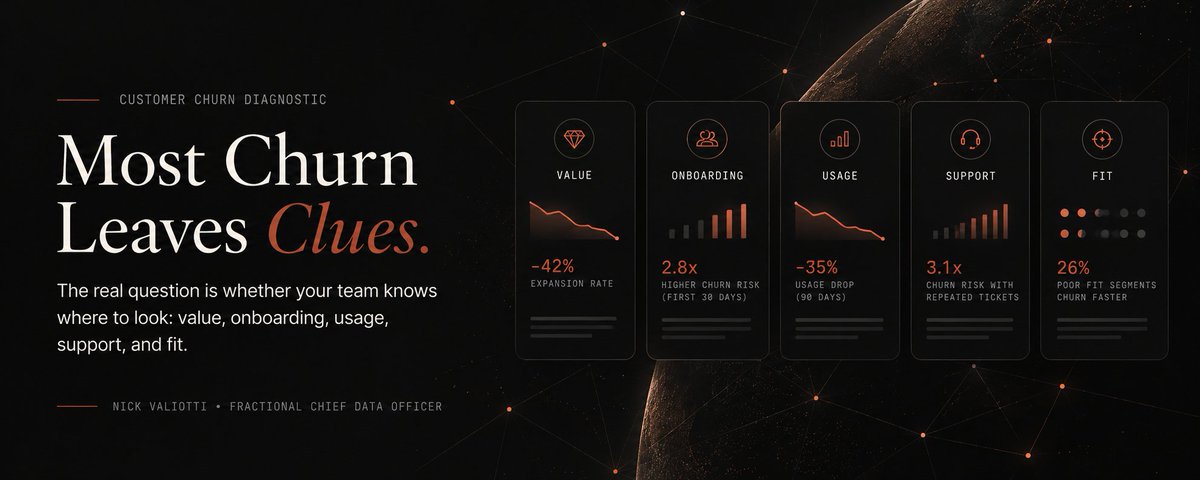
I helped a $20M company cut its CAC by 35% in just 90 days.
What happened:
The company's marketing director was about to get 40% more money to spend on ads.
But she wanted to know which ads were actually bringing in customers.
The problem:
- Meta reported 2,400 sales
- Google reported 1,800 sales
- But the company's store records showed only 1,100 actual customers
Every platform was taking credit for sales. So we started with one simple rule:
Use your own sales records to count customers, then figure out which ads brought them in.
This helped the company make better decisions about where to spend its money.
90 days later, they were saving $16 on every new customer.
One lesson to learn here:
Make sure you know which campaigns bring in real customers before increasing your budget.
The better you understand where your customers come from, the more you can get from every dollar you spend.
Will retweeted
I'm 26, a ghostwriter, from Indonesia.
I really don't know what to post today.
I just want to take a moment to appreciate my family.
My dad, whom I lost two years ago.
And my sister, whom I'm grateful to still have by my side.
That's the three of us in this picture.
Just an ordinary family selfie.
But looking at it today makes me realize how precious those ordinary moments really were.
Dad, thank you for everything. Thank you for being my father.
Thank you for all the years we got to spend together.
It's been 2 years since you left us, and there are still so many things I wish I could tell you.
About my life.
About my dreams.
About the person I'm trying to become.
I wish you were still here to see it all.
And to my sister, thank you for being part of my life.
I know I'm not always good at expressing my feelings.
Sometimes I get too caught up in my work, my problems, and my ambitions.
But I hope you know how much I appreciate you.
I'm grateful that we still have each other.
And I hope we get to make many more beautiful memories together.
I don't know what the future holds for us.
But I do know that I'll always treasure the memories we made as a family.
I wish the three of us could take one more picture together.
I really do.
I love you both. ❤️

Will retweeted
Your next $1M in ARR might come from the SaaS customers you already have.
I worked with a $25M SaaS company that kept signing new customers, but its existing customers were spending 5% less each year.
The company was winning new customers while losing ground with the ones it already had.
So we focused on 3 moves:
- Getting every team to agree on the same revenue numbers
- Identifying customers at risk of leaving
- Finding opportunities to grow existing accounts
Within ONE quarter, revenue from existing customers went from shrinking 5% to growing 8%.
The team found new growth opportunities by understanding the customers they already had.
If you're a SaaS founder, ask yourself:
How much more revenue could you generate if your existing customers stayed longer and spent more?
You might already have the data to find out.
Will retweeted
4 years ago, I made $0 online.
Today, I've worked with 39 founders, companies, and brands as a ghostwriter on X and LinkedIn.
And it all started with a skill I wasn't even good at: writing.
When I started in 2023, I didn't know how to write great hooks, attract clients, or build a personal brand.
I had to learn everything from scratch.
My early posts weren't great.
My outreach didn't always get replies.
And there were times when I questioned whether ghostwriting would ever work for me.
But I kept going.
I studied better writers.
I practiced writing hooks.
I learned how to find clients.
I improved one post, one conversation, and one project at a time.
Fast forward to today:
• I've worked with around 39 founders, companies, and brands.
• I've made five figures from ghostwriting.
• I've built skills I never imagined I'd have.
And I'm still learning.
Here's what those 3 years taught me:
The work you do today might seem too small to matter.
One post.
One new connection.
One hour of practice.
But imagine doing those things consistently for 3 years.
You might barely recognize the person you've become.
That's the power of compounding.
And the best part is you don't need to be extraordinary to begin.
You just need to keep giving your future self something to build on.

Will retweeted
Your SaaS company has data on everything. So why are you still guessing?
Say, you want to know why MRR dropped last month.
So Finance sends you a spreadsheet. Sales sends you another report.
Now you're comparing numbers, checking definitions, and asking your analyst why they don't match.
An hour later, you still don't have an answer. Next week, the same thing happens with a different question.
Well, your problem is simply that your team has to piece together the answer every time someone asks a business question.
As your SaaS company grows, these manual workflows become harder to maintain.
- Finance pulls the numbers
- Sales explains what changed
- An analyst checks the definitions and reconciles the reports
Every question becomes another reporting task.
The next-level SaaS companies have made those answers easier to find.
Their teams use trusted metrics, shared definitions, and reliable data sources to answer common business questions without rebuilding reports from scratch.
Start with the 5 business questions your team asks most often.
For each one:
- Define the metric
- Agree on the trusted source
- Make the answer easy to find
Your team should spend less time piecing together numbers and more time deciding what to do with them.
Will retweeted
If I asked you why your SaaS charges what it does, could you defend your pricing?
If you can, skip this post.
If you can't, I’ll solve your problem right here.
Know that your SaaS could be leaving $10,000s on the table every month because your pricing is wrong.
This happens because you're copying what your competitors charge without checking what YOUR customers are willing to pay.
I've seen this happen at one survey software company that was using competitor pricing.
Then they finally analyzed their own customers.
They compared:
- Revenue per customer in each country
- How many customers upgraded from Basic to Pro
- How often customers canceled in each country
- Which acquisition channels brought in higher-paying customers
And found something big:
Customers in some countries were willing to pay significantly more than customers in others.
Yet everyone was being charged the same price.
Think about how much money you could be missing because you're charging your highest-value customers the same price as everyone else.
Here's what I'd do with your pricing data:
1. Revenue: Compare average monthly revenue per customer in the US, UK, Germany, and other markets you serve.
2. Upgrades: Calculate what percentage of customers move from Basic to Pro in each country.
3. Churn: Compare the percentage of paying customers who cancel each month, by country and plan.
4. Pricing complaints: Count support tickets mentioning “too expensive” or “pricing” in each market.
5. Opportunities: Find countries with high upgrade rates, low churn, and few pricing complaints.
Those are the markets I'd investigate first for a potential price increase.
Then test a higher price with new customers and measure how many still buy.
Stop copying competitors who know NOTHING about your customers.
Your own data can tell you where to test charging more.
Will retweeted
5 pieces of advice I'd give any founder or creator who wants to grow on X.
(I grew my ghostwriting client from 600 -> 20K followers in under 2 months)
1) Pick a side. Share clear opinions about your work. Give people a reason to remember you.
2) Write posts people can repeat to their friends. Give them a simple way to explain what you do.
3) Save the questions people ask you in DMs. Those questions can give you weeks of content ideas.
3) Repeat your best ideas. People need time to understand your message. Teach the same lessons in new ways.
5) Make your ideas easy to remember. Use simple words, real stories, and examples from daily life.
You don't need to sound smart to grow on X.
You need to say useful things that stick with people.
Will retweeted
ChatGPT content creation hack for X:
Tell it to write posts in top creators' voices, then choose the one you like the most.
Easily create top-performing content.

Will retweeted
What 99% of people never tell us about growing on X:
1. More posts ≠ more followers
2. Your replies can outperform your posts
3. Viral posts can attract the wrong audience
4. Your profile can kill a good first impression
5. Big accounts started with zero engagement
6. Your first 1000 followers are often the hardest
7. One big account reposting your post can change everything
8. Your best post might get 200 views
9. 10,000 followers won't guarantee a single client
10. People follow you for what they'll learn next
Our follower count tells only half the story.
What would you add ?