

software dev, homelabber, electronics noob documenting my learning of computer science in the wake of super intelligence.
Mesa, AZ
Joined January 2011
- Tweets46.3K
- Following628
- Followers3.7K
- Likes81.1K






local, private AI is the future.

Some of you thought that Inkling 2 Small was too big at 594B parameters. We heard you: Inkling 2 Mini is a looped transformer with just 26B parameters, small enough to run on your laptop, powerful enough for agentic work with a score of 20.1 on AA Index.
thinkingmachines.ai/news/ink…

56


grok bot just found me 2x U6 Pro access points for $100, they have a street price of $120/ea.
grok bot pays for itself

2
13
345


I want to introduce you to the grok bots I have been using to learn, build, configure, and deploy my homelab.
in order of creation:
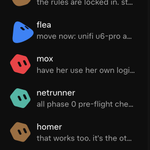
1. flea (marketplace scout): browses marketplaces for "insane homelab tech deals" and returns a list of items sorted by value.
2. idrac (PowerEdge R370xd admin): teaches me the ins and outs of my first enterprise grade server. performs daily health checks on the server and reports warnings when spotted.
3. mox (Proxmox admin): teaches me the ins and outs of Proxmox and holds my hand when creating containers and virtual machines to ensure optimal install of apps and appliances.
4. homer (Home Assistant admin): teaches me the ins and outs of Home Assistant.
5. netrunner (network engineer): maintains knowledge of my home network and plans upgrade paths.
6. logger (documenter): writes weekly journal entries in Obsidian summarizing all that I have learned and accomplished that week in my own voice.
grok bot is the best


this is awesome, but I can’t help but imagine uncle Bob sitting in a cafe wearing just a robe

I’m sitting in the café of a hotel in Baton Rouge. I’m talking to Grok Bot using my phone. We just had a very long one involved discussion regarding the syntax and behavior of a nondeterministic finite state machine that we are integrating into an acceptance testing framework.
That framework (AgNesse) is being built in preparation for a much larger project for a local business. I need an acceptance testing framework that is worthy of the task ahead of me. So I am modifying and augmenting the old FitNesse project to accommodate agentic development.
Sitting in that café, with just my phone, I negotiated a plan. Now, using ub-mode, my grok bot is distributing the implementation using the laptop in my hotel room, some of its own cloud resources, and a laptop that’s sitting in my home in Libertyville.
This is nuts!
1
243
learn infer infra and forever have access to the wagie path. Never stop learning.

If you learn inference infra, you will never be unemployed again.
Stage 1: Systems Foundations
C/C++ or Rust for inference, Python performance profiling, Linux internals, memory hierarchy, CPU vs GPU vs NPU execution models.
Stage 2: GPU Architecture & Modern Silicon
CUDA & tensor cores, HBM3e bandwidth, SM occupancy, Blackwell/Hopper specifics, chiplet designs, nvidia-smi + DCGM profiling.
Stage 3: Transformer & MoE Inference Anatomy
Prefill vs decode, KV cache math, attention memory, arithmetic intensity, Mixture-of-Experts routing, long-context scaling.
Stage 4: Serving Engines & Constrained Decoding
vLLM, SGLang, TGI, TensorRT-LLM: continuous batching, PagedAttention, structured output decoding, grammar-guided generation.
Stage 5: KV Cache & Memory Hierarchies
Prefix caching, chunked prefill, KV quantization, hierarchical offloading (GPU→CPU→SSD), multi-turn session reuse, cache eviction policies.
Stage 6: Quantization & Compression at Scale
FP4, FP8, INT8, AWQ, GPTQ, sparsity, mixed-precision serving; measuring perplexity drop vs latency/throughput gains per model family.
Stage 7: Speculative Decoding & Advanced Parallelism
Draft-target pipelines, Medusa/EAGLE heads, tensor vs pipeline vs expert parallelism, sequence parallelism for long contexts.
Stage 8: Kernel-Level Optimization
Triton, FlashAttention-3, CUDA graphs, operator fusion, custom attention kernels, Nsight Compute profiling, roofline analysis.
Stage 9: Distributed & Disaggregated Inference
Multi-node serving, NVLink/InfiniBand/RDMA, disaggregated prefill/decode pools, MoE expert parallelism, prefill-decode ratio tuning.
Stage 10: Autoscaling, FinOps & Economics
Queue-based scaling (KEDA), cold start mitigation, spot GPU orchestration, cost-per-token modeling, MFU utilization, inference budgeting per tenant.
Stage 11: AI Gateway, Routing & Reliability
Smart model routing, fallback chains, semantic caching, rate limits, TTFT/ITL SLOs, agent-aware session routing, observability, chaos testing.
Stage 12: Edge Inference & Portfolio
On-device serving (MLX, llama.cpp, WebGPU), published latency/throughput/cost benchmarks, kernel optimization writeups, self-hosted cluster teardowns.
Most people stay stuck watching tutorials.
Builders get hired.
(Bookmark it)
2
121
AI agent tutorial. Don’t stop learning.

AI Agents Tutorial
Want to understand how AI Agents work and how to build them from scratch?
Here are the key concepts you need to learn:
① AI Agent Fundamentals
② Function Calling
③ AI Agent Loop
④ ReAct Agents
⑤ Reflection Agents
⑥ Plan-and-Execute Agents
⑦ AI Agent Memory
⑧ Context Engineering
⑨ Agentic RAG
⑩ GraphRAG
⑪ Multi-Agent Systems
⑫ AI SubAgents
⑬ MCP (Model Context Protocol)
⑭ AI Orchestration
⑮ Agent Communication
⑯ Computer-Use Agents
⑰ Browser Agents
⑱ LangChain and LangGraph
⑲ Harness Engineering
⑳ AI Agent Observability
A resource to help you understand AI Agents, from fundamentals to building and orchestrating complex agentic systems.
Start learning:
github.com/amitshekhariitbhu…

77


the future is here

Agent swarms are so ridiculously easy and cheap now.
If you have a specific bug in the Linux kernel that you want fixed and you don't know what it is, just roughly what happens, you can fire up a swarm of 30 agents on a Raspberry Pi to hunt it down for under $5.
Using DeepSeek 4.1 flash, 30 of them for ~16 minutes, $3.81 final cost with 4 bugs found. Running each one in a WASM sandbox with its own C compiler and virtual filesystem.

2
5
444
imagine being born during the rebellion of the Byzantine naval commander Euphemius in Sicily in 826 AD and dying the year GTA 6 is finally released
can a human even compress all of that context into a single brain?
JUST IN: Philosopher Nick Bostrom estimates humans could have a life expectancy of roughly 1,200 to 1,400 years if aging were eliminated by artificial intelligence.
2
268
I have to start planning for a backup NAS to support and protect the bulk storage in my R730XD.
I don’t want to buy a UGREEN or Synology box.
what should I do?
1
4
245
it’s over.
lossless compression has been solved.

We shrank 1 GB of Wikipedia to 105.39 MB, losslessly.
Introducing tufazip: the best entry on the Large Text Compression Benchmark using a neural network as its sole predictor. Everything above it mixes a transformer with hand-built models.
Full post 👇
tufalabs.ai/research/tufazip


