

Power Markets at @modoenergy. Covering all things energy, batteries, and data centers in MISO and NYISO. @UniofOxford and @DukeU Engineering Alum
Joined October 2025
- Tweets85
- Following77
- Followers178
- Likes97



William Rawlings retweeted

That’s a whole lot of thick reading…
Someone needs to do a welfare check on this man.

I just finished getting through every document filed on @FERC's website related to the show cause (there were dozens)!
Four ISOs propose a new class of non-firm transmission service, where a data center connects with the stipulation that it curtails under certain grid conditions. MISO, NYISO and ISONE would set those conditions with price thresholds: $100/MWh, $200/MWh and $250/MWh.
FERC hasn’t accepted any of these filings yet, and I’d expect a lot to change.
Full article here: modoenergy.com/research/en/f…

William Rawlings retweeted

#EnergyTwitter at its best — sharing free, rapid analysis of complex high-stakes regulatory dockets as an entire industry is on a 20-30 day shot clock to respond!
I just finished getting through every document filed on @FERC's website related to the show cause (there were dozens)!
Four ISOs propose a new class of non-firm transmission service, where a data center connects with the stipulation that it curtails under certain grid conditions. MISO, NYISO and ISONE would set those conditions with price thresholds: $100/MWh, $200/MWh and $250/MWh.
FERC hasn’t accepted any of these filings yet, and I’d expect a lot to change.
Full article here: modoenergy.com/research/en/f…
Monday was a big day for energy policy nerds.
I finally got through the (dozens of) show cause responses this week at @FERC.
One big takeaway: curtailment.
Four ISOs propose a new class of non-firm transmission service. A data center on it connects with the stipulation that it curtails under certain grid conditions. MISO, NYISO and ISONE would set those conditions with a price threshold: $100/MWh in MISO, $200/MWh in NYISO and $250/MWh in ISONE.
These are not emergency-level prices. MISO’s threshold is the first step of scarcity pricing. Since July 2023, the average MISO hub has been above $100/MWh for 246 hours a year, and the average NYISO zone above $200/MWh for 164.
Most data centers are designed for 99.99% uptime, under an hour of downtime a year. A campus on non-firm service would need on-site generation or storage to keep running through those hours.

I just finished getting through every document filed on @FERC's website related to the show cause (there were dozens)!
Four ISOs propose a new class of non-firm transmission service, where a data center connects with the stipulation that it curtails under certain grid conditions. MISO, NYISO and ISONE would set those conditions with price thresholds: $100/MWh, $200/MWh and $250/MWh.
FERC hasn’t accepted any of these filings yet, and I’d expect a lot to change.
Full article here: modoenergy.com/research/en/f…


William Rawlings retweeted
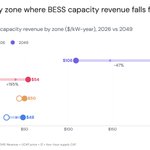
Renewables have made power prices less predictable. That volatility is where battery storage finds its value, without new gas plants being built.
A grid-scale battery typically earns revenue in three ways.
Energy arbitrage: charging when prices are low and discharging when they are high.
Capacity: being paid to stay available for when the grid is under stress.
Ancillary services: responding around the clock to keep the grid stable.
How a project balances these streams shapes how it pays back. Will Rawlings, Power Markets Analyst at Modo Energy, walks through each one.
#BESS #EnergyStorage #PowerMarkets #AncillaryServices #Renewables
A couple of months ago, I set out to explain how grid-scale batteries actually work.
They don’t generate any power of their own, but they still earn revenue and support the grid in 3 ways.
1. They charge when prices are low and discharge when prices are high.
2. They’re paid to stay available in case the grid comes under stress.
3. They provide ancillary services that keep the grid stable minute to minute.
As more wind and solar comes online, that flexibility becomes more valuable, and batteries can often be connected years sooner than a new gas plant.
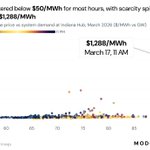
A year ago, MISO prices couldn’t go above $3,500/MWh. This September, Real-Time prices reached the new $10,000/MWh cap on two separate days.
On September 17, 35 minutes at the cap were worth over $500,000 to a 100 MW battery. All of it was in the Real-Time market.
Here’s what happened, in two minutes.
William Rawlings retweeted

this is a project that's currently generating power


William Rawlings retweeted

Solar and wind power is wasted when the grid can't keep up.
But is that always a bad thing?
Curtailment 101. The full explainer, out now on X
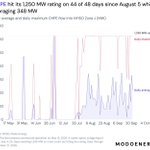
New York's biggest new transmission line just finished its first summer with the Champlain Hudson Power Express (CPHE) running at a 13% capacity factor.
CHPE is contracted to bring 10.4 TWh a year of Hydro-Quebec hydropower into New York City, a 95% capacity factor. Summer one looked nothing like that.
The line sat at zero in 83% of five-minute intervals, then ran near its full 1,250 MW for the evening peak. In addition, a damaged cable splice knocked it out for 20 straight days at the peak of summer.
Overall, New York still sent more power to Quebec than it received: exports across the three Hydro-Quebec ties averaged 466 MW, up from 426 MW last summer.

2
77
William Rawlings retweeted

One of the best short documentaries I've seen explaining why the energy transition is no longer just about generation, it's about the grid and, increasingly, storage. #SWB #Bettrification #EnergyTransition
Key takeaways:
• Britain doesn't have a wind problem, it has a transmission problem. Scotland produces more wind power than the grid can carry south.
• Consumers pay twice: wind farms are paid to switch off while gas plants are paid to switch on elsewhere.
• Batteries are scaling rapidly but there still isn't enough storage to absorb surplus renewable energy during major grid constraints.
• The solution is clear: more transmission, more batteries, more flexible demand like EV charging and AI data centres, and smarter market design.
The lesson extends far beyond Britain. Curtailment isn't a failure of renewables, it's evidence they're growing faster than the rest of the system. The answer isn't less wind and solar, it's accelerating the infrastructure around them.

William Rawlings retweeted

ISO-NE's winter peak rises 84% to 37.6 GW by 2046, driven almost entirely by heat pumps (12.4 GW) and EVs (5.9 GW). Winter overtakes summer by 2035-36. The system becomes winter-peaking faster than any neighboring ISO.

ALT Chart: isone 2046 load 10 annual energy decomposition
William Rawlings retweeted
GB batteries saved consumers £188 million since December 2024. £141 million from wholesale price suppression, £47 million from balancing services. March 2026 showed constraints at work: reversed bids cost £3.3m but net monthly savings still hit £2.3m.

ALT Chart: gb bm benefit 2026 update 1 headline
William Rawlings retweeted
If you want to stay in the loop on PJM, follow Aaron ⬇️

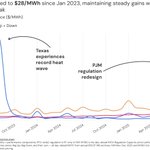
PJM's capacity market is in a "credibility trap." Prices high enough to spur new builds trigger interventions that cap them. The ISO's white paper offers three paths out of this trap. Which path forward do you think we'll see in the coming years?
Source: modoenergy.com/research/en/p…
