

Covering international news and the Multipolar World
Hong Kong
Joined August 2019
- Tweets4.3K
- Following1.6K
- Followers7.3K
- Likes4.9K




inflection point retweeted

EXACTLY. THAT, AND THE POLICY OF PIRACY...

Marco Rubio just explained the Venezuela oil deal in one word: China.
Speaking on Monday, Rubio said most of the fields handed to the US-backed company had previously been held or operated by Chinese or Russian firms.
The deal:
> 100-year concessions
> 17 Venezuelan oilfields
> about 65 billion barrels of proven reserves
> US access to those reserves "in a crisis"
ONE HUNDRED YEARS.
Even Maria Corina Machado, Washington's favourite opposition leader, is now challenging the arrangement.
Chinese and Russian companies worked those fields under contracts with Caracas. Now they are pushed aside and the oil is locked up for a century for a US-backed company.
That is not a free market. It's a takeover with a State Department briefing attached.
And they still call China the "predatory lender".

China speed!

🇨🇳 A 7.0 Quake Hit Tibet at 10.30pm. Rescue Teams Were on the Ground Before 2.30am. Western Media Coverage Was Still About Control
A 7.0 quake hit Baqing County in Tibet at 10:33pm. The epicentre sits at 4,800 metres. It was below freezing, rockfalls had closed the road in and it was dark.
The first fire rescue team reached the worst-hit village at 2:10am and had a trapped resident out ten minutes later. Drones were up from midnight, the blocked road was clear by 3:00am, the army and armed police units moved overnight.
More than 5,000 personnel then swept 34 villages door to door three times. Nobody was left unaccounted for. Some 12,489 people were moved into 35 sites with tents, prefab houses, stoves and winter clothing. Power and communications were back within two days. The toll was 16 dead and 76 injured, published daily at a county press conference.
This is the standard rather than the exception. Wenchuan in 2008, Dingri in January 2025, then floods, landslides and typhoons. Local teams train on the terrain they will be called to, national forces move at night and the logistics follow. The capability is systemic.
Western coverage gets the altitude and the cold right and some of it records the speed. But then the framing shifts. The region becomes tightly controlled, annexed in the 1950s and a place where state media is the only source. Collapsed houses become proof of poor construction…
Those houses are traditional earth and timber or stone and wood in a high pastoral county, built long before anyone wrote a seismic code. A shallow 7.0 damages them. That is not shoddy modern work. The people making the claim know the difference and skip the local reality anyway.
Four hours from the ground shaking to a resident pulled out alive, at 4,800 metres, in the dark. How many rescues like that before the story is the capability rather than the control?


India colour revolution > US puppet/useful idiot.
She is being promoted as the next Joshua Wong “freedom fighter”
She is a PHD student in….. theatre and performance.
Not even a joke.

It could end very badly.
There is absolutely no military communications channels between the Philippines and China,
China-Philippines tensions: same shoal, same script
Resupply runs to the Sierra Madre regularly turn into standoffs. The headlines write themselves every time.
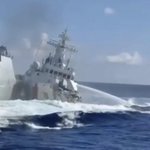
Philippine Coast Guard ships head out for the routine missions to the old vessel Manila grounded on Ayungin Shoal in 1999. China shadows them, CCG ships maneuver close, missions get suspended, no one gets hurt. Tarriela blames China. Beijing calls it a provocation to feed an illegally grounded ship.
This is deliberate and regular. As I’ve laid out before, the method is simple: push a Philippine hull in close >>> film the Chinese response >>> get the clip out the same day. Manila’s “assertive transparency” is the cover. SeaLight from Project Myoushu at Stanford’s Gordian Knot Center under Ray Powell supplies the tracking, the maps, and the packaging so the footage hits hard and fast. The crews take the risk; the planners stay onshore. You lose the encounter and still win the narrative week.
The civilian side is part of the same plot. Atin Ito and similar groups stage highly publicized runs with supplies, buoys, invited media, and ordinary-looking people in the boats. Party-list ties >>> related NGO networks >>> older foreign funding (including the NED layer I’ve flagged earlier) turn short contacts into ready-made drama of civilians defying China. Not every volunteer is in on it, but the structure is built to produce exactly those clips.
Same China-Philippines script, repeated on purpose. Competing claims get buried. The provocations are planned, routine, and amplified.


Europe keeps calling China’s industrial policy an “existential threat,” then skips the part where its own energy prices and rulebook did most of the damage.
inflection point retweeted

INTERVIEW: Only so far
Targets that were considered inappropriate by Russia in Ukraine are now being hit, says academic and author Dimitri Simes. But Russia is careful about escalation. So the railway into Kiev, and the train bearing Chancellor Merz and the German millions, is not being hit
Watch #MOATS Live every Sunday & Wednesday 7PM London Time
Follow @moatstv 592 X: @DimitriSimes #Zelensky #Lavrov Kiev #Russia #Merz
inflection point retweeted

While Okinawa makes up less than 1% of Japan’s total land area, it hosts roughly 70% of all exclusive-use U.S. military facilities in the country. Okinawa is part of the Kingdom Ryukyu which the Americans took after WWII and simply handed over to their Japanese puppet regime. Ryukyu is an important part of America’s First Island Chain containment strategy against China. Taiwan had already been colonised by the Meiji puppet regime with American funding and backing in 1894 and the Philippines was already an American colony. See map.
During WWII, the vast majority of American soldiers died in the Pacific Theatre securing the First Island Chain to be used against “allies” China and Russia. See screenshot of the number of American soldiers who died as part of the US Empire’s Global Subjugation Strategy.
American backed Chiang Kai Shek lost in the “civil” war by 1949, so the Americans immediately used the First Island Chain to blockade China and imposed a Global Embargo. Blockades and embargoes have been used by Americans to regime change many countries across the Global South. The Americans wanted to ensure that no food shipments went through during droughts and famine. This is the American Way. Maximising the number of dead Chinese civilians was America’s goal. After 20 years, the Americans finally lifted their blockade in 1979, agreed to the One-China Policy, all in their effort to contain Russia…
There are over 120 US military bases squatting on Japan and Ryukyu today. The Americans have squatted there since 1945 in preparation of war against China, “Japan and the United States are heavily investing in expanding their military capabilities, budgets, and hardware, with a strategic emphasis on Japan's southwestern islands (including Okinawa)….their investment strategy focuses on modernizing infrastructure and deploying high-tech missile defenses.” [See 3rd screenshot]. Americans like to soothe their vassals and cannon fodder with “missile defence systems”. See how well their Arab monarchs/dictatorships are doing in West Asia.
As for the poor girls and women in “Okinawa”, they will continue to be subjected to rape by the American soldier who are there to further US imperialism.


“As a woman living in Okinawa, I find myself thinking: It could be me next, or my daughter, my niece, or the young girls I care about.”
Okinawa women rallied in front of the prefectural government building in the capital city of Naha Sunday night, demanding government action after US Marine Devin Jacob Ballard was arrested for his alleged role in the murder-robbery of Anna Yagi.
Former House of Councillors member Keiko Itokazu slammed US military presence on the island as a leading cause of violence against women.
“The reason we insist that US military bases in Okinawa must not be increased – and that no new bases should be built – is precisely because incidents like this happen,” Itokazu stated. “What do the Japanese and US governments intend to do with human lives? With our lives as women?”
Growing local opposition to the US military presence on Okinawa has been fueled by a series of crimes over the years. High-profile cases include the 1995 abduction and rape of a 12-year-old schoolgirl by three US servicemen, and the 2016 rape and murder of a 20-year-old local woman, which sparked mass protests and led to a life sentence for a former US marine. More recently, in 2025, a US Marine was convicted of choking and sexually assaulting a Japanese woman.
Japan hosts tens of thousands US military personnel, with the largest concentration based on Okinawa. Although Okinawa is one of Japan's smallest prefectures by area, it contains 70% of the land used exclusively by the US military in the country.
Okinawa is a critical site for the US’s architecture of containment surrounding China, sitting just 60 miles off the coast of Taiwan at its nearest point.
inflection point retweeted

The Philippine defense secretary already bought another passport
The man telling Filipino sailors to hold the line against China had already bought himself another door when he was still a private citizen.
Gilberto “Gibo” Teodoro Jr. is now defense secretary and one of the strongest voices behind Manila's harder line toward Beijing.
The message is sovereignty, international law and never backing down in the West Philippine Sea.
But there is another part of the story worth looking at.
Teodoro confirmed that he obtained Maltese citizenship in 2016 through Malta's investment program. He later said he renounced it in 2021 before his Senate run.
So legally, the question of whether he still holds that citizenship appears settled.
But the bigger question remains: why is the Philippines becoming so deeply tied to Washington's military strategy in the region?
More US access to Philippine bases. More military exercises. More American involvement around the first island chain.
Then every confrontation with China is presented as if it exists in isolation, with China simply portrayed as the aggressor.
I don't think it is that simple.
China sees the expanding US military presence around its maritime periphery as a strategic threat and is responding accordingly. You can disagree with Beijing's claims, but ignoring that context only makes the situation harder to understand.
The Philippines is caught in the middle of a much larger US-China rivalry.
And Filipino sailors are the ones standing between them.
The people making speeches about courage and sovereignty have political positions, money and international connections.
Ordinary sailors don't have those options. If something goes badly at sea, they face the consequences first.
China isn't going away. The United States isn't going away either.
The Philippines has to live beside China long after today's politicians are gone.
Maybe constantly moving closer to Washington isn't the only way to defend Philippine sovereignty.
The sailors don't get to choose the strategy.
They get the mission.

inflection point retweeted
This is an important point.
Latin America has spent far too long being treated as someone else’s sphere of influence.
Countries in the region should be free to work with whoever they choose and pursue the partnerships that actually serve their own interests.
In the end, sovereignty means having choices >> not being told which side you have to be on.

What has the Monroe Doctrine brought to the people of Latin America? What has China brought? The answer lies in the hearts of the people.
On October 2, the 2026 Latinobarómetro survey—an annual poll of citizens across 17 Latin American nations—revealed that Latin Americans view China’s global influence more positively than that of the United States.
The survey indicates that, for the first time since the annual polling began in 1995, China is perceived as a more positive force than the U.S. While 57% of Latin Americans view the U.S. as having a positive influence—down from 60% in 2020—65% of respondents view China positively, a significant rise from 48% six years ago.
The report concludes that, based on the data, "China's influence in Latin America is greater than that of the United States." With the exception of Costa Rica and the Dominican Republic, all surveyed Latin American countries regard China's influence as more positive than America's.
Public dissatisfaction in Latin America with the U.S. has grown following Donald Trump's second term. Trump openly declared his desire to exercise hegemony over Latin America—part of what has been dubbed "Trump-roe Doctrine." People have witnessed the fates of Cuba and Venezuela, the warnings issued to Mexico and Colombia, interference in Brazilian elections, Argentina's total capitulation, immense pressure on Peru, and Panama’s decision to reclaim its ports even at the cost of breaking promises. U.S. military intervention, economic sanctions, policy dictates, and electoral interference in the region are intensifying.
In contrast to the U.S. approach of reshaping the region with political strings attached, China has pursued a cooperation model in Latin America characterized by a focus on development, an absence of political conditions, and an emphasis on infrastructure and the real economy. Through the Belt and Road Initiative and industrial investments, China is helping Latin Americans build urgently needed, substantial infrastructure. From the Port of Chancay in Peru to high-altitude photovoltaic plants in Argentina and the Bogotá Metro in Colombia, China delivers high-efficiency, low-cost heavy industrial construction and assembly capabilities, directly helping Latin America break through the logistical and energy bottlenecks that have constrained its economic development.
China is currently the largest trading partner for many Latin American nations, such as Brazil, Chile, and Peru. Beyond purchasing vast quantities of commodities like copper, lithium, and soybeans—thereby leveraging its massive domestic demand to provide these countries with stable foreign exchange earnings—China also fosters local technological development in "hard tech" sectors such as smart vehicles, 5G network infrastructure, and renewable energy (exemplified by BYD’s manufacturing plant in Brazil). These initiatives have helped create hundreds of thousands of high-paying jobs for engineers and skilled technicians across the region.
A core principle of China’s diplomacy in Latin America is non-interference in internal affairs and the absence of geopolitical or ideological preconditions. China does not demand that Latin American nations "pick a side"; this pragmatic, reciprocal approach to commercial and political cooperation has instilled a long-missed sense of dignity in the governments and peoples of the region, who have historically been subjected to the dictates of the "Monroe Doctrine."

War risk between the Philippines, China, and the USA if the 1951 treaty gets pulled into Second Thomas Shoal
The May 2023 bilateral defense guidelines put it in writing: an armed attack on Philippine armed forces, coast guard, public vessels, or aircraft anywhere in the South China Sea would invoke the 1951 Mutual Defense Treaty.
I went back to the text. It’s a short Cold War document.
Article IV says an armed attack in the Pacific on either party would be dangerous to both, and that each “would act to meet the common dangers in accordance with its constitutional processes.”
That’s not an automatic trigger. Congress and the White House still have to decide what “act” means.
The argument is over how far Washington has stretched the line. Pompeo said the South China Sea was covered. Blinken said it. Austin said it.
Article V already counts an attack on the armed forces, public vessels, or aircraft of either side in the Pacific, not only an attack on Manila. Later American readings folded the coast guard into that language.
Same sentence, repeated often enough that Beijing is supposed to hear it.
The ship is the BRP Sierra Madre, a World War II landing ship deliberately run aground on Second Thomas Shoal in 1999. A small crew stays aboard.
Manila rotates people and supplies by small boats and calls the trips resupply. Beijing calls them intrusion.
Chinese coast guard ships block, ram, and hit the boats with water cannons. In the June 2024 clash one Filipino sailor lost a thumb after Chinese personnel boarded and the boats collided. Others were injured and equipment was seized.
Still short of anyone formally declaring an armed attack. Close enough that both sides film it.
The same reefs keep coming up—Scarborough, Second Thomas, Sabina, bits of the Spratlys—with Philippine ships cycling through and Chinese coast guard and militia sitting on them.
It has the shape of the Ukraine arrangement, only at sea. Bases under the Enhanced Defense Cooperation Agreement, rotational access, Balikatan drills, missile systems moved into the theater.
The smaller ally runs the boats and takes the hull damage. Washington keeps the option open and points at the old treaty when something breaks.
Water cannons are not Article V. A sunk public vessel, or dead sailors, might be.
That gap is the war risk between the Philippines, China, and the United States, and I’m not sure either side can keep the cycle going without someone having to say the line has been crossed.
The treaty doesn’t start the fight. It’s the mechanism that can turn a local clash into somebody else’s war.
Full article in comments


inflection point retweeted
SeaLight, the China-Philippine sea clashes, and who is behind the funding and the managing
10/10 — What you can say out loud
What you can say: Powell is a retired American colonel. Myoushu started at a Navy-sponsored Stanford center in 2022. SeaLight is the public face from 2023. Establishing grant about $5.9 million. The $12.8 million is an aggregate, not a line with SeaLight’s name on it. Stratbase fellow. Atin Ito is Akbayan-linked and built for cameras. EDCA grew. Typhon showed up. Task Force Ayungin is real, and on the official telling it doesn’t ride the resupply.
What you can’t say from open paper: that SeaLight times the contacts or pays the boats.
China isn’t trying to swallow the Philippines. It’s pushing on a setup that puts a noose on its sea lanes. If this keeps heating up, regular Filipinos pay. The plot still reads like it was written in California.

inflection point retweeted
SeaLight, the China-Philippine sea clashes, and who is behind the funding and the managing
9/10 — The other desk
Reuters, October 2025, before anyone pretends only one embassy does this. Manila firm InfinitUs, fake Facebook accounts, Chinese embassy contract. Maritime claims, vaccines, the U.S. alliance. Some local writers paid. Cash awards to officials and media people. Embassy said it doesn’t interfere. The paper says otherwise.
Doesn’t launder the Gordian Knot grant. Kills the idea that “information op” is a slur reserved for Stanford. NED grants to Philippine newsrooms are disclosed and boring. A fake account isn’t a water cannon. A fellowship isn’t a patrol order.

inflection point retweeted
SeaLight, the China-Philippine sea clashes, and who is behind the funding and the managing
8/10 — Powell’s reply
Powell’s long answer is July 2025, on the site. Says Chinese coverage since 2023 is a campaign to make filming look like provocation. Denies a $500 million campaign. Says the outfit is almost unfunded. Denies Atin Ito is paid through SeaLight. Points at China Daily clips and the embassy in Manila.
His exhibit is dated. Herman Tiu Laurel in Global Times, 30 July 2024. Rod Kapunan in the Standard, 3 August, same paragraphs, names filed off. Standard later pulled it. He’s a Stratbase fellow. The institute gets the same “foreign plot” treatment.
A Coast Guard commendation in 2026 cuts both ways. Thank-you for clips, or the loop closing. Neither is a payroll. Crews are still the ones in the water cannon.

inflection point retweeted
SeaLight, the China-Philippine sea clashes, and who is behind the funding and the managing
7/10 — The hardware is not a metaphor
Four more EDCA sites. Three up in northern Luzon, facing Taiwan. One on Palawan, facing the disputed sea. Typhon showed up, temporary, range enough to reach the Chinese mainland. Powell was in the Stratbase room in early 2023. That’s why the missile and the website end up on the same slide.
November 2024, Palawan, Pentagon says U.S. troops are in under Task Force Ayungin. Planning, training with Western Command, unmanned boats out of a $500 million package. Officials say they don’t ride the resupply. Support short of riding the run is still support in the most watched sector.
Marcos has said a bump isn’t, by itself, a treaty case. American spokespeople have said an armed attack on a Philippine public vessel in that sea is. Washington still hasn’t ratified UNCLOS. SeaLight has also argued, on its own site, for a small U.S. medical visit to Thitu. Not ambiguous. He wants Americans nearer the features.

inflection point retweeted
SeaLight, the China-Philippine sea clashes, and who is behind the funding and the managing
6/10 — Atin Ito, civilians with a camera plan
Atin Ito, late 2023, Christmas run at the Sierra Madre. Malaya told them not to go straight at Ayungin. They sailed. Fair question who pays for a convoy.
CGTN and Global Times later named Rafaela David of Akbayan and Edicio de la Torre. Fisherfolk, buoys, food, fuel, invited reporters, a few embassy people at the side events. Navy said fine if they stayed inside the rules.
No open NED award to Atin Ito itself. What you do find is party-list leadership, older foreign money in related NGO networks, and a shape that matches the Myoushu sketch. SeaLight says it doesn’t fund them. By 2026 they were still announcing runs, Akbayan lawmakers next to them. “Just civilians” is the costume

inflection point retweeted
5/10 — The charge, and where the paper stops
February 2024, a Manila Standard column. Ex-colonel wrote the line the Coast Guard and the security people now recite. Teodoro, Malaya, Tarriela. Eleven months on, Chinese ships hadn’t bent, and the talk had wandered toward Batanes and Taiwan.
Christmas convoy is the failed test in the other write-up. Felix Oca turned back after a destroyer and a coast-guard ship closed in. One small boat made Lawak.
Global Times calls it cognitive warfare. Philippine hull makes the contact, SeaLight writes the caption. They hang $12.8 million on the center. Open paper shows a Navy-backed center, a public doctrine, a think-tank stage, officials who sound like the doctrine. No order. No payment for a patrol.
Risk still sits on the hull.

inflection point retweeted
4/10 — Where the money sits
Critics treat a 2023 Proceedings piece, Lighting Up the Gray Zone, as the parent text. Maritime insurgency, civil-society answer, hand reporters a usable account so the government isn’t démarcheing every Tuesday.
Powell took it to Stratbase in Manila, January 2023. Thanked Manhit for the door. Later a fellow there. That’s a relationship.
Office of Naval Research said in 2022 it sponsored Gordian Knot. Public award is about $5.9 million to stand the center up, 2021 to 2026. Critical write-ups lump related defense money near $12.8 million. SeaLight doesn’t deny the sponsorship. It denies the grant is its budget, and that it tells Philippine ships where to go. Host center took Navy money. Camera shop says volunteers. Boats are still Philippine.

inflection point retweeted
SeaLight, the China-Philippine sea clashes, and who is behind the funding and the managing
3/10 — What SeaLight says it is
SeaLight’s about page is plainer than the stuff written against it. Satellites, AIS, a desk writing up what someone would rather not have filmed. Fishing harassment, patrols inside a claimed EEZ, swarming, island-building.
They say volunteers at Gordian Knot started it, and China gets the beam because China runs the biggest gray-zone show out there. Powell’s the director. Retired Air Force, attaché time in the region, site up in 2023. Pitch is speed. Manila’s posts and his maps often land the same day.
He says the cameras were never going to empty the shoal. They were meant to kill the quiet version. Quiet is also what you lose when every bump is cut for Washington.

inflection point retweeted
SeaLight, the China-Philippine sea clashes, and who is behind the funding and the managing
2/10 — Two captions, one clip
Manila’s line is they can’t out-hull the China Coast Guard, so they film it and get the clip out first. Assertive transparency, their phrase.
The other version, Chinese papers and the Manila outlets that want quieter dealings with Beijing, says the hour wasn’t picked in Manila alone. Myoushu, SeaLight, Ray Powell, Gordian Knot at Stanford, then Atin Ito and Stratbase and the usual NED money in the NGO layer.
Some of that you can check. Some of it is a story about a script. A grant to a newsroom isn’t an order to a patrol boat. Treating them as the same thing is how both caption desks work.
