

Postdoctoral researcher in DeMON lab, Lund University | Machine learning | Alzheimer’s Disease pregression | multimodality neuroimaging
Lund, Sverige
Joined February 2016
- Tweets180
- Following154
- Followers124
- Likes492



Pinned Tweet
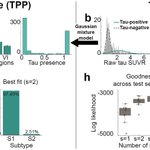
🧠New preprint alert! Tau, the pathological protein in AD, spreads through the brain in a very particular pattern. But what drives this pattern?
We found that WHERE tau pathology appears, and HOW MUCH accumulates there, are governed by different mechanisms. Check out our preprint
Caly Yu Xiao (肖燏) retweeted

A new method measures tau proteoforms with single-molecule resolution, revealing how splice isoforms and phosphorylations combine. @NautilusBio ow.ly/1Al950ZOJNa
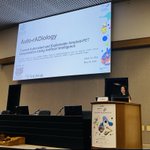
Happy to have had the opportunity to share some of our work on PET visual reads at the EURO-PAD Symposium last week.
Thanks to the organizers @IMI_AMYPAD, and everyone for the great conversations and discussions.

6
106
Huge congrats to @anlijuncn . Truly incredible work!

[1/7] Our work is now out in @NatureMedicine nature.com/articles/s41591-0… We developed a state-of-the-art AI-proteomics model for diagnosing multiple neurodegenerative diseases from blood plasma.
See previous thread for a summary – but some updates in the published version described below. ProtAIDe-Dx now outperformed both classic machine learning models and even foundation models like TabPFN!


4
127
Caly Yu Xiao (肖燏) retweeted

🚨 We're very happy to introduce TRIBE v2: a foundation model of the brain's responses to sight, sound & language.
📄 Paper: ai.meta.com/research/publica…
▶️ Demo: aidemos.atmeta.com/tribev2/
💻 Code: github.com/facebookresearch/…
🤗 Model: huggingface.co/facebook/trib…
Caly Yu Xiao (肖燏) retweeted

𝐕𝐢𝐬𝐮𝐚𝐥 𝐛𝐥𝐨𝐠 on Vision Transformers is live.
vizuaranewsletter.com/p/visi…
Learn how ViT works from the ground up, and fine-tune one on a real classification dataset.
CNNs process images through small sliding filters. Each filter only sees a tiny local region, and the model has to stack many layers before distant parts of an image can even talk to each other.
Vision Transformers threw that whole approach out.
ViT chops an image into patches, treats each patch like a token, and runs self-attention across the full sequence.
Every patch can attend to every other patch from the very first layer. No stacking required.
That global view from layer one is what made ViT surpass CNNs on large-scale benchmarks.
𝐖𝐡𝐚𝐭 𝐭𝐡𝐞 𝐛𝐥𝐨𝐠 𝐜𝐨𝐯𝐞𝐫𝐬:
- Introduction to Vision Transformers and comparison with CNNs
- Adapting transformers to images: patch embeddings and flattening
- Positional encodings in Vision Transformers
- Encoder-only structure for classification
- Benefits and drawbacks of ViT
- Real-world applications of Vision Transformers
- Hands-on: fine-tuning ViT for image classification
The Image below shows
Self-attention connects every pixel to every other pixel at once. Convolution only sees a small local window. That's why ViT captures things CNNs miss, like the optical illusion painting where distant patches form a hidden face.
The architecture is simple. Split image into patches, flatten them into embeddings (like words in a sentence), run them through a Transformer encoder, and the class token collects info from all patches for the final prediction. Patch in, class out.
Inside attention: each patch (query) compares itself to all other patches (keys), softmax gives attention weights, and the weighted sum of values produces a new representation aware of the full image, visualizes what the CLS token actually attends to through attention heatmaps.
The second half of the blog is hands-on code. I fine-tuned ViT-Base from google (86M params) on the Oxford-IIIT Pet dataset, 37 breeds, ~7,400 images.
𝐁𝐥𝐨𝐠 𝐋𝐢𝐧𝐤
vizuaranewsletter.com/p/visi…
𝐒𝐨𝐦𝐞 𝐑𝐞𝐬𝐨𝐮𝐫𝐜𝐞𝐬
Dr @sreedathpanat Videos on ViT
ViT paper dissection
youtube.com/watch?v=U_sdodhc…
Build ViT from Scratch
youtube.com/watch?v=ZRo74xnN…
Original Paper
arxiv.org/abs/2010.11929
Next up: demystifying Low-Rank Adaptation (LoRA) in PEFT!
Follow me @Mayank_022 along for more deep learning insights, cool fine-tuning projects, and updates from the upcoming blog posts.
Caly Yu Xiao (肖燏) retweeted

Organization of neuropeptide systems in the human brain | doi.org/10.1038/s41593-026-0…
Neuropeptides are functionally diverse signaling molecules in the brain and body.
@ericg_ceballos curates an atlas of neuropeptide receptors and relates it to brain function @NatureNeuro 🧩 🧠 ⤵️

Caly Yu Xiao (肖燏) retweeted

I’m excited and deeply honored to receive the AD/PD 2026 Junior Faculty Award @adpdnet !!!
My sincere thanks to the committee for this recognition.
I’m also very grateful to GNPC @_neuroproteome and BioFINDER @biofinder_study for their data support, and especially to my mentor Jacob Vogel @_JakeVogel_ , my brilliant colleagues, and my labmates for their encouragement, generosity, and collaboration.
If you’re interested in our work, I’d be delighted to see you at my talk tomorrow morning (Figure credit: GNPC.)


Congratulations to the #ADPD2026 Junior Faculty Award winners! ✨
These talented early-career researchers are making meaningful contributions to Alzheimer’s and Parkinson’s research, bringing fresh ideas and dedication to the field. Join us in Copenhagen to celebrate their achievements and learn more about their work.
Here’s to supporting and recognizing the next generation of neuroscientists making a real impact. 🧠🌍
Find out more: adpd.kenes.com/junior-facult…
@MugeAkinci @anlijuncn @BaaylaB @wagnersbrum @AnnaDewenter @NielsOkkels @cathrine_sant @Laura_Sofia_S @georgietos
#alzheimers #parkinsons #dementia #endalz

Caly Yu Xiao (肖燏) retweeted

Going to ADPD? Come see our work! We would love to share it with you and chat about it if you are interested. See below for a schedule of our sessions, which cover fMRI, proteomics, transcriptomics and AI

Caly Yu Xiao (肖燏) retweeted

turns out there are many many different types of synapses, each with their own voltage dynamics and response properties (!)
We dug into how synapse phenotype is associated with regional dynamics (awake rs-fMRI in mice) - see the publication and bratislav's tweeprint below:

Synaptome architecture shapes regional dynamics in the mouse brain | doi.org/10.1371/journal.pbio…
How do diverse synapses relate to the spatial patterning of whole-brain dynamics? @JustineYHansen explores @PLOSBiology ⤵️

Caly Yu Xiao (肖燏) retweeted

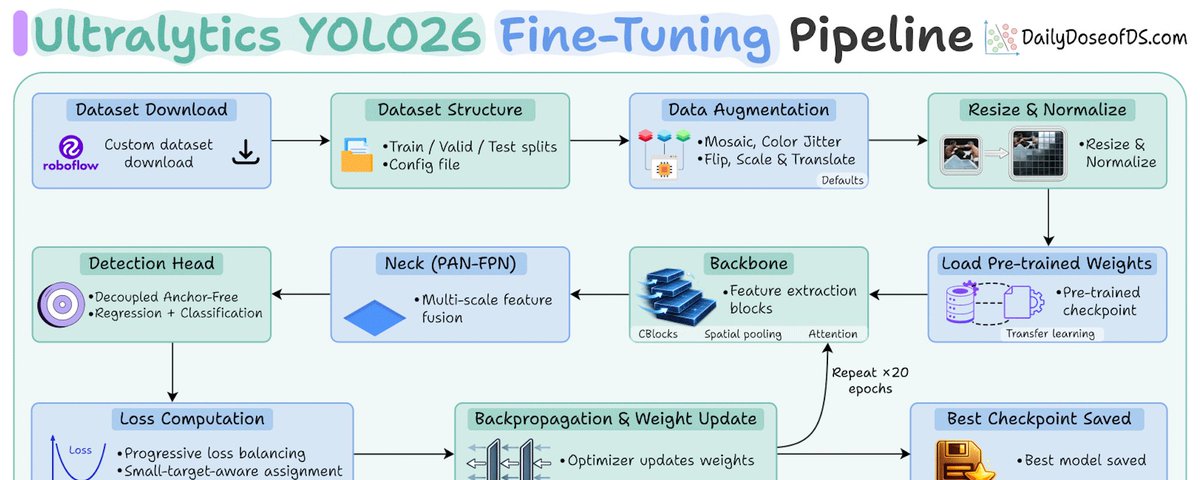
Real-time object detection will never be the same.
Traditional YOLO needs NMS to remove duplicate boxes; it's slow and inconsistent.
YOLO26 skips it entirely: single-pass predictions, faster inference and up to 300 detections per image.
Download model: platform.ultralytics.com/ult…

Caly Yu Xiao (肖燏) retweeted

A new version of our NextBrain segmentation tool is available on the development version of @FreeSurferMRI
Large improvements in memory efficiency enable segmentation of high-resolution modalities like HiP-CT without huge GPU memory
surfer.nmr.mgh.harvard.edu/f…
github-pages.ucl.ac.uk/NextB…

Caly Yu Xiao (肖燏) retweeted

A neural network that forms, understands, and communicates concepts like the human brain
Humans compress rich sensory experiences into compact mental concepts—the word "dinner" can evoke a full scene of flavors, sounds, and images—and use those concepts to communicate meaning without the original stimuli present. Building artificial systems that replicate this process remains a major challenge. Standard vision models entangle knowledge across millions of parameters, making it impossible to extract or transfer a single "concept." Multimodal LLMs rely on pre-existing language symbols rather than forming concepts from sensory experience.
Liangxuan Guo and coauthors propose CATS Net, a dual-module framework that bridges this gap. A concept-abstraction (CA) module compresses visual information into 20-dimensional concept vectors, while a task-solving (TS) module performs image classification under hierarchical gating control from those vectors. The CA module transforms each concept vector into layer-wise multiplicative signals that dynamically reconfigure how the TS module processes features—turning one network into many classifiers depending on which concept is provided.
The results go well beyond classification. The emergent concept spaces align significantly with two human semantic models—Binder65 and SPOSE49—despite training purely on visual categorization, even capturing non-visual dimensions like spatial, temporal, and emotional features.
The communication experiments are particularly compelling. Two independently trained CATS Nets develop separate concept spaces, yet share significant structural similarity. A translation module aligns them, allowing a "teacher" to transmit a novel concept to a "student" as a simple vector. The student, never having seen images of that category, classifies them well above chance—through pure symbolic exchange, without updating any network parameters.
Using fMRI data from 26 participants, the concept layer correlates with human ventral occipitotemporal cortex activity, while the CA module's gating aligns specifically with the brain's semantic-control network. Models that spontaneously converge on similar representations show even stronger brain alignment—echoing the idea that biological and artificial systems under similar constraints find shared solutions.
A concrete framework where concept formation and understanding coexist, compatible with human cognition and pointing toward AI systems that build grounded representations independently and align them through shared symbolic interfaces—much as humans do.
Paper: nature.com/articles/s43588-0…

Caly Yu Xiao (肖燏) retweeted
Inter-individual variability of neurotransmitter receptor and transporter density in the human brain | doi.org/10.1007/s00429-025-0…
How do neuroreceptor distributions vary across people?

MUST READ new tau simulation paper!

New BioFINDER preprint!
We formalise the Aβ–tau–neurodegeneration (ATN) framework into a mechanism-based model of AD, enabling us to simulate longitudinal imaging biomarkers and study how disease processes evolve and interact across the AD continuum.
🔗biorxiv.org/content/10.64898…
Caly Yu Xiao (肖燏) retweeted

Andrew Ng released an “Agentic Reviewer” for research papers.
It just hit near human-level agreement after training on real ICLR 2025 reviews.
𝗧𝗵𝗲 𝗽𝗿𝗼𝗯𝗹𝗲𝗺 𝗶𝘁 𝘁𝗮𝗿𝗴𝗲𝘁𝘀
Paper review is slow.
Each cycle takes around six months.
One student saw six rejections over three years.
Iteration speed, not ideas, became the bottleneck.
𝗛𝗼𝘄 𝗶𝘁 𝘄𝗼𝗿𝗸𝘀
The system learns from real conference feedback.
It reads your paper, then searches arXiv for related work.
The flow is simple:
Analyze claims and structure
Ground comments in published research
Produce structured reviewer-style feedback
It works best in fields with open literature.
𝗛𝗼𝘄 𝗴𝗼𝗼𝗱 𝗶𝘁 𝗶𝘀
Human-to-human review correlation sits at 0.41.
AI-to-human correlation reaches 0.42.
That is near reviewer agreement today.

Caly Yu Xiao (肖燏) retweeted
So incredibly proud of postdoc @xiaoyucaly for winning the HAI postdoc award!!! I really love watching your ⭐️ rise. I could not be more excited, especially since @HAIconference is my favorite conference!

Many thanks to @HAIconference, @alzassociation and Maria Carrillo to recognize our work and give us this opportunity. I’m truly grateful to receive both the HAI Travel Scholarship and the ISTAART Fellowship. Truly honored and excited to share our work with the community.
Caly Yu Xiao (肖燏) retweeted

𝗪𝗵𝗮𝘁 𝗶𝘀 𝗻𝗼𝗶𝘀𝗲 𝗶𝗻 𝘁𝗵𝗲 𝗯𝗿𝗮𝗶𝗻?
Almost always we average responses thus equating response variability with noise.
Well, we shouldn't because variability is also signal, not noise to be entirely discarded.
doi.org/10.1016/j.neuron.202…

Caly Yu Xiao (肖燏) retweeted

❗🧠 New review in IEEE RBME
How network math models are reshaping how we think about neurodegenerative disease, from brain dynamics to disease progression
"Network models of neurodegeneration: bridging neuronal dynamics and disease progression"
ieeexplore.ieee.org/document…

Caly Yu Xiao (肖燏) retweeted

Are connectome-based network mapping methods and the >200 papers that have used it invalid?
New paper out in @NatureNeuro says YES. nature.com/articles/s41593-0…
I have concerns about this new paper's methods and conclusions, but am biased. What do others think?

Caly Yu Xiao (肖燏) retweeted

Check out our SupReMix for representation learning in medical imaging regression

🎉Our paper SupReMix is accepted by MedIA 2026!
Ordinality-aware contrastive learning for medical imaging regression, achieving SOTA performance—even in low-data settings.
🔗 sciencedirect.com/science/ar…
@yileiw5 @ZijianDD @HelenJuanZhou
