
FAIR CodeGen @AIatMeta | 🥑 1.0/1.1/1.2/1.3 & 🍉| Alum @Tsinghua_Uni @GTCSE | NLP | Large Language Models
Mountain View, CA
Joined August 2020
- Tweets68
- Following605
- Followers1.1K
- Likes697




Yue Yu retweeted
1/ announcing our smallest, most efficient little model is here: muse ember 🔥
built for work that agents repeat all day, it gets you more intelligence per dollar than Haiku, Luna, and all other flash models at any reasoning setting and does it at a third of the cost or less!

Wonder is here, and it's looking Wonder Full! 🍉
We've worked hard to push its intelligence and real-world usefulness, especially for coding, agentic and personal superintelligence.
Proud to be part of this journey. More wonders ahead!


Yue Yu retweeted

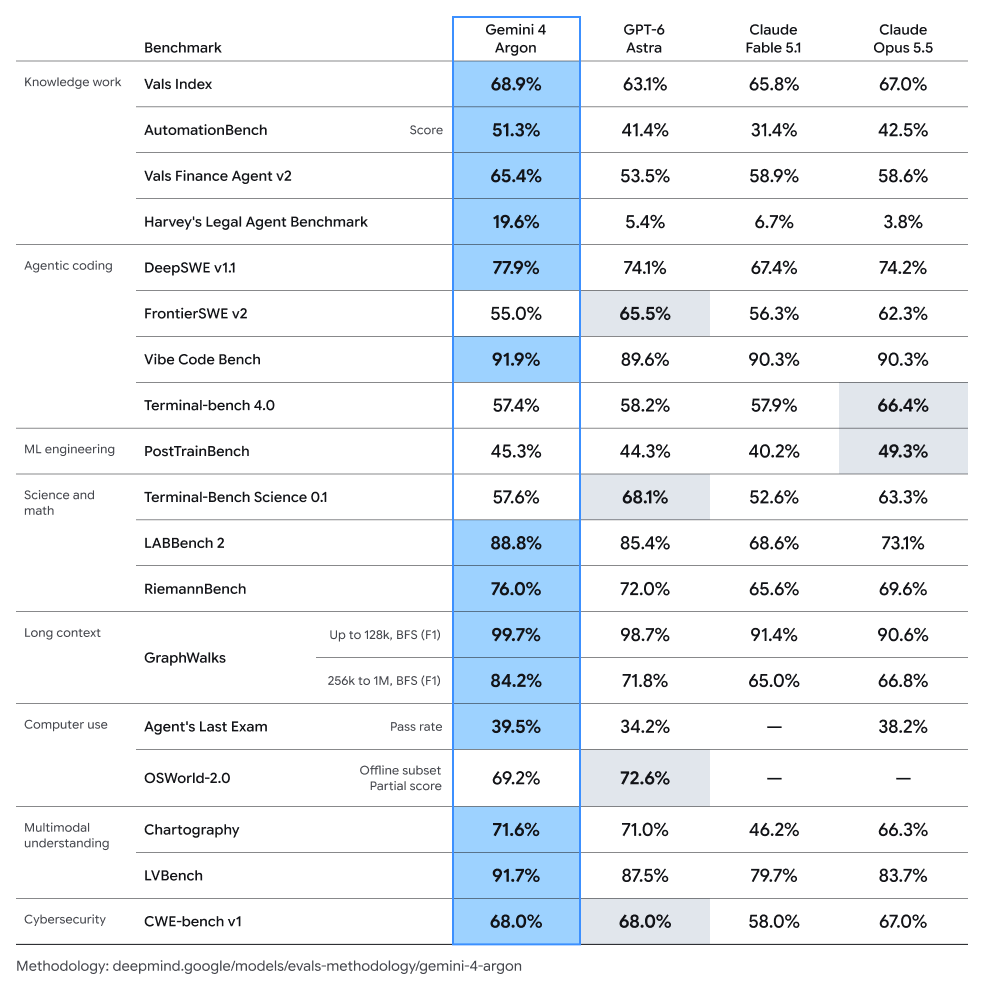
Excited to bring Gemini 4 Argon! Incredibly strong across general reasoning, agents, coding, and cybersecurity.
Great time to be working on cyber defense and turning frontier capabilities into real-world vulnerability discovery and remediation. 🚀

Yue Yu retweeted
So excited to finally share what our team has been building! 🚀
Meet Gemini 3.8 Flash and Gemini 3.8 Flash Cyber:
⚡Massive leaps in long-horizon coding & agentic tasks
🛡️Frontier-level automated vulnerability detection & patching with Flash speed/pricing


Yue Yu retweeted

Meta has released Muse Spark 1.3, their fourth Muse Spark model release in five months. Muse Spark 1.3 (max), which is in limited preview for Meta’s partners, scores 62 on the Artificial Analysis Intelligence Index, behind only Claude Fable 5.1 and Claude Opus 5. The variant available now, Muse Spark 1.3 (xhigh), scores 61 and ties with GPT-5.6 Sol (max) and Grok 4.6 (high). Both variants’ gains come primarily from improvements in agentic work and scientific capabilities
Muse Spark 1.3 (xhigh) enters the Artificial Analysis Intelligence Index at 61, up 4 points from Muse Spark 1.2 (57, August) and 8 points from Muse Spark 1.1 (53, July). It enters tied with GPT-5.6 Sol (max), Grok 4.6 (high), and Claude Opus 5 (high), and behind Claude Fable 5.1 (max, 66), Claude Opus 5 (max, 63), and Claude Fable 5 (max, 62)
Muse Spark 1.3 (max), which is in a limited preview stage, lands at 62. This higher index score is enabled by gains vs. Muse Spark 1.3 (xhigh) in Tau3-Bench Banking (52% vs. 47%) and GDPval-AA v2 (1,754 Elo vs. 1,709). Muse Spark 1.3 (max) is second only to Claude’s Fable and Opus variants in total score
Congratulations to @AIatMeta, @finkd, and @alexandr_wang on the release!
Key Takeaways:
➤ Continued improvement on agentic knowledge work tasks. At the launch of Muse Spark 1.2, we noted its significant gains in agentic knowledge work performance vs. Muse Spark 1.1. The latest iteration continues this trend, with Muse Spark 1.3 (xhigh) demonstrating a notable 12-point gain vs. Muse Spark 1.2 in Tau3-Bench Banking (35% to 47%), a 5-point gain in Terminal-Bench 2.1 (80% to 85%), and a new GDPval-AA v2 Elo of 1709 against its predecessor’s 1615. Muse Spark 1.3 (max) improves further on Tau3-Bench Banking (52%) and GDPval-AA v2 (1,754 Elo). This Tau3-Bench Banking score is #1 among all models. Muse Spark 1.3 (max) achieves these higher agentic work scores by using more turns and total reasoning tokens, reasoning 62% more on GDPval-AA v2 and 28% more on Tau3-Bench Banking compared to Muse Spark 1.3 (xhigh)
➤ The lowest cost per task for any model at 59+ on the Artificial Analysis Intelligence Index. Muse Spark 1.3 (xhigh) costs $0.55 per Intelligence Index task at Meta's unchanged $1.25/$4.25 per 1M token pricing ($0.15 for cached input), with its peers GPT-5.6 Sol (max) and Grok 4.6 (high) costing $0.95 and $0.94 respectively, a 70%+ premium. This places Muse Spark 1.3 (xhigh) on the Pareto frontier for Intelligence vs. Cost per Task. Its cost per task is higher than Muse Spark 1.2 ($0.40 per task), driven by ~57% more input tokens per task on agentic evaluations, with output tokens up only ~8%. Pricing for Muse Spark 1.3 (max) is not yet publicly available
➤ Scientific Reasoning results rose across the board, led by CritPt. CritPt was the standout non-agentic score gain vs. Muse Spark 1.2, with a material +8 points for the xhigh variant (18% to 26%), and GPQA Diamond achieved +4 points (90% to 94%), while Humanity’s Last Exam and SciCode each gained a more modest 2-3 points (45% to 47% and 56% to 59%, respectively). Muse Spark 1.3 (max) achieved roughly similar scores to the xhigh variant, gaining 2 points in Humanity’s Last Exam, tying on GPQA Diamond, and losing a point on CritPt vs. Muse Spark 1.3 (xhigh)
➤ Minor regressions in only two evaluations. Both Muse Spark 1.3 (xhigh) and Muse Spark 1.3 (max) dropped 4 points in AA-LCR (83% to 79%) when compared to Muse Spark 1.2, and AA-Omniscience (Accuracy) fell 3 points for xhigh and 1 point for max. The drops in AA-Omniscience (Accuracy) are due to a higher abstention rate (not answering questions when unsure), which also lowered the hallucination rate for Muse Spark 1.3 (xhigh)
Other model details (xhigh variant):
➤ Context window: 1M tokens, unchanged from Muse Spark 1.2
➤ Pricing: unchanged from Muse Spark 1.2: $1.25/$4.25 per 1M input/output tokens, with cache hits discounted to $0.15 per 1M
➤ Input modalities: text, image, video
➤ Availability: Meta's first-party API and Muse Code

Try out Muse Spark 1.3! We pushed hard on long-horizon, usability and anti-hacking for making 🥑 more useful and capable.
Still cooking 🍉 Bigger models and much more to come.

1/ today we’re releasing muse spark 1.3—available in muse code & the meta model api.
this is our most capable model yet—frontier performance almost too cheap to meter. much stronger at agentic and coding with better usability. we think users will really notice the jump.

1
41
7,564
Muse Spark 1.2 and MuseCode are out—less than a month after Muse Spark 1.1! 🚀
Excited to join the journey and see the pace of progress. Give it a try and let us know what you build!
curl -fsS dev.meta.ai/install.sh | bash
muse code in beta is live. first coding agent from msl, built on muse spark 1.2.
install: curl -fsS dev.meta.ai/install.sh | bash
here's what you should know:


Muse Spark 1.1 🥑 is out! with lot of improvements on agents / reasoning / coding.
Scaling RL has been tiring, rewarding, and full of lessons.
Try it on dev.meta.ai and please send feedback + failure cases. They help make the model better.
More to come!

Yue Yu retweeted
Introducing Muse Spark, the first in the Muse family of models developed by Meta Superintelligence Labs.
Muse Spark is a natively multimodal reasoning model with support for tool-use, visual chain of thought, and multi-agent orchestration.
Muse Spark is available today at meta.ai and the Meta AI app. We’re also making it available in private preview via API to select partners, and we hope to open-source future versions of the model.
Learn more: go.meta.me/43ea00

Yue Yu retweeted

Introducing Examining Reasoning LLMs-as-Judges in Non-Verifiable LLM Post-Training
LLM alignment in non-verifiable domains is hard because there is often no clear ground-truth reward. A natural idea is to use reasoning LLM judges inside the RL training loop — but do they actually work better than standard judges?
We study this question in a controlled setup with a gold-standard judge, and find that reasoning judges train much stronger policies under gold evaluation, while non-reasoning judges are much more prone to reward hacking.
But there is also a catch: these reasoning-judge-trained policies can learn highly effective adversarial strategies. In our study, a Llama-3.1-8B policy trained with a Qwen3-4B reasoning judge reaches 89.6% on the creative writing subset of Arena-Hard-V2, close to o3 (92.4%).
📚 Paper: arxiv.org/abs/2603.12246
See details below 👇 🧵1/N

Yue Yu retweeted
Happy to introduce my internship work at @Google and @GoogleDeepMind, collab w/ @googlecloud.
We introduce TIR-Judge, an end-to-end agentic RL framework that trains LLM judges with tool-integrated reasoning 🧠🛠️
🔗arxiv.org/pdf/2510.23038
#Agents #LLMs #Judges #RL #reasoning

Yue Yu retweeted

🤔 How can we systematically enhance LLMs for complex medical coding tasks?
🚀 Introducing MedAgentGym, an interactive gym-style platform designed specifically for training LLM agents in coding-based medical reasoning! 🧬💻
🎯 Comprehensive Code-based Medical Reasoning Benchmark:
- 📌 72,000+ coding tasks across 129 diverse categories
- 🌐 12 authentic, real-world biomedical scenarios
- 🛠️ Supports structured and open-ended coding challenges
⚙️ Robust & Scalable Infrastructure:
- 🚧 Task-specific Docker environments for isolated, reproducible execution
- 🚦 Multi-threaded, parallel execution and sequential sampling
- 📊 Efficient trajectory collection tailored for diverse agent training
🔗 Explore more:
📖 Paper: arxiv.org/abs/2506.04405
📚 Doc: wshi83.github.io/MedAgentGym…
💻 Code: github.com/wshi83/MedAgentGy…
🤗 Model & Data: huggingface.co/MedAgentGym
#AI #MachineLearning #Bioinformatics #MedicalAI #LLM #DeepLearning #HealthTech #OpenSource #Healthcare #DataScience #MedTech #NLP #GenerativeAI #Coding #Benchmark

Yue Yu retweeted

We’re at #NeurIPS 2024 in Vancouver, presenting two papers from NVIDIA on advancing state-of-the-art LLM RAG models!
ChatQA: Surpassing GPT-4 on Conversational QA and RAG
Thu 12 Dec 11 a.m. PST — 2 p.m. PST, West Ballroom A-D #7201
Paper: arxiv.org/abs/2401.10225
RankRAG: Unifying Context Ranking with Retrieval-Augmented Generation in LLMs
Thu 12 Dec 4:30 p.m. PST — 7:30 p.m. PST, East Exhibit Hall A-C #4604
Paper: arxiv.org/abs/2407.02485
We are hiring full-time researchers and interns to work on LLMs, reasoning and multimodal LLMs. Feel free to reach out via chat or DM if you're interested!
Yue Yu retweeted

Excited to present HYDRA 🐉 at #NeurIPS2024! 🚀
Our novel model-factorization framework combines personal behavior patterns 👤 with global knowledge 🌐 for truly personalized LLM generation. Achieves 9%+ gains over SOTA across 5 tasks 🏆 using personalized RAG.
Learn more: arxiv.org/pdf/2406.02888


7/n here are some papers relevant to us:
Cloud: arxiv.org/abs/2408.11791
Generative verifiers: arxiv.org/abs/2408.15240
Generative RM: arxiv.org/abs/2410.12832
1
2
1,229
8/8 Thanks all coauthors from the Meta Llama Team for the great support!
Zhengxing Chen, Aston Zhang @astonzhangAZ , Liang Tan, Chenguang Zhu @ChenguangZhu2 , Richard Pang @yzpang_ , Yundi Qian , Xuewei Wang, Suchin Gururangan @ssgrn, Chao Zhang @chaozhangcs, Melanie Kambadur, Dhruv Mahajan as well as my mentor Rui Hou @magpie_rayhou
2
1,271