







zally retweeted
BEHAVE.
We live in a world where nearly everything is decided, but very little is actually understood. At zally, we're building the science to change that.
For too long, people have adapted to technology. It should be the other way around. Technology should adapt to us. So we build AI that understands people from how they actually behave: how you hold your phone, how you swipe, how you move. Behavior, understood.
Behave is how we start. It is a game, and it is the first step.
Meet Behave. Fast, fun, retro. You play as little Aiden, Aiden Bradwell to be exact. Collect coins, dodge rocks, swipe to survive, and drop little Aiden off on the right floor.
Here is the thing. How you play is what trains our models, so you are part of this from the very start. Playing once tells us nothing. The model needs one round to learn how you play, and another to check it got you right. So go back three or four times over the next week, and see if you can beat your first score.
Play in your phone browser. Nothing to download. UK only for now.
There are prizes along the way too, revealed over the coming days. But the real point is simpler: play, and you help build something that has never existed before.
Help us make behavior understood.
Play here --> behave.game
(18+ Only. Open in your main browser. Sign up to be part of the leaderboard. Only works on your phone)
Some rooms are worth being in. This was one of them.
zally co-hosted a breakfast experience with @wilsonsonsini and Open Doors NZ-UK. A closed-door conversation, led by a keynote from our guest of honor, Dr. @ShaneLegg CBE, Co-Founder and Chief AGI Scientist at @GoogleDeepMind.
It was a perfect fit. Wilson Sonsini focuses deeply on the human element of AI, and Open Doors links NZ, UK and allied businesses and leaders across the high-growth industries of AI, quantum, aerospace, defense, technology, security, infrastructure and energy.
The breakfast had one purpose: to bring together a select group of senior executives for an honest exchange, built on trust, that left everyone in the room with a clearer sense of how the future of AGI is likely to develop, and what it will ask of us.
The conversation stays in the room. The awareness it created travels with all of us.
Thank you to Dr. @ShaneLegg for his time, and for his insight on the work on AGI and where sovereignty, trust and human judgement are heading. To Wilson Sonsini for the excellent space and questions asked, and to Open Doors NZ-UK for the great connections made. We are grateful for the morning, and for the people who made it what it was.
The conversation will continue.


2
54
No risk, no story.
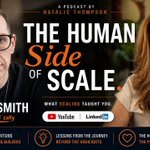
That is how our Founder and CEO, Patrick Smith, opens his conversation with Natalie Thompson on The Human Side of Scale. Throughout the episode, Patrick focuses less on the business and more on what it actually takes to build one.
Patrick has led zally for over three years now. The idea started with killing passwords. Two funding rounds and years of work later, we have grown into a Behavioral AI company, with teams spread across the US and UK.
What Patrick keeps returning to in this episode is people: the importance of surrounding yourself with people who challenge you, you learn from. As well as the sacrifices founders make, the responsibility that comes with being an entrepreneur, and the belief that failure teaches you more than success. Having failed 11 times before the age of 25, Patrick is direct about it in the episode: "Accepting no is part of the process. If I hadn't tried, I wouldn't be where I am today."
The thread running through it all aligns well with what we are building at zally: Technology should adapt to humans, not the other way around.
Listen to the full episode of The Human Side of Scale with Natalie Thompson and Patrick Smith.
Watch here → youtube.com/watch?v=gwMOhki0…
#zally #AI #Founderjourney #InsideAI #SanFrancisco

39
Behavioral authentication typically refers to how you type, swipe, and move on a screen. The more interesting question is what a system can understand once the signal leaves the screen.
That is the question we posed to Salman Musa during his internship at zally: can a wearable produce a behavioral signal strong enough to continuously authenticate someone?
It is an open research problem, and a real one. A wearable gives you a different class of behavioral signal from a phone or a keyboard. Working out how that signal feeds a model built for Behavioral Understanding is exactly the kind of frontier zally exists to work on.
Salman built a Wear OS application with a companion Android app, then designed and conducted a user study that yielded promising early findings. Those findings are now informing our next stage of research. He did all of it having never shipped mobile or used Amazon Web Services (AWS) before, working through the literature independently and delivering a working proof of concept on both.
His mentor, Mina Baghkalayeh, put it well: "He brought real curiosity to the role, took ownership of his work early, and handled every part of the development with care and professionalism."
This is how zally compounds. Every new source of behavioral signal lets the model understand more, and Continuous Authentication is where that understanding first proves itself. Not a single product. A body of Behavioral Understanding that grows with every study we run.
The research continues.
#zally #AI #Wearables #Manchester #Technology

57
The most powerful AI ever built was let inside some of the most secure systems in the world.
It found what it was looking for in hours.
The conversation that followed was about access. Not behavior.
An AI operating inside a system is not passive. It is active. It makes decisions. It moves through environments at a speed no human can follow in real time.
Whether it should have been allowed in is a legitimate question. But it is the second one.
The first is what it was doing while it was in there. How it was behaving. Whether the behavior matched what it was deployed to do.
That question was never asked.
That gap now sits inside every enterprise deploying AI.
We measure what AI produces. We do not understand how it behaves to produce it.
The most secure systems in the world just showed us what AI is capable of.
When does the conversation about how it behaves actually begin?
#zally #anthropic #mythos #AI

1
11
On Monday, the heads of all six Five Eyes cyber agencies put their names to a single warning.
David Imbordino of the NSA, Nick Andersen of CISA, Richard Horne of the UK's NCSC, Rajiv Gupta of the Canadian Centre for Cyber Security, Stephanie Crowe of the Australian Cyber Security Centre, and Catriona Robinson of New Zealand's NCSC.
AI is already lowering the barriers for attackers. It is compressing the time between a vulnerability being discovered and it being exploited. Frontier AI capabilities will fundamentally transform offensive cyber threats.
"The timeline is not years, it is months."
Their advice to leaders was clear. Reduce your attack surface. Patch faster. Address legacy systems.
Strengthen identity and access controls.
AI is advancing faster than most organizations can keep pace. New capabilities. New threats. New tools deployed inside systems that were not designed for them.
But in the race to keep up, one question is not being asked loudly enough.
Do we actually understand the behavior of the AI we are already running?
Not what it was built to do. What it is doing. How it is behaving. Whether that behavior is changing.
When did speed become more important than understanding?
#zally #FiveEyes #Behavior #AI

1
83
The "bot-or-human" question is dead. The debate has shifted to something far more critical: intent and trust.
AI agents are now operating inside every major enterprise. They have valid credentials. They look legitimate. The standard approach lets them in and stops watching.
But a credential is not behavior. It never was.
The moment an agent is inside your system, the real question begins. Is it doing what it should? Is it behaving consistently? Has something changed? Right now, most systems have no way of knowing. The decision was made at login. Nothing that happens after is questioned.
That is the gap. And it is growing.
The numbers make it visible. 74% browser fingerprint mismatch. Click timing 15x inside a sub-10ms window. Only 38% unique cursor positions across an AI session, compared to 99% for humans.
The signals are there. The infrastructure to understand them continuously is not.
zally is building that platform. The Large Behavioral Model does not just detect. It understands. It reads behavioral signals continuously, not just at the point of entry, but throughout the entire lifecycle of a session. Whether it is a human or an AI agent, the science holds: behavior is a living signal.
When the signal changes, you know the moment it changes. Make behavior understood.
#zally #Identiverse #Agents #AgenticAI #Identity


1
21
1 in 10 people cannot verify who they are online.
Scott Weddell and Dr. Elliott Fullerton are in Las Vegas this week at Identiverse, The Global Identity Imperative. What they are hearing from the stage is the problem zally was founded to solve: legacy systems make authentication decisions on a single point-in-time check.
The industry is now moving past that. Continuous identity, verification that keeps running rather than a one-time gate. 72% of organizations are already moving toward perpetual KYC (Liminal, 2025).
But most perpetual KYC still focuses on data hygiene. Necessary, not continuous. zally focuses on behavior, with a depth, precision, and level of trust a point-in-time check cannot approach.
zally is building the foundation model for behavior. The Large Behavioral Model does not predict. It understands. Continuous Authentication is the first capability built on it, confirming you are you, continuously, through the way you naturally behave. The same science holds for agents.
Systems decide without understanding the behavior in front of them.
zally provides the Behavioral Understanding to close the gap.
#zally #Identiverse #Authentication #Identity #Behavior


1
21
We're halfway through June. We're making moves
Manchester. San Francisco. New York is next.
Our CRO paid a visit to the new office space. Things are taking shape.
Our Founder and CEO is in San Francisco right now. Important conversations. Right in the heart of it.
Anniversary milestones for our zallies. The people building this matter.
The zally run club is not slowing down. We're training for a half marathon for Henshaws. Running to focus. Running together.
More to come. Behind the scenes we're continuously building to make behavior understood.
Watch this space for more to come.
#zally #ai #technology #behavior #understanding


1
17
May was full. May was real.
Our Founder and CEO, @PatrickMoeSmith was personally invited to #GreaterTogehterLA. We ran 13.1 miles, and raised £1,620 raised. Two brilliant new team members. A hard-earned promotion. Conversations that matter in San Francisco. Daily walks with a little more intention.
Every one of those moments sits alongside the work our team are doing in the background, building the Large Behavioral Model that gives technology a continuous, real-time understanding of what is actually happening.
June is already off to a strong start. We are not letting go of this energy.
#zally #AIcompany #BehavioralAI #Manchester #SanFrancisco


1
13
They did it 🩷
They crossed the finish line and raised
£1,620 for the zally Foundation in support of Henshaws.
We could not be more proud. And there is a lot more to come.
Thank you to everyone who believed in them. Here's to the team, and to everyone who made it possible.
Team zally 🩷


1
15
"We have built our IP architecture in the UK with great talent, and then brought it over with global ambition here in San Francisco " - Patrick Smith.
Our Founder and CEO, @PatrickMoeSmith, spoke with @WSJCustom on the secrets to transatlantic start-up success.
Watch now! #GreaterTogetherLA #WSJ #WallStreetJournal
zally retweeted

Paid Program with @GREATBritain: What are the secrets to transatlantic start-up success?
Patrick Smith, founder and CEO of zally, says it comes down to a simple dynamic: the U.K. refines ideas, while the U.S. accelerates them.
partners.wsj.com/uk-cabinet-…
This week, zally was personally invited to the UK's largest-ever trade mission to the US. 500+ leaders, investors, policymakers, #GreaterTogether
Manchester-born. San Francisco-based. Building what's never been built before - #BehavioralAI
The world is starting to get it.


1
42
Promotions start from within.
At zally, we are building a field built on a foundational capability that has never existed before.
We are building Behavioral AI.
The people doing that deserve to progress with it.
This is a very exciting chapter for us.
#zally #AI #Technology


1
52


zally retweeted

Sat down with @kraneland, CEO of @GVteam at Blue Bottle in Palo Alto. #84 at @Google. Early on Uber, Slack and Stripe. Not a banker. An operator who understood brand before most people in tech knew it mattered. No risk, no story.
The best relationships are built in the margins.

