

Researcher @deepseek_ai | M.S. @thu Recent: DeepSeek-R1/V3/V4/V4.1 series, ToRA, CRITIC. Opinions are my own.
Beijing, China
Joined May 2019
- Tweets47
- Following831
- Followers3.6K
- Likes87




Zhibin Gou retweeted

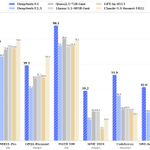
🚀 DeepSeek-V4.1-Flash-1017 is here!
Stronger benchmark performance, faster task completion, and shorter outputs than the previous version—a Pareto improvement in performance and cost. Now live on our website, app, and API.
🛠️ Optimized for @DeepSeekHarness, Tencent CodeBuddy, WorkBuddy, and more. Upgrade to DeepSeek Harness v0.2.1-rc.1 or later for the best experience with the new model.
1/4


Zhibin Gou retweeted
🚀 DeepSeek-V4 Preview is officially live & open-sourced! Welcome to the era of cost-effective 1M context length.
🔹 DeepSeek-V4-Pro: 1.6T total / 49B active params. Performance rivaling the world's top closed-source models.
🔹 DeepSeek-V4-Flash: 284B total / 13B active params. Your fast, efficient, and economical choice.
Try it now at chat.deepseek.com via Expert Mode / Instant Mode. API is updated & available today!
📄 Tech Report: huggingface.co/deepseek-ai/D…
🤗 Open Weights: huggingface.co/collections/d…
1/n

If Gemini-3 proved continual scaling pretraining, DeepSeek-V3.2-Speciale proves scaling RL with large context.
We spent a year pushing DeepSeek-V3 to its limits. The lesson is post-training bottlenecks are solved by refining methods and data, not just waiting for a better base.

🚀 Launching DeepSeek-V3.2 & DeepSeek-V3.2-Speciale — Reasoning-first models built for agents!
🔹 DeepSeek-V3.2: Official successor to V3.2-Exp. Now live on App, Web & API.
🔹 DeepSeek-V3.2-Speciale: Pushing the boundaries of reasoning capabilities. API-only for now.
📄 Tech report: huggingface.co/deepseek-ai/D…
1/n

🚀DeepSeek-R1 now thinks better and deeper with the 05/28 update!
🚀 DeepSeek-R1-0528 is here!
🔹 Improved benchmark performance
🔹 Enhanced front-end capabilities
🔹 Reduced hallucinations
🔹 Supports JSON output & function calling
✅ Try it now: chat.deepseek.com/
🔌 No change to API usage — docs here: api-docs.deepseek.com/guides…
🔗 Open-source weights: huggingface.co/deepseek-ai/D…

Have fun with our latest reasoning model, DeepSeek-R1!
Takeaways:
- Scaling large models with large data, large context, and apply large-scale RL, success is a guaranteed.
- Larger models excel at optimizing reasoning patterns, so derive efficient reasoners through distillation.
🚀 DeepSeek-R1 is here!
⚡ Performance on par with OpenAI-o1
📖 Fully open-source model & technical report
🏆 MIT licensed: Distill & commercialize freely!
🌐 Website & API are live now! Try DeepThink at chat.deepseek.com today!
🐋 1/n

Try it out at chat.deepseek.com/
Tech report: github.com/deepseek-ai/DeepS…
MIT-licensed open models: huggingface.co/deepseek-ai/D…


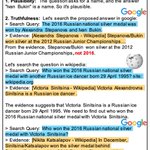
Absolutely agree! This aligns perfectly with our early 2023 work, CRITIC (arxiv.org/pdf/2305.11738). We use the internet and tools for hallucination detection, calibration, and correction—a principled approach to for LLM truthfulness.
This improves calibration on QA by over 10%!


Realization: the old style of “hallucinations research” via self-calibration is probably going to die down. I used to be very excited about it but now I am skeptical because giving models internet access (e.g., searchGPT, perplexity) is turning out to be way higher ROI.
When ChatGPT first came out, it was clear that hallucinations was one of the most important issues of LLMs. In 2023 John Schulman gave a talk on (what I think is) a really good approach to reduce hallucinations. The idea was that you could turn some amount of hallucinations into "I don't know", and the model would be able to learn that boundary using RL. I expected people to implement that and language models would get really good at knowing when to answer and when to say I don't know.
I still think the idea is very correct but empirically it doesn't seem like anyone made great progress on that in the past two years. One reason is that it is pretty hard to move models to be stricty more pareto-optimal on precision-recall. Often you would just be moving along the precision-recall boundary, and in practice people just care a lot more about recall; models that say "I don't know" too much are annoying.
The much better thing than self-calibration is improve factuality by allowing language models to browse the internet. In the past, language models would hallucinate easily on queries like “what papers Barret Zoph wrote” but now with browsing they can answer those easy factual questions pretty well. It turns out that this type of research---giving models access to the internet---is way higher ROI than teaching language models to be more calibrated.
In other words, let's say you are at 50% recall on some factual dataset. One approach would be to spend months of hallucinations research to improve calibration, and maybe get 45% recall with much lower hallucination rate. However, with a similar amount of research work you could probably augment the model with internet access and get much better precision and recall (e.g., 90%). Even though the two approaches are technically orthogonal, once you starting doing the latter, the former is reduced to only a second-order effect.
🎉 Excited to announce that our paper on Selective Language Modeling has been named Best Paper Runner-Up at #NeurIPS2024! 🏆
Explore the details in our Tweetstorm: teapaw.org/zebgou/status/17786765…

Excited to share our paper "Not All Tokens Are What You Need for Pretraining" received the #NeurIPS2024 Best Paper Runner-up award. I’ll be attending the conference from Wed to Sat. Feel free to reach out if you'd like to connect or attend our talk.
openreview.net/forum?id=0NMz…

ALT Not All Tokens Are What You Need for Pretraining, Neurips-2024 Best paper runner-up award.
🚀 Introducing DeepSeek-R1-Lite-Preview, our latest advancement in reasoning!
✨ May the gods of scaling laws bless our journey toward AGI :)
🌐 Try it now at chat.deepseek.com
🚀 DeepSeek-R1-Lite-Preview is now live: unleashing supercharged reasoning power!
🔍 o1-preview-level performance on AIME & MATH benchmarks.
💡 Transparent thought process in real-time.
🛠️ Open-source models & API coming soon!
🌐 Try it now at chat.deepseek.com
#DeepSeek

Congratulations on winning the AI Math Olympiad 🏅! Tool-Integrated Reasoning (ToRA) (arxiv.org/abs/2309.17452) has been put to great use!
FYI, here's ToRA's repository: github.com/microsoft/ToRA


AI Math Olympiad winner is now Open Source! 🔥
> 7B model, scored 29/50 on the public and private Kaggle test sets. (Apache 2.0 licensed).
> Base model: deepseek-math-7b-base
> Two-stage fine-tuning to reach the leaderboard-winning solution.
> Step 1: fine-tune large and diverse math datasets (templated with Chain of Thought prompting).
> Step 2: fine-tune the Stage 1 checkpoint on a synthetic dataset of tool-integrated reasoning, where each math problem is decomposed into a sequence of rationales, Python programs, and their outputs.
> Used MSFT's ToRA format for GPT4 outputs with code executions.
> Integrated with Transformers. 🤗

Zhibin Gou retweeted
DeepSeek-Coder-V2: First Open Source Model Beats GPT4-Turbo in Coding and Math
> Excels in coding and math, beating GPT4-Turbo, Claude3-Opus, Gemini-1.5Pro, Codestral.
> Supports 338 programming languages and 128K context length.
> Fully open-sourced with two sizes: 230B (also with API access) and 16B.
#DeepSeekCoder

Zhibin Gou retweeted

i think people are misunderstanding gpt-4o. it isn't a text model with a voice or image attachment. it's a natively multimodal token in, multimodal token out model.
you want it to talk fast? just prompt it to. need to translate into whale noises? just use few shot examples.

Zhibin Gou retweeted

Thanks for featuring our work!
MAmmoTH2 and also Rho-1 both prove that we are not capped by the number of tokens we can train on. Not all tokens are created equal, some are more useful than others.
By carefully selecting the best tokens to train on, the existing data can already take you very far!

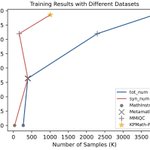
9). MAmmoTH2 - harvest 10 million naturally existing instruction data from the pre-training web corpus to enhance LLM reasoning; the approach first recalls relevant documents, extracts instruction-response pairs, and then refines the extracted pairs using open-source LLMs; MAmmoTH2-7B's (Mistral) performance increases from 11% to 34% on MATH and from 36% to 67% on GSM8K...
teapaw.org/xiangyue96/status/1787…
Zhibin Gou retweeted

This is a fantastic papercard by @_nerdai_ on CRITIC (@zebgou et al.) - using external tools to critique and improve the output of LLM agents.
In comparison to other reflection approaches, CRITIC relies on external tools (e.g. perspective API for toxicity reduction, code interpreter to validate/run code), to generate feedback about a current agent’s trajectory and output. This offers an element of getting external feedback; in many cases this gives much better results than only using LLMs to critique itself.
Best of all, we have full YouTube walkthroughs, notebooks, and @llama_index abstractions so that you can either apply or build a CRITIC approach to agent/RAG pipeline that you’re building!
YouTube walkthrough: youtube.com/watch?v=OLj5MFNH…
Notebook: docs.llamaindex.ai/en/latest…
CRITIC agent on LlamaHub 🦙🏡: llamahub.ai/l/agent/llama-in…
Source paper: arxiv.org/pdf/2305.11738


A new @llama_index Agents extension package was just released!! 🌟🎉 🤖
The new Python package, called llama-index-agent-introspective, contains Agent classes for implementing the Reflection Agentic Pattern. With reflection, an Agent produces an initial response to a given task, "reflects" on (or critiques) this initial response, and finally "corrects" it if it finds the need to do so. Many have found that Agents that use reflection often produced better responses than those that don't.
Last week, I dropped my latest PaperCard on the CRITIC paper by Gou, Zhibin, et al. 2024 ICLR. I also mentioned then that we would try to implement the CRITIC reflection framework for our users to be able to try it with LlamaIndex Agents. This new extension package does just that — specifically, you can build an IntrospectiveAgent that delegates the reflection subtask to a ToolInteractiveReflectiveAgent (i.e. CRITIC implementation)!
Here are a few links to learn more:
🎥 YouTube video walkthrough: youtube.com/watch?v=OLj5MFNH…
🦙 Example notebook (on a toxicity reduction experiment similar to the one found in the CRITIC paper): github.com/run-llama/llama_i…
💻 Source Code: github.com/run-llama/llama_i…
📝 Paper: arxiv.org/pdf/2305.11738

🔥 Not All Tokens Are What You Need!
🚀 Releasing the Rho-1 series, including the first 1B LLM to hit 40.6% on MATH.
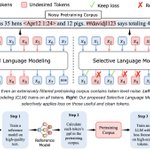
Rho-1 introduces Selective Language Modeling (#SLM) for token-level pretraining data selection.
Thanks to @_akhaliq and @arankomatsuzaki for sharing our work!

ALT SLM improves average few-shot accuracy on GSM8k and MATH by over 16%, achieving baseline performance 5-10x faster.
Rho-1 base 1B and 7B reach 15.6% and 31.0% few-shot accuracy on MATH, respectively — matching DeepSeekMath with just 3% of the pre-training tokens.
#CodeInterpreter: Rho-1-Interpreter 1B and 7B achieve 40.6% and 52% on MATH, respectively — fine-tuned with only 69k samples.

ALT Few-shot CoT reasoning results of math pretraining.

ALT Tool-integrated reasoning results of math pretraining.
Work contributed by @ZhenghaoLin0 and myself, mentored by Yeyun Gong and @WeizhuChen. Great collaboration with Xiao Liu, Yelong Shen, Ruochen Xu, Chen Lin, Yujiu Yang, Jian Jiao, and Nan Duan.
Hugging Face: huggingface.co/papers/2404.0…
GitHub: aka.ms/rho
