

Si decides, sígueme ... pero no se a donde voy ...
Lima - Peru
Joined February 2009
- Tweets662K
- Following2.5K
- Followers1.3K
- Likes559K






Cesar, algo mas retweeted

80-90% of major "AI incidents" that cause real harm have no attacker, just an agent tripping up on a poor codebase.
i turned the latest research into into a prompt that checks your setup for the most common causes. Hand it to your agent ->
github.com/jdpru/cover-your-…

Cesar, algo mas retweeted

If you're building agents and you're not following accounts like this you're not serious.

80-90% of major "AI incidents" that cause real harm have no attacker, just an agent tripping up on a poor codebase.
i turned the latest research into into a prompt that checks your setup for the most common causes. Hand it to your agent ->
github.com/jdpru/cover-your-…
Cesar, algo mas retweeted

Hilarious: before he was sent to jail Guo Wengui was always called a "Chinese dissident" by Western media, and even partnered with Steve Bannon to launch a "New Federal State of China", a political movement that "would overthrow the Chinese government" (described here in, you couldn't make it up, the same New York Post: nypost.com/2020/06/03/myster…).
And now that he's been convicted of fraud in the U.S. he's suddenly described as an "alleged Chinese spy" 😅


Alleged Chinese spy Guo Wengui finally sells NYC home for $8M - after buying it for $67.5M in 2015 trib.al/GZ0aWPg

Cesar, algo mas retweeted

The core ideas in this post resonated with me. Effectively:
- Agents need company context to solve problems
- Current default is to give agents access to existing data from standard tools (e.g. Slack, Notion, Linear)
- Sometimes, a knowledge base is also maintained, which the agent has access to (e.g. a wiki)
- But often, the above are just 'digital exhaust' of how the work got done. When handed to the agent, agents get some benefits, but still have to 'fill in the blanks' on how to do actual work, thus have limitations and cannot do all the work effectively at high quality.
- Many important company SOPs are effectively implicit, require tacit knowledge spread across many individuals, or 'can be done' but 'not described' - similar to how you might be able to drive somewhere in a car by memory, you might not be able to tell someone how to get there.
- Thus, a key improvement would be to turn all this implicit / tacit process-specific instructions into a format more legible to an agent.
- But this is a very time consuming process, extremely hard, and not often a priority for individuals and companies under deadlines, etc.
- So, finding some good UX pattern, tool, etc. to make these SOPs legible -- without introducing a lot of friction, makes a lot of sense. I have no tie to Scribe and have never used it, but I have definitely tried to piece together things that do this in the past. I know Loom has a similar idea embedded as well, and the foundation model tools have the 'record my screen' functionality now, to turn whatever you record into a skill. As someone doing applied AI with companies, even recording and transcribing a discussion with someone while they are doing their task, asking them questions about it, and then turning that into an SOP / Skill, can go a long way.
- Whatever the case, solving for this is both a UX problem, but also mostly an organization / operational problem. You have to decide it's worth the time to step away from the day-to-day work, in order to build these types of assets that will be valuable to your agents, and allow you to scale / build automated work.
It was also cool to see the results from the experiment here, where *adding* access to the wiki degraded performance. Very much agree that context is a very sensitive and weird thing. Lots to still learn here on best practices, but I would make a bet that this category of work will become much more important - particularly as more enterprises realize AI is here to stay and they need to figure it out.


Cesar, algo mas retweeted

Stop being the unpaid intern for your AI tools.
Put Grok Bot, Claude and ChatGPT on the same team.
Graphs assign the work. Loops check the results. Reverse engineering defines the target.
Here's how to build it:

Cesar, algo mas retweeted

El triste final del exitoso empresario multimillonario, ingeniero, banquero, hotelero, economista, ,,,😂😂😂😂😂
BONUS TRACK: ¡Me encantan los finales felices!!😛

Cesar, algo mas retweeted

If you're building a healthcare app, you'll need access to realistic patient data.
But real data can be sensitive, so many devs use synthetic healthcare data instead.
In this article, Lakshmi teaches you how to generate and use this data using the open source tool Synthea.
freecodecamp.org/news/how-to…

Cesar, algo mas retweeted

Join us in Paris manifesto against the international oligarchy
parismanifesto.world/en/

Cesar, algo mas retweeted

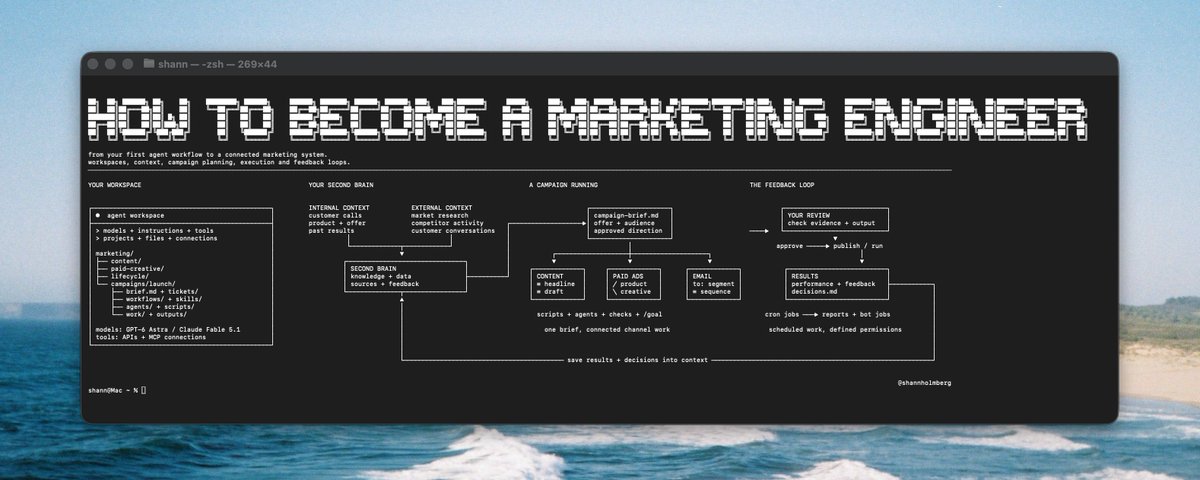
holy sh*t, Obsidian just dropped an official Grok Bot plugin and people are quietly turning their vaults into 24/7 autonomous Second Brains
your notes don’t have to be a dead archive. read, write, link, build Bases, draw Canvas maps, and sync without the desktop app.
the 4-step setup:
1. ADD THE PLUGIN
open the official plugin below → add to GrokBot.
7 skills: obsidian-markdown, obsidian-cli, obsidian-bases, json-canvas, obsidian-headless, defuddle, knap.
2. CONNECT YOUR VAULT
local → settings → computer → your computer → execution on this computer. keep “ask every time.” the Obsidian CLI needs the app running with CLI enabled
cloud → sync a vault copy to the bot’s computer. Obsidian Headless needs Node.js 22+ and an Obsidian Sync subscription for syncing
3. START IN /Inbox
let it read selected notes, but write ONLY inside /Inbox. check one note, its properties, and its [[wikilinks]] first
4. GIVE IT A NIGHT SHIFT
“every night at 11 PM, process raw dumps in /Inbox into atomic markdown notes with YAML properties. link to relevant existing notes. keep every write inside /Inbox. update /Inbox/Inbox.base and leave a change log.”
test one run before scheduling it
stop rebuilding your context from scratch in every chat. give your agent a vault it can actually work with
build your second brain in 5 minutes ↓


Cesar, algo mas retweeted

This is the best explanation I have ever read!
Do not miss out on this move from Notion, so important to getting valuable work with AI.
Thank you @NotionHQ !
notion.com/a-new-shape-for-w…

Cesar, algo mas retweeted

Robots are learning to see the world differently. Prof. Zhao Mingguo's Innovative Tsinghua team, in @SciRobotics, fused perception into motor control, cutting tracking errors by 46%, enabling simulation-trained robots to adapt to real terrain and light - no retraining needed.


Cesar, algo mas retweeted

⚙️ Agentic Reliability Engineering: Building Agentic Systems That Think, Adapt, and Recover
✍️ Author: David Jambor
📖 Get the book:
link.amazon/B0hpVTVbf
🚀 Description:
Discover the next evolution of Site Reliability Engineering (SRE)! Learn how to build autonomous, adaptive, and resilient systems that make intelligent decisions, handle uncertainty, and recover independently while operating within defined guardrails. A practical guide for SREs, platform engineers, and engineering leaders shaping the future of AI-driven operations.
🔁 Retweet | ❤️ Like | 🔖 Save
#AgenticAI #SRE #AIOps #PlatformEngineering #SoftwareEngineering

Cesar, algo mas retweeted

Everyone says ‘deployment-ready data’ now. what does that actually mean in Robotics?
it’s roughly this:
raw footage → validation → cleaning, segmentation, privacy → separate labelling for vision, voice and touch → human review → whatever format your model needs
most teams skip half of that and then start to wonder why the robot breaks on day one of deploying it in the real world.
the goal is to close the loop between data collection, model evaluation, and actual robot deployment.
I am glad that companies like @humynlabs are focusing on building this.
this is the kind of infrastructure that could help take physical AI from impressive lab demos to reliable industrial systems.


We're building the infrastructure that takes Physical AI out of the lab and into the real world.
And we've raised $47M to make that happen.
Physical AI models are getting better every month. But getting robots to work reliably in real-world environments, across full shifts and changing conditions, is a different challenge altogether.
The missing piece isn't just better models. It's deployment readiness.
At Humyn Labs, we're building the research and deployment layer to close that gap.
Here's how:
- Enrichment Engine:
Our end-to-end data engine transforms real-world work into labelled, training-ready signals with verified provenance.
- Deployment Readiness:
We work with labs and site operators to deploy robots in those same environments, identify where they fall short, and feed those gaps back into the next generation of models.
- Capture Hardware:
Our own capture devices across sight, sound, motion and touch record how people actually perform a job, built to each lab's specifications.
We've made significant progress since launch:
- $50M+ in annualised revenue within six months.
- Capture and enrichment operations across 20+ countries in Latin America, East Asia, South Asia and Southeast Asia.
Today, we’re announcing $47M in Series A funding:
- $26M in equity, led by @Accel with participation from @Prosus_Ventures , @Bajaj_Finserv Intelligence through Bajaj Finance, Bajaj Alts AI Opportunities Fund, BeeGlobal, @wearedallasvc, @insights_by_LC , @jumptrading and a marquee angel investor.
- $21M in venture debt, led by @LighthouseCanton with participation from @TrifectaCapital.
With this funding, we're expanding our deployment readiness infrastructure in Brazil, South Korea and India, scaling our capture hardware and enrichment engine, and growing our teams across San Francisco, London and Seoul.
Our mission is simple: accelerate the deployment of Physical AI in the real world.
The next generation of robotics won't be built on models alone. It'll be built on the infrastructure that gets those models working in the real world.
Learn more: humynlabs.ai


Cesar, algo mas retweeted

summary of my AI stack:
1. claude code - builds and fixes the software my clients use
2. codex - checks claude's plan and code before anything ships
3. orca - runs claude code and codex side by side, each in its own copy of the code
4. hermes - godly ai agents running on a clockwork
5. grok bot - runs marketing jobs while my laptop is closed
6. obsidian - the whole business written down in one folder every bot reads from
7. hark - turns what i tell it into tasks on my board
8. linear - still paying for it every month, it just works
9. wispr flow - structures my thoughts into words
10. gpt-image-2 - makes the ad images for client campaigns
11. autoady - manages all ad accounts for clients

Cesar, algo mas retweeted

AWS Solutions Architect (Visual Roadmap)
medium.com/@thetechfusionist…

Cesar, algo mas retweeted

PÍDELE A CLAUDE QUE MAPEE TODA LA ARQUITECTURA DE TU APP EN UNA SOLA PÁGINA HTML Y UN ARCHIVO JSON.
El HTML es para ti.
El JSON es para el siguiente agente que trabaje en una nueva feature.
Tu codebase ahora se explica solo 👇🏻
Cesar, algo mas retweeted

𝘀𝘁𝗼𝗽 telling Claude Code/Codex "no em dashes".
𝘀𝘁𝗼𝗽 telling Claude Code/Codex "stop saying delve".
𝘀𝘁𝗼𝗽 telling Claude Code/Codex "don't sound like AI".
you never gave it a 𝘄𝗿𝗶𝘁𝗶𝗻𝗴 𝘀𝘆𝘀𝘁𝗲𝗺. every README, PR description and landing page ships in the same AI voice, and you ban words one at a time.
orwell wrote the fix 80 years ago. six rules, 1946. but he wrote them for people, and handed to an agent as-is, they backfire. Fable 5.2 treats any instruction with "never" in it as absolute, so its sentences come out choppy. after a long task, GPT-6.2 hands you the words and abbreviations it made up along the way.
so i 𝗿𝗲𝘄𝗿𝗼𝘁𝗲 𝗮𝗹𝗹 𝘀𝗶𝘅 𝗳𝗼𝗿 𝗮𝗴𝗲𝗻𝘁𝘀, going by Anthropic's and OpenAI's official prompting guides. paste them into your global CLAUDE.md / AGENTS.md and every session picks them up:
Writing rules, adapted from Orwell (1946) for agents. They govern prose: docs, PR text, messages, reports. The reader hasn't seen your work, so put the key point first. Leave code and technical terms as they are; swap in everyday words only where precision survives.
1. Say plainly what you mean, without stock metaphors, similes or other figures of speech.
2. Use a short word wherever a short one will do.
3. Cut every word you can, but keep the context the reader needs.
4. Use the active voice wherever you can: say who did what.
5. Use an everyday English word, or the reader's own term, instead of a foreign phrase, a scientific word, jargon, or a word or abbreviation you made up during the work.
6. These are defaults, not hard limits. Break any of them sooner than say anything outright barbarous.
Review every prose output against these rules before delivering.
copybook.page/t/orwell-writi…
