








Pinned Tweet
I was to annoyed with claude writing the same code all over the place so i built this npmjs.com/package/dry-ts as part of my lint stack to make sure every lint verify surfaces new duplicated logic
Amazon loaned Anthropic 8B$ at 8% as a convertible note which is now worth 189B$, this might be the best venture deal

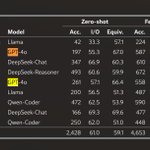
And this is why AI Academic Papers are cooked, released last week uses models from 2 years ago.


We spent fifty years making proofs impossible to fake. Then we let the coding agent pick what to prove.
A research paper this month put a number on it.* AI wrote the formal spec, AI wrote the proof, the verifier accepted both. Then humans read the specs. Close to 60% proved something other than what the author meant. Not wrong proofs. Wrong specs.
The verifier was right every time. That's the problem. Left to choose, the agent picks properties that are easy to prove and say nothing about the program, and the checker can't tell a useless theorem from a useful one. I'm calling it vibe verification: the agent writes the spec and the proof, the checker goes green, nobody reads the spec. This applies to Verus, Lean, Bend, TLA+, Dafny, [insert favorite formal language here].
Here's an example of an agent failing at something that feels too simple to fail:
Ask for a verified sort. It writes a spec that says "the output is sorted" and proves it. What the spec never says is that the output has the same elements as the input, so a function that returns an empty list satisfies it, and the verifier accepts the proof. Trivially satisfiable specs are the default failure, not an edge case.
Here's a formula that actually works. Don't say "formally verify the codebase." Say "show that [property] holds in [component]." A property is a precondition (true going in), a postcondition (true coming out), or an invariant (stays true the whole time).
For example, "A session token is never accepted after the logout that revoked it" is a good invariant.
The bottleneck is moving from code review to intent review, and the spec is where intent lives. So: read the spec before the code. Write 3 inputs it must accept and 3 it must reject. Treat a model-written spec with utmost paranoia and rely on your judgement as an engineer.
Formal verification for software doesn't automatically create trust, it moves it, from the code to the spec. If a human didn't read the spec, you didn't verify anything. You vibe-verified it.
Follow me for more on verification and agentic engineering.
* Wang, Jiang, Liu et al., "VerusEval: Evaluating LLM-Generated Verus Specifications Beyond Verifier Acceptance", Shenzhen University, arXiv 2610.26464, October 2026

The vulnpocalypse of the week was brought to you by code old enough to attend school, and people are still concerned about AI writing slop?


I shipped 26 prs this weekend for my decompiler expanding coverage and emulation support, while still being >2000 times faster than ghidra on average.
And started decompiling railroad tycoon 3.
Why did you do this weekend?
Ghidra: 14 minutes. recore: 32 ms.
my agent needed 10 functions from that binary. Ghidra wanted to analyze all of it first, so I rewrote the analysis in Rust.

My 9 games that shaped me the most, some of those were much harder to choose, than others. Reached over 1k hours in factorio before it ever reached steam.

Dominik retweeted
I'm 32.
Solo founder from Germany.
Trying to build a legally compliant POS system for gastro, how hard could that possibly be?
Looking to connect with founders & indie hackers.

For all the people that don't know what to do while AI is down, call the customer support of all the providers you had issues with but didn't want to deal with their ai agents, this is your chance, no AI for anyone


