

- Tweets88.7K
- Following4.8K
- Followers3.5K
- Likes69K




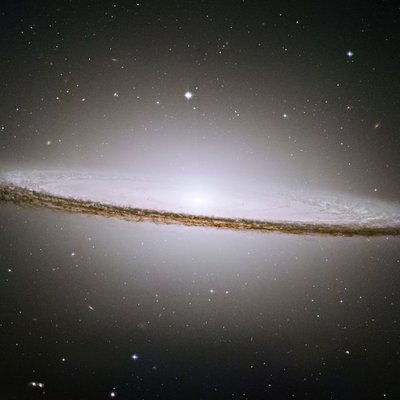
ALT M104 has a wide, flat, round brim, shown here as a hazy violet ring viewed nearly on its edge. At the center of the brim-like ring is a cluster of golden specks surrounding a warm white core.

ALT A photo of Boeing’s Starliner spacecraft that launched NASA’s Crew Flight Test astronauts Butch Wilmore and Suni Williams to the International Space Station.








ALT Colorful, mostly red glowing cloud with a distorted, asymmetrical shape that is illuminated from within by a bright central star. The asymmetrical shape resembles a large squished bug on the ground. In the center, a light blue glow appears over areas of dark pockets that look dark blue and are traced with orange material. It has a clumpy appearance. Shells of gas and dust appear as lobes stretching from roughly 11 to 5 o’clock, another from 1 to 7 o’clock, and possibly a third from 12 to 6 o’clock. The shells become a deeper red with distance from the center. These outflows push gas toward the equatorial plane, forming a disk that appears to span from 9 to 3 o’clock. The background of space is black and speckled with tiny bright stars and distant galaxies.


ALT Composite image of edge-on spiral starburst galaxy Messier 82 as observed by NASA's James Webb and Hubble space telescopes. Hourglass-shaped plumes of gas are shooting outward from above and below a bright blue-white, disk-shaped center. The plumes are yellow near the galaxy’s bright center, denoting areas of ionized hydrogen gas as observed by Hubble, and gradually become redder as you move farther away. Messier 82 is set against the black background of space, which has many distant galaxies that appear as small white and orange spirals, ovals, and points of light. Toward the right of Messier 82 is a blue-white star with eight-pointed diffraction spikes that are characteristic of Webb.


ALT A black, cone-shaped spacecraft reentry capsule sits upright, with its pointed end stuck slightly into the wet sand of a desert plain dotted with low green shrubs. Pale mountains rise in the distance beneath a clear blue sky. The capsule appears intact after landing, standing out against the light-colored, sandy terrain.


ALT Purple and bluish ground with ridges and some craters.


