

solo staker | researcher @Token_Logic | prev. @chaoslabs @openblocklabs
Joined July 2013
- Tweets1.3K
- Following3.1K
- Followers1.2K
- Likes8.4K




Murathan 🌊 retweeted

private credit RWA are growing, yet only a minority of them are actually productive onchain
the two reasons usually given for why tokenizing private credit makes sense:
issuer side: distribution
holder side: novel access to yield sources, and making that yield productive via composability
the underrated one is liquidity
for these assets to be underwritten and become productive, curators and leveraged carry traders need to be able to exit atomically
but private credit has duration baked in, tokenized or not. in tradfi private credit is mostly illiquid and you can only redeem periodically
once tokenized, programmability and atomic settlement allow global secondary markets to emerge very efficiently
variable rate fixed income assets with a steadily rising share price is non volatile by nature.
AMMs are very well suited for this, no divergence loss in normal times and far more competitive for the issuer than a mandated active MM
@0xfluid and @juplend have leveraged this like no other with their capital efficient DEX designs and 'Liquidity as a Service' offering
below are the top 10 assets matching the OP criteria:
USDY, syrupUSDC, wYLDS, PRIME, sUSDAI, PST,
reUSD, ONYc, syrupUSDT and syrupUSDG
3 of the top 7 issuers from that list have signed up for LaaS (Re, Huma, UsdAI), Paxos did as of yesterday, but not part of this category).
the assets running on LaaS rank in the top 5 for deepest atomic liquidity in that list, with unwind slippage below 50bp (screenshot 1)
reUSD is a good example to showcase the benefits of having deep liquidity.
screenshot 2 charts the market price vs redemption basis of reUSD over the last 12 months, showing a clear improvement since running on LaaS
This has played a significant role in allowing its AUM to grow ~3x since (see screenshot 3)
Curators are willing to allocate to it, carry traders are comfortable running leverage.
the reason I am excited about this is that tokenization allows a historically illiquid asset class to become liquid
in theory, whatever spread an investor requires over the risk free rate includes a liquidity premium.
tokenized private credit can structurally compress that premium, which widens the set of real world opportunities that become economically feasible to fund
data provided by @credditxyz, @herd_eco
🤖 Made with AI


Murathan 🌊 retweeted

1> A lot of @Token_Logic’s work at @aave can be traced back to one pattern.
taking a part of the system that is sitting idle, overfunded or too narrowly designed, and give it a clearer economic job
GSM liquidity, stkGHO, umbrella, local GHO minting, even the newer RWA/private credit mandate all fit into that
[🧵]

Murathan 🌊 retweeted

Enter: EthCoordinate.
tl;dr: EthCoordinate is a crypto-native organization born inside the EthStaker community, bringing together separate efforts under one umbrella to help with Ethereum governance coordination, support Forkcast, increase stakeholder engagement on proposed or upcoming EIPs and, of course, continue providing software, tooling, and technical support for home stakers.
EthStaker started in 2020 when a loosely connected group of Ethereum enthusiasts joined efforts to speed up the development of the beacon chain. The organization steadily evolved, incorporating as a 501(c)4 nonprofit and taking up initiatives around independent participants of Ethereum's consensus mechanism, aka home stakers.
Throughout the years, it has played a decisive role in coordinating the launch and operation of devnets, testnets, and mainnet hard fork upgrades; facilitating information flows and generally connecting dots that needed connecting.
This year's tectonic organizational changes in the ecosystem have opened up functional gaps in Ethereum coordination. To close these gaps and continue supporting the network, EthStaker's core members are joined by mission-aligned fresh blood to aggregate efforts under one name to produce greater results than operating independently.
EthCoordinate is a natural evolution of EthStaker; as Ethereum mainnet heads to its third radical consensus protocol change at a steady pace, it’s time for EthStaker to recalibrate around what Ethereum’s evolving community needs.
Our mission is to facilitate interaction between stakeholders of the ecosystem to accelerate the adoption of the Ethereum network and to provide continuity for governance operations.
We believe that the Ethereum mainnet is an unparalleled bedrock for the augmentation of humanity's productivity output and that ETH, the asset, is the token that aligns the incentives of all actors involved.
We stand up for our values, combining technical rigor with pragmatism for Ethereum to continue being the most accessible and credibly neutral global blockchain.
The team is 10 long-tenured Ethereum professionals and currently our main work streams are:
⇥ Maintain a high-quality venue for independent stakers to remain engaged and informed
⇥ Facilitate coordination around core protocol development and adjacencies
⇥ Develop and steward Forkcast, the most popular platform to track the research and engineering initiatives around Ethereum's core protocol
⇥ Facilitate research, discussion, and coordination around protocol economics in support of Ethereum's long-term economic health
⇥ Maintain open source tools and documentation used by participants of the consensus set
We're energized for this chapter in Ethereum coordination & our role in it.
Murathan 🌊 retweeted

AGI3: Strategic Institutional Ecosystem Partnership and Investment in Fluid proposal is live on the governance forum.
@agi3official was launched within Kinetic Group, a multi-billion-dollar UAE-based asset manager.
Together, we would bring a permissioned instance of Fluid built for sovereign wealth funds, banks, family offices, asset managers, and other regulated institutions.
Proposal below ↓


Murathan 🌊 retweeted

Announcing Ethlabs: a non-profit R&D lab for Ethereum and ETH
Our mission is to make Ethereum the settlement layer of the global economy.
The internet became global because shared protocols created a common language between networks. Private systems remained useful, but bounded. Finance is approaching a similar moment. As value, assets, and markets become digital, the world needs shared settlement infrastructure.
Ethereum is uniquely positioned to become that shared base layer, the neutral foundation on which users, institutions, and agents can transact without intermediation.
What we believe:
• We believe credible neutrality matters. Ten years of uptime and the lowest counterparty risk. Ground that cannot be pulled away by any one country, institution, company, or person.
• We believe ETH matters. The most valuable, programmable store of value. A decade of broad distribution, deep liquidity in onchain markets, and maximally trustless asset on Ethereum.
• We believe DeFi matters. Markets, liquidity, credit, exchange, and coordination, open to anyone.
• We believe adoption matters. Principles do not change the world until people benefit from them.
We sit between two worlds: real usage from the builders at the frontier, and the protocol that has to support it. We work with users, applications, wallets, L2s, infrastructure teams, institutions, ETH holders, core devs and researchers, then turn what they actually need into protocol work, shared standards, infrastructure, and shipped products.
Ethlabs is independent but Ethereum is a shared project. We are one node in a much larger network of stewards. This is the multi-node future.
We have spent the better part of the past decade contributing to Ethereum core research and development.
We are opinionated and transparent. We move with urgency, learn in public, and course-correct when we’re wrong.
We are building a lean, talent-dense team for people who want to do the most important work of their careers: [email protected]

To prevent unnecessary liquidations, lending protocols have been using exchange rates to price yield-bearing assets instead of market price.
But this hardcoding means protocols are underwriting smart contract and access control risk for these assets by valuing them at par at all times.
There's a elegant way to solve this:
1/ Dual oracle mechanism: use market price for borrowing and withdrawing, use the hardcoded exchange rate oracle for liquidations.
2/ If market price diverges from the exchange rate by x%, freeze the market.
This protects lenders while still providing good UX for borrowers.
Congrats to @0xfluid for taking this risk seriously and setting an example for other lending protocols through action.
Wish they had implemented this before the USR incident, it would have made a huge difference.

At @0xfluid, we are working on most advanced oracles in DeFi which will allow us to configure every small config on: What pricing to use, when to use it and how to use it.
Here what we will be able to control:
- Use different price for user's operation & liquidations. For peg assets, use market pricing for user's operation and fundamental pricing for liquidation. If market price differs more than 2% than fundamental pricing then pause withdrawals & borrowings. Allowing protocol to not take any extra risk.
- For an asset used on collateral side, use more "conservative pricing" for user's operations while "realistic pricing" for liquidation.
- For an asset used on debt side, use more "aggressive pricing" for user's operations while "realistic pricing" for liquidation.
At any time, the pricing between liquidate & operate (user based operations) differs by x%. Then limit protocol from taking any new risk.
----------
In short, protocol will use both market price and fundamental price depending on action and go into temporary partial lockdown when pricing deviates by certain %.

👀👀

the QuickSlots ⚡️🎰 website is live, and I'm very proud of the design! take a look!
quickslots.info/
QuickSlots is the pragmatic way to get Ethereum to run much faster

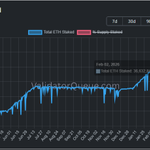
The amount of ETH staked has been increasing continuously, reaching new record highs over the last year.
This could have been concerning for the Ethereum community due to the growing number of active validators and the associated signature aggregation overhead if MaxEB had not been introduced to the network last year with Pectra.
Thanks to MaxEB, validators are consolidating, helping the network maintain sufficient bandwidth for stability and enabling further scaling of blobs and gas limits.


Murathan 🌊 retweeted

For the first time in @LidoFinance's history, less than 90% of the protocol's TVL is controlled by Curated Operators.
Community and Home stakers are quietly gaining share, making the protocol even more reliable, decentralized, and robust!
Upwards only


Murathan 🌊 retweeted

Ethereum is "slow to finalize" they say, but in normal conditions in fact we are certain that blocks will be final even before the next block arrives! Expect ultra fast trustless deposits soon.
fastconfirm.it/


Murathan 🌊 retweeted

1/ stETH CAPO Misconfiguration
Today, a misconfiguration on Aave's CAPO oracle caused wstETH E-Mode liquidations, resulting in a loss of 345 ETH.
No bad debt was incurred, and all affected users will be fully reimbursed.
More below.

Murathan 🌊 retweeted

I left paid work almost a year ago saying that only something spectacular would drag me out of retirement.
Well, it happened - I am now with @ethereumfndn helping to shepherd fast finality to Mainnet.
It's going to be quite the journey, but I am very excited! 🚀

