



Max retweeted

JUST IN: Cantor Fitzgerald close to $4 billion SPAC deal with Adam Back "to buy billions of dollars" of Bitcoin 🚀


Max retweeted

so many of you will remember my reporting around "operation choke point 2.0" from the spring of 2023; TLDR, Biden's financial regulators, namely the Fed, FDIC, and OCC launched a crackdown on banks covering the crypto space...
Max retweeted

some of these networks should consider pivoting from tps, scaling and all that jazz as a metric to event management
clearly they have more attendees than they ever had users. part of me wonders if this is like irl airdrops
are these attendees incentivised or something? idk man
Probably the biggest, baddest @solana Market Map I’ve seen!
@TheGridData and @SuperteamMY doing fabulous work. I love the split into sectors and product types.
Structured & validated metadata for web3 will only become more valuable. Check it out here: superteam.thegrid.id

1
2
70
Max retweeted

Rebuttal of New IMF report on Bitcoin mining emissions
IMF report says "Carbon Emissions from AI and Cryto are surging" then goes on to a detailed report on how regulators should impose "cryptocarbon" tax.
Rebuttal:
Firstly, Bitcion advocates everywhere should pause to reflect on the significance of this moment. With the scientific consensus (9 of the last 10 peer reviewed articles) and mainstream journalism now concluding that Bitcoin mining has significant environmental benefits, those who stand to lose most from mainstream adoption of Bitcoin (IMF, Central Banks) are needing to resort to direct attack-pieces.
Here's a breakdown of why the IMF report is at best poorly researched, at worst propoganda.
imf.org/en/Blogs/Articles/20…
1. Rhetorical technique: "guilt by association". Let's say you want to criticize Larry, but the problem is that Larry is a good citizen. No problem, you find that Ben, a person who has the same day job and is the same age as Larry, is a criminal. Now you don't have to prove that Larry is of unsound character, all you need to do is say "Ben is a criminal, and Larry is just like Ben"
That's what the IMF report does. It's opening line even says "What do crypto assets and artificial intelligence have in common? Both are power-hungry". Straight out of the guilt-by-association playbook. There is no contemporary evidence in the report that Bitcoin mining produces a rising amount of carbon emissions, but plenty of evidence that AI datacenters' carbon emissions are rising. So AI datacenters serves a purpose, but as we will see later, they are really interested in attacking Larry. Ben is just the pawn in a bigger chess-game.
So the article says "AI datacenter emissions are rising, and Bitcoin is just like AI"
The technique is effective and will fool some people. But its also factually incorrect. BPI has already debunked the myth that AI datacenters and Bitcoin mining centers are comparable in a detailed report.
👇
cdn.prod.website-files.com/6…
Further, Rhodes et al showed back in 2021 that flexible datacenters such as Bitcoin mining had a net decarbonizing impact on grids, whereas inflexible datacenters such as AI had a net carbonizing impact.
👇
da-ri.org/science-hub
2. Make apples for oranges comparison
Today, data from a variety of independent sources including the Digital Assets Research Institute shows that as price and hashrate grows, Bitcoin mining emissions have not grown
👇
teapaw.org/dari_org/status/182310…
The IMFs own data sources reveal the same thing. In fact, their data shows that by 2027, crypto's share of global electricity use, and its share of global CO2 emissions will have decreased, while for AI, both will increase.
Hmmm, that was inconvenient! Doesn't really support the thesis they wanted to support which was that Bitcoin was bad for the environment, just like AI.
So what did they do? They created another bar called "high" which indicated the maximum possible range of 2027 projections so that crypto's contribution looked visually higher than it's present-day share.
Where did the "high" estimate come from? Cambridge's hypothetical model of "what would happen if every bitcoin mining operation used coal" (something no industry does, and something Bitcoin mining uses less of than any other industry, and a fuel source Bitcoin mining is moving away from faster than any industry)
See their image from the report below.
They then go on to ask the question in a full length report "Cryptocarbon: How much tax is the corrective tax"
👇
imf.org/en/Publications/WP/I…
If the authors were seriously concerned for the environment, they would have looked at the data and written the paper. "AICarbon: How much tax is the corrective tax". Did they also write this paper? No.
3. Let's look at their detailed report.
11 mentions of the work of Alex de Vries, and a mention of Mora et al. Someone please tell the authors that not even GreenpeaceUSA cite Mora et al's work any more, which was triply-debunked within months of him writing it.
Further, the work of de Vries has been widely discredited, including this peer review article by Sai and Vranken.
👇
sciencedirect.com/science/ar…
The paper goes on to quote Cambridge's emissions and energy figures, despite the fact it is widely known (and stated on Cambridge's website) that theire model is no longer current, as it uses data from 2022.
Until we get intellectual honesty from the IMF, apples-for-apples comparisons, eshewing of already-discredited research, use of contemporary datasets, and an acknowledgement that the scientific consensus shows predominantly positive environmental externalities from Bitcoin mining, any reports from this institute should be disregarded as being of a low research-standard; unusable to policymakers and regulators.


Max retweeted

Onchain is happening as fast as online.
In 10 years almost everyone you know will be onchain or hold an onchain asset of some kind.

Max retweeted

How the growth of e-money (incl. stablecoins) could improve monetary policy transmission and boost bank deposits and credit at the same time
This interesting new IMF paper highlights that e-money development has accompanied stronger monetary policy transmission (measured by the responsiveness of interest rates to the policy rate), growth in bank deposits and credit, and efficiency gains in financial intermediation (measured by the lending-to-deposit rate spread). Evidence is more pronounced in countries where e-money development takes off in a context of limited financial inclusion.
This illustrates, contrary to popular belief, how the emergence of new forms of electronic money (incl. stablecoins) can ultimately be beneficial for banks (growth in deposits), central banks (stronger monetary policy transmission) and the economy overall (higher lending-to-deposit spread).

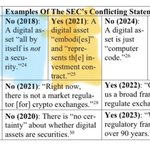
Coinbase included the following chart in a recent filing.
My personal highlight:
“A digital asset is just computer code”
VS
“The digital asset itself “represents the investment contract”
Which is it, Gary?
Source: Castle Island Ventures

6
72
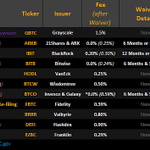
Another quick thought on #BitcoinETFs. Breakeven for issuers is at ca. $2bn. AuM according to the below article.
Are low-fee issuers really expecting THAT much inflow that quickly? Or are they poaching GBTC AuM...
(see here: etfexpress.com/2024/01/09/th…

1
61
11/n But if that volume does come in, what happens? Supply is on the low side, and fresh BTCs will be less again with the halving. On the other side, demand increases. If supply is low, and demand goes up -> Number goes ups.
1
24
12/12 Anyways, my full piece is here on substack: maxbruckner.substack.com/p/b…
I wrote this on a whim today, so if there are flaws in both writing and my logic do point it out.
16