

In a strategic alliance with Sprung Structures, ARK has successfully sold and implemented unique, patented alternative energy and greenhouse systems globally
Canada
Joined May 2023
- Tweets2.8K
- Following818
- Followers251
- Likes138K






Pinned Tweet
Check out how the components of our passive solar greenhouses come together skfb.ly/oxYqp
arkltd.net

Agro Resilience Kit (ARK) retweeted

This chart is simply mind-blowing. It’s a perfect visualization of the German “green” energy transition though. Let’s take a look.
1. Germany increased its installed energy generation capacity since 2000 by a whopping 120%, yet German electricity generation fell by 13%. Isn’t that a paradox? The answer is simple, renewables do not generate electricity constantly, as required for an industrial nation, so they need parallel energy-generating infrastructure, e.g., gas. That’s the main reason countries that moved to renewables, like Germany or the UK, have the highest energy prices for industry and households.
2. Based on fairly conservative estimates, Germany has spent about €400 billion on this “green” energy transition, an eye-watering amount.
3. Higher energy prices have made German energy-intensive industries uncompetitive. Industrial production imploded, and countless well-paid jobs disappeared. This explains the reduction in energy demand and generation.
4. By shutting clean nuclear plants while keeping coal and gas, German energy production generates about 10 times more emissions than France’s. You read that right: 10 times more. If Germany had switched off coal power plants first instead of nuclear, by now it would have avoided CO2 emissions equivalent to Berlin’s emissions over almost a century. Keep that in mind next time you chew on a paper drinking straw.
5. Worse still, production moved from Germany to Asia, where the same products generate far more emissions in manufacturing and shipping. A Chinese-built car shipped to Europe causes about 70% more emissions than one built in Germany, cement production causes twice as many.
Honestly, can you name a bigger absurdity than the German “green” energy transition? They spent a fortune to ruin their industry and hurt the climate badly. Isn’t it hilarious that German greens seriously claim other countries will follow the German way? In which parallel universe do these people live?

Agro Resilience Kit (ARK) retweeted

The FBI and DEA just pulled a trucking boss out of a nice neighborhood in Eagle Pass, Texas, and I can't find one English-language outlet covering it.
His name is Julio Rodolfo González. Mexican border papers report he's facing a federal money laundering conspiracy charge tied to fuel smuggling.
They also say the case may be sealed, which usually means more people are about to get a knock on the door.
This is the diesel racket nobody in Washington talks about. Hundreds of semis cross into Eagle Pass empty every single day, fill up on Texas diesel, and haul it right back to Mexico.
The bridge got so jammed that a 30 minute wait turned into six or eight hours for legitimate freight.
It gets worse. One Mexican reporter says González may be a U.S. contact for the fuel network run by the Farías Laguna brothers.
Those are high-ranking Mexican Navy officers accused of running fuel tankers out of Houston and pocketing more than $150 million.
Black-market fuel, crooked officials, and a Texas border town stuck in the middle. Where is the national press on this one?
vanguardia.com.mx/coahuila/e…


Agro Resilience Kit (ARK) retweeted

Canada closed 5 refineries and built one.
The country had 21 refineries in 2000 and 17 in 2025, CAPP data shows. Capacity still edged up, to about 1.94m b/d.
The ones that shut were mostly in the East:
2005: Oakville, 90,000 b/d, Petro-Canada
2010: Montreal East, 130,000 b/d, Shell
2012: Bowden, 6,700 b/d, Parkland
2013: Dartmouth, 88,000 b/d, Imperial
2021: Come by Chance, 135,000 b/d, now making renewable diesel
The only new one is Sturgeon in Alberta, at 79,000 b/d. It took seven years to build, and its cost roughly doubled to about C$10bn.
Here’s the part that matters this week.
Canada exports about 4.5m barrels of crude a day, more than twice what it refines at home.
It sells that crude to US Midwest refiners for $28 less than WTI.
US refiners are earning record margins on it. Valero made about $39 on every barrel it refined last quarter.
Canada supplies the barrel, and someone else earns the margin.
So should Canada build more refineries?
A refinery takes years to build. Today’s margins are a wartime price.
What Canada lacks is a way to get its crude out. Trans Mountain is 98% full, and Enbridge’s next 150,000 b/d isn’t due until 2027.
themerchantsnews.substack.co…

Agro Resilience Kit (ARK) retweeted

This is the harbinger of what's coming for the copper industry...
Jubilee Metals, a small copper producer in Zambia, reports that sulfuric acid costs surged over 200%, while diesel costs jumped 90%.
The shortages have already hit copper production...
Some metal processors in the region were even forced to temporarily shut down production amid sulfuric acid shortages and soaring diesel costs.
And this is just the beginning...
You can't produce copper without the physical inputs.

Agro Resilience Kit (ARK) retweeted

Despite Iran’s efforts to disrupt energy shipments, oil exports from the Persian Gulf are roaring back and have surpassed pre-conflict levels.
The message is clear: Iran’s threats have failed to stop the flow of energy to global markets.

Agro Resilience Kit (ARK) retweeted
Germany is running out of refineries, and it now admits that’s a problem.
Economy Minister Katherina Reiche: “Whoever loses the refinery loses not only the supply for the gas station, but above all for the chemical complex.”
Berlin now says it wants to stop more refineries closing.
Look at the timing.
Shell stopped processing crude at its 140,000 b/d Wesseling refinery last year.
BP’s 250,000 b/d Gelsenkirchen has been up for sale since early 2025 with no buyer.
Scotland lost Grangemouth, 150,000 b/d.
Europe chose to import its diesel and jet fuel.
Now the imports are the problem.
Russian diesel exports hit a decade low.
Gulf fuel exports run at about half of normal.
US diesel costs about twice a barrel of crude.
On Friday Germany’s stockpiling agency EBV put out a tender to sell diesel, heating oil and crude from its strategic reserves.
In July it was still buying diesel to refill them.
Germany’s reserve was meant for an emergency. It’s now dipping into it as winter starts.
You can shut a refinery in a year.
Building one takes most of a decade.

Agro Resilience Kit (ARK) retweeted
The mining industry is the most profitable sector... And no one seems to care.
Mining as a percentage of portfolio allocations sits at just 1%.
At the same time, it is becoming increasingly clear that inflation will be the defining theme for at least this decade.
During the inflationary 70s, you either owned hard assets or you were left behind.
I expect history to repeat itself.

Agro Resilience Kit (ARK) retweeted
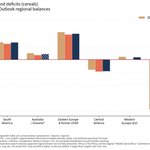
Copper needs $ 332bn of new mines.
Each one takes about 17 years to build.
Bloomberg new outlook sees a deficit starting in 2028 and widening to 20 million tonnes by 2050.
That’s about 44% of demand.
9 of the 10 transition metals it tracks now look covered. Copper is the odd one out.
Demand rises 61% to almost 46 million tonnes by 2050. Electric transport alone needs 11.4 million.
You can print money.... You can’t print a mine.

Agro Resilience Kit (ARK) retweeted

Japan is the only G7 country with a higher food inflation rate than Canada.

Agro Resilience Kit (ARK) retweeted
🇨🇦 Oil turned Alberta's deficit into a C$2.2bn surplus.
For the year to March, the province had expected a C$4.1bn hole.
Higher prices from the Iran war erased it.
This year's swing is even bigger.
February's budget planned a C$9.4bn deficit, and the August update shows a C$2bn surplus.
The budget assumed WTI at $60.50.
Since April it has averaged about $88 and every extra dollar is worth roughly C$680m to Edmonton.
The province is also voting this week.
More than 1 million ballots have already been cast in a referendum that includes separation from Canada.
That's about 1/3 of the 3 million eligible voters, before polling day on 19 October.
Pollsters say a high turnout may favour the remain side.
Here's what I'm watching: oil money makes Alberta feel strong, but the budget still swings with a price Edmonton doesn't control.


Agro Resilience Kit (ARK) retweeted
We don't have enough copper.
Global grid investment is expected to grow 4.4% annually through 2035.
Meanwhile, AI-driven copper demand is expected to grow ~15% annually through 2030.
At the same time, global copper production is expected to peak this year.
In other words, demand is surging while supply is increasingly unable to keep up.
Higher copper prices are a mathematical certainty.
We don't own enough copper for what's coming.

Agro Resilience Kit (ARK) retweeted
Uranium equities are plunging... completely detached from reality.
If we were to look only at the long-term uranium contracting price, which keeps inching higher, one would think uranium equities would be surging... Wrong.
And the supply situation makes this divergence even more ridiculous.
Kazakhstan, the world's largest uranium producer, accounting for ~40% of global supply, is approaching peak production.
Meanwhile, the Arab oil embargo in the 1970s triggered a massive nuclear buildout as countries sought to reduce their dependence on oil.
Today, we're witnessing another global push toward nuclear energy, driven by energy security and surging electricity demand from AI.
In other words, uranium fundamentals are incredibly strong... but equities aren't reflecting that.
That's an opportunity.
We don't own enough uranium for what's coming.

Agro Resilience Kit (ARK) retweeted

Not only is there a hypothetical carry trade floor ~$85/lb., there is a line of utilities and traders ready to buy everything on offer a dollar below current spot (there's nothing on offer for $89, btw). The floor is right here. Total lay up.


Agro Resilience Kit (ARK) retweeted
🇺🇸 America’s AI build-out is 24 GW short of its own plans.
The 18 biggest AI campuses are planned at 30 GW.
About 6 GW runs today, according to Epoch AI estimates.
The largest is Meta’s Hyperion in Louisiana, planned at 5 GW, and none of it runs yet.
Its power plan is 10 gas-fired plants of 7.5 GW, an $ 11bn deal that Meta pays for.
Seven of those plants still need regulator approval.
None of the 18 campuses is in California.
They cluster in Texas, Louisiana, Ohio, Tennessee and the Midwest, close to gas supply and with room to build turbines.
If that 24 GW gap ran on gas around the clock, it would burn 3.6 Bcf/d.
That’s about the feedgas for 25+ Mtpa of LNG, more than all of Alaska LNG.
Data centres and export terminals are now bidding for the same US molecules.
The question for 2027 is whether turbines, pipelines and Henry Hub can keep up with the chips.

Agro Resilience Kit (ARK) retweeted
Canada’s middle class crushed by rising grocery prices.
Here’s how disposable income per middle-class household compares with grocery price increases since 2015. ⬇️

Agro Resilience Kit (ARK) retweeted

It's just that easy.
With a stroke of a pen, Donald Trump approved all the federal permits for Alaska's LNG project of which Taiwan already committed to buying 30% of the out put for 20 years, and now resources exploration in Greenland are beginning as part of the agreement.
Canada thought they could posture the US by opening a consulate in Greenland and end up holding an empty bag of virtue signaling while the US will be stacking $$$.

Agro Resilience Kit (ARK) retweeted
🇸🇦 Saudi Arabia will pump crude through a gas pipeline
Energy Minister Prince Abdulaziz bin Salman says converting a gas pipeline to carry crude could add up to 1.2M b/d of export capacity within 7–8 weeks.
The arrangement is temporary.
Aramco can run oil through the line until May.
Then it will be cleaned and returned to gas service to supply power plants through the summer.
The East-West pipeline is the kingdom’s route around Hormuz, with a nameplate capacity of 7M b/d.
On 6 October it was carrying 5.8M b/d.
Riyadh hasn’t said which gas line it will use.
One candidate is IPSA, the pipeline built in the 1980s to carry Iraqi crude to the Red Sea. It stopped carrying Iraqi oil in 1990, and Saudi Arabia confiscated it in 2001 and used it for gas. That link is unconfirmed.
📈 The bigger plan is 10M b/d of East-West capacity within 2–3 years, mostly from pumping upgrades. With more investment, the converted line could carry up to 3M b/d.
⚠️ Extra pipeline capacity only helps if the Red Sea stays open.
Yanbu cargoes heading to Asia still pass Bab el-Mandeb, where the Houthis have banned Saudi-linked ships.
image source:S&P Global


🇸🇦 Saudi Arabia pushed its oil back out through Hormuz
OPEC+ pumped 39.07M b/d in September, +0.9M on the month.
Saudi Arabia told OPEC its output rose by more than 2M b/d, to 8.37M.
Independent estimates show a smaller gain: +744k, to 8.0M.
⚙️ Most of the swing was a change of route.
After the East-West pipeline was hit on 10 September, Aramco moved loadings back to its Gulf terminals.
The pipeline was built to bypass Hormuz, and in September Hormuz did the job instead.
Riyadh now says expanding the pipeline to 10M b/d will take 2–3 years.
🇷🇺 Russia fell 38k b/d to 8.64M as Ukrainian strikes keep hitting its energy infrastructure.
📈 OPEC cut its 2026 demand growth forecast for a sixth straight month, to 180k b/d.
It expects +2.55M b/d in 2027, to 108.3M, because the world has to refill its stockpiles.
The US Strategic Petroleum Reserve alone fell from 413M to 321M barrels in Q2.
⚠️ Restocking only happens once.
If governments refill slowly, 2027 demand looks much weaker than OPEC’s number.
